To track time of day drinking, record two moments: when you first notice an urge and when your first drink begins. At the end of the day, mark equal two-hour windows so you can distinguish a drinking start from ongoing drinking, an urge without drinking, a clear period, or a window you did not reliably observe.
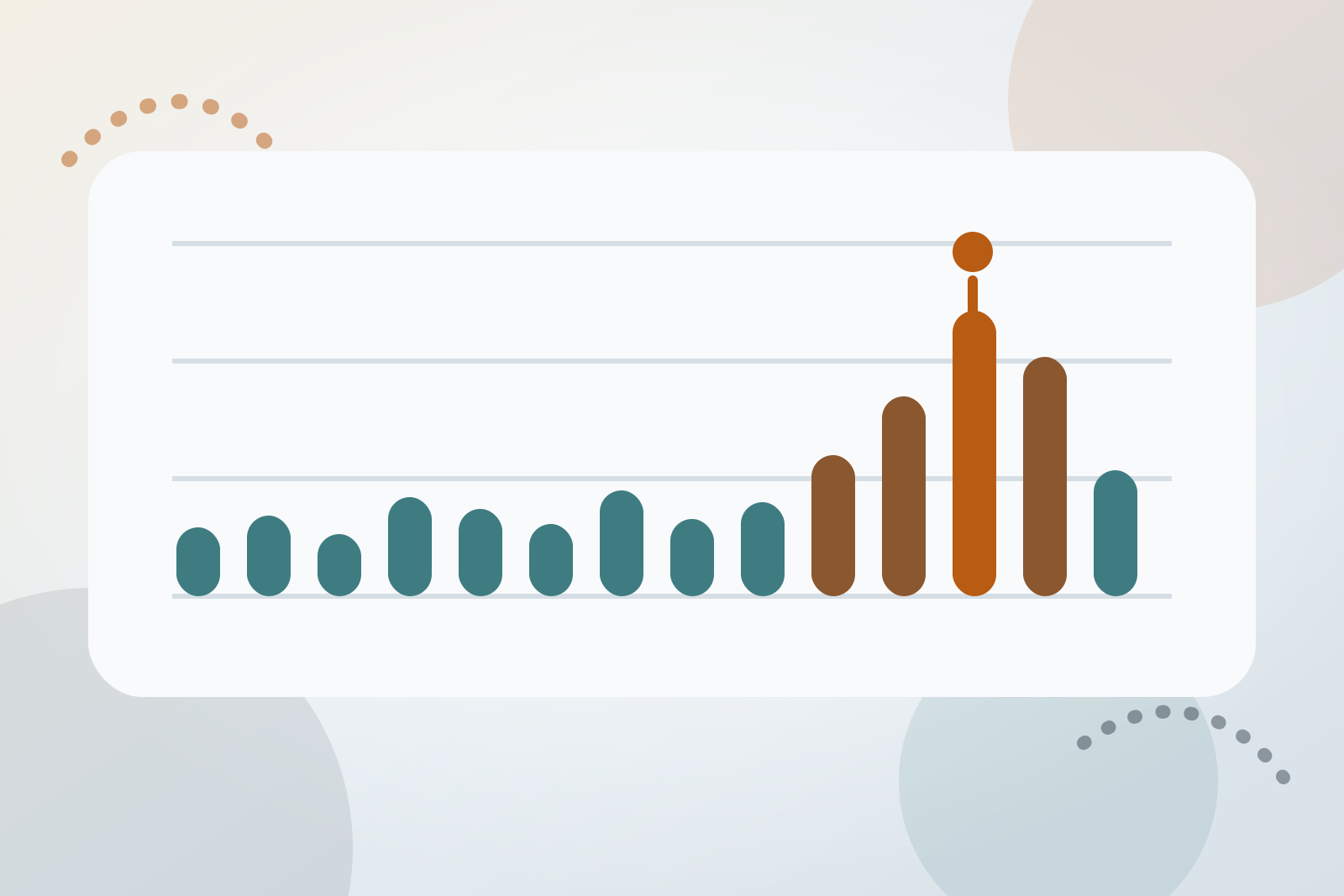
After about two weeks, compare each window with the number of days it was actually observed. This can turn “evenings are difficult” into a more useful description, such as “my first drink began between 6pm and 8pm on 8 of 13 observed evenings.”
Check whether changing your drinking could be unsafe
Tracking does not require you to stop drinking. Acting on the record might, so check the safety issue first.
The NHS advises that if you have become physically dependent on alcohol, stopping overnight can be harmful. Symptoms that may indicate a need for medical support include:
- anxiety after waking,
- sweating or mild tremors,
- nausea or retching in the morning,
- vomiting.
Severe tremors, hallucinations, seizures, or fits are medical emergencies. Call 999 in the UK or your local emergency number.
If these symptoms apply, or you are unsure about dependence, speak to a GP or alcohol service before cutting down or stopping. You can still keep a record and take it to the appointment. A timing log cannot assess withdrawal risk or tell you how to change safely.
Decide which timing question you want to answer
“Which hours do I drink?” can mean two different things:
- When does my first drink begin?
- During which hours am I still drinking?
The first-drink time is usually more useful for planning because it identifies where the drinking period begins. Ongoing-drinking windows show how long the period extends, but they may be consequences of an earlier start.
Keep quantity separate. NIAAA’s Rethinking Drinking tracker recommends recording every drink and notes that marking each drink before having it may help someone slow down. Use that kind of quantity record alongside this timing log if you also need to understand how much you drink.
Record four details close to the moment
In one small study of 32 moderate-to-heavy drinkers without alcohol dependence, researchers collected craving and stress ratings at waking, bedtime, random prompts, immediately before the first drink, and after the last drink. The study cannot tell you what your pattern will be, but it illustrates a useful method: make short entries close to the event rather than reconstructing the whole week later.
Record:
- First-noticed urge time. If you did not notice an urge before drinking, write “not noticed.”
- First-drink time. Record when drinking began, not when you later remembered to make the entry.
- Immediate context. A few words are enough: “finished work, cooking alone.”
- Urge strength. Use the same simple scale each time, such as 0–10, only to compare your own entries.
If you want to understand total drinking time, add the approximate last-drink time as a separate field.
Never make an entry while driving or during any situation that needs your attention. Deal with immediate safety first and record the event later.
Mark every observed window
At the end of each day, divide the relevant part of your schedule into equal two-hour windows. Two hours is a practical choice, not a clinical standard. One-hour windows may produce sparse data, while broad labels such as “evening” can hide the useful difference between 6pm and 10pm.
Use five marks:
- S: the first drink started in this window,
- O: drinking continued from an earlier window,
- U: an urge occurred, but no drinking occurred in the window,
- C: observed and clear, with no urge or drinking,
- —: asleep or not reliably observed.
If more than one label could apply, use S for the starting window and O for later drinking windows. Do not mark an unobserved period as clear.
The Alcohol and Drug Foundation recommends filling in days with no drinking, noting strong urges that did not lead to drinking, and recording how difficult situations were handled. Those clear and urge-only entries stop the log from presenting drinking as inevitable.
For example:
| Date | First urge | First drink | 4–6pm | 6–8pm | 8–10pm | Context |
|---|---|---|---|---|---|---|
| Monday | 6:20pm | 6:45pm | C | S | O | Cooking after work |
| Tuesday | 7:10pm | — | C | U | C | Ate before leaving work |
| Wednesday | Not noticed | 8:25pm | C | C | S | Friend visited |
For places, feelings, people, and events beyond the clock, use the broader guide to identifying triggers and difficult times.
Compare starts with observed days
After about two weeks, count each window separately:
| Window | Days observed | First-drink starts | Urge only | Ongoing drinking | Common context |
|---|---|---|---|---|---|
| 4–6pm | 14 | 1 | 3 | 0 | Finishing work |
| 6–8pm | 13 | 8 | 2 | 1 | Cooking, arriving home |
| 8–10pm | 12 | 3 | 2 | 7 | Watching television |
| 10pm–midnight | 10 | 0 | 1 | 5 | Drinking continued |
Use fractions rather than precise-looking percentages. “The first drink began from 6pm to 8pm on 8 of 13 observed evenings” keeps the limited sample visible.
Drinkaware lists particular times, the end of the working day, preparing food, eating an evening meal, and watching television among possible routine-based alcohol triggers. Your table may show one of these combinations, another combination, or no repeated time at all.
Two weeks gives you two examples of each weekday, but it is not a threshold at which a pattern becomes proven. Extend the observation period if illness, travel, visitors, shift changes, or missing entries made the fortnight unusual.
Use the urge-to-drink interval carefully
On days when you noticed an urge before drinking, note the interval between the first urge and first drink. This may help you decide when a plan needs to begin.
For example, if the urge often appears around 5:45pm and the first drink begins around 6:30pm, an earlier meal or planned call may need to start before 5:45pm. If no earlier urge was noticed, prepare something that can happen immediately when you reach the usual starting situation.
Do not use this interval to judge dependence, severity, or how much control you have. A short interval can have many explanations, and a long interval does not guarantee that changing course will be easy. Treat it only as a description of recent entries.
Test one change before the repeated window
If it is medically safe for you to change your drinking without supervised withdrawal care, choose one condition to alter before the busiest starting window:
- eat before the period begins,
- take a route that avoids the usual shop,
- change the first activity after arriving home,
- arrange a call during the repeated window,
- prepare a specific alcohol-free drink or activity in advance.
Write one if-then plan:
If I arrive home before 6pm, I will eat and call Sam before I start cooking.
Keep the same log for another week or two and compare the same windows. If the plan does not hold, keep the entry and revise the plan rather than deleting the record. What to do after a slip without erasing your progress explains that review process.
Once you know the likely starting window, the practical plan for the difficult hour covers preparation and in-the-moment options.
Where Hard Bit fits
Paper or a notes app is enough for this exercise. Hard Bit is an optional iPhone companion that keeps drinking in its own private record, separate from other habits.
The counter, logging, journal, milestones, hard-moment flow, personal sentence, help links, and export and deletion tools are free. Hard Bit Plus adds the on-device difficult-hour forecast, advance warning, patterns, calendar, widgets, and short reads.
The forecast makes no prediction below five entries and relies fully on your history at around twenty. It describes a difficult hour; it does not predict that you will drink. There is no account, advertising, social feed, third-party analytics, or server copy of your entries.
The Hard Bit overview explains the workflow. The support page documents the feature and subscription boundaries.
Know when a log is not enough
Speak to a GP or alcohol service if you often feel a need to drink, find it difficult to control your drinking, or think alcohol is causing problems. Seek medical advice before stopping suddenly if dependence or withdrawal may be involved.
Stop or simplify the exercise if logging increases shame, distress, or compulsive checking without helping you make a useful decision. A record can help you describe what is happening, but it cannot diagnose a condition or replace treatment.
The NHS lists local community alcohol services, mutual-aid groups such as AA and SMART Recovery, and the UK Drinkline helpline on 0300 123 1110. If you are outside the UK, use an appropriate local health or alcohol service. Contact emergency services if severe withdrawal symptoms or another immediate danger occurs.
Our editorial policy explains how health and product information is reviewed. More articles are available in the Hard Bit guide library.
Frequently asked questions
Do I need the exact minute?
No. The nearest fifteen or thirty minutes is usually enough for a two-hour-window review. Use the same level of precision throughout rather than guessing an exact time later.
Is two weeks enough to establish a drinking pattern?
It is enough for an initial comparison, not a permanent conclusion. Continue if the counts are sparse, many windows were unobserved, or the fortnight was unusual.
What if no repeated hour appears?
That is useful information. Group the entries by weekday, place, preceding activity, people present, or feeling instead. Your pattern may follow situations rather than the clock.
Should I count drinks as well as times?
Quantity and timing answer different questions. Track both if useful, but keep separate columns so the time of the first drink is not lost inside a daily total.
Does a repeated hour mean I will drink then?
No. It describes what happened during the observation period. It is a window worth preparing for, not a prediction or diagnosis.