
The best birthday messages from family sound like several people made one thoughtful gesture. They do not need four versions of “happy birthday” or a long paragraph pretending everyone has the same relationship with the recipient.
Use one person to draft the core message. Then give each participating family member a small, distinct role: add a memory, offer thanks, make a wish, contribute a drawing, or sign their own name.
This article focuses on a family acting as the sender. A card passed around an office or large social group has a different problem because its contributors may not know one another or coordinate their messages.
Build one message from different contributions
Start with three parts:
- A shared greeting: One or two sentences everyone can comfortably sign.
- Distinct contributions: Add up to two or three details from individual family members.
- A clear signature: Show exactly who the message represents.
For example:
Happy birthday, Grandma. We love how you turn every Sunday lunch into an occasion. Leo says your roast potatoes are still unbeatable, and Maya drew the birthday cake she thinks you should have. We cannot wait to celebrate with you this weekend. Love, Sam, Alex, Leo, and Maya.
The message has one opening and one ending. Leo supplies an opinion, Maya contributes a drawing, and the shared weekend plan gives the adults something truthful to say together.
Hallmark offers very short lines for people adding to a crowded group card and separately recommends naming a family relationship when it matters. The useful principle here is that every signer does not need a paragraph. One recognizable contribution is enough.
For help finding the personal detail itself, use the guide to planning birthday messages without making them generic.
Choose a format before anyone starts writing
The right format depends on whether the family members share the same relationship with the recipient.
| Format | Use it when | Structure |
|---|---|---|
| One collective message | Everyone knows the recipient well and agrees on the sentiment | Shared greeting, two details, family signature |
| Shared opening with named additions | Family members have different memories or ages | Shared greeting, “Leo says…,” “From Maya…,” signature |
| Separate short notes | Each person has a distinct relationship with the recipient | One line per person, then individual signatures |
| One message with signatures only | Space is limited or some members barely know the recipient | Short shared greeting followed by names |
A collective message should not erase meaningful differences. One parent may have known the recipient for decades while a young child has met them twice. In that case, attribute the personal memory to the parent and let the child draw or sign rather than making both speak through the same intimate “we.”
If each person wants to write a complete message, the birthday message formula gives every contributor a simple structure.
Give adults and children different jobs
Ask each adult for one piece of material, not a complete competing draft:
- A shared memory the recipient will recognize.
- Something the family appreciates.
- A harmless habit or tradition.
- A plan that has already been arranged.
- A wish that fits the recipient’s life.
Then choose the best two or three contributions. More material is not always better.
Children can participate without borrowing an adult voice:
- A child who cannot write: Add a drawing, mark, or signature with a simple label.
- A child who can speak but not write confidently: Ask what they want to say and transcribe their answer without polishing it into adult language.
- A school-age child: Invite one true sentence, such as “I like when you teach me card games.”
- A teenager: Let them write independently, sign only, or opt out of a separate note.
Do not write an elaborate sentence and attach a child’s name unless those were genuinely their words. A short, slightly imperfect contribution is more recognizable than a polished line they would never say.
Grammarly recommends making birthday cards genuine through memories, familiar names, and reasons you value the person. It also advises writing conversationally. Those principles apply to each family member: preserve their actual voice instead of editing every contribution until it sounds the same.
Use “we” only when everyone can stand behind it
“We love you,” “we are proud of you,” and “we will always be here” claim to speak for every named sender. Use them only when the participating family members have seen the message and agree.
When a thought belongs to one person, attribute it:
Happy birthday, Aunt Rosa. We hope you have a peaceful day. Alex still talks about the road trip you took together, and the kids are looking forward to seeing you on Sunday.
This is more honest than pretending the children remember a trip that happened before they were born.
Also check future plans before writing them as a group promise. “We hope to see you soon” is safer than “We are all coming to visit next month” unless the visit is arranged.
Choose how to sign a card from the family
A signature should help the recipient identify the senders. It does not need to obey a formal hierarchy.
| Signing style | Example | Best use |
|---|---|---|
| Individual first names | Alex, Sam, Leo, and Maya | The recipient knows everyone |
| Family surname | The Patel family | The household is known by one shared name |
| Named adults and family | Alex Chen, Sam Rivera, and family | The adults use different surnames |
| Separate signatures | One name beneath each contribution | Everyone added their own note |
Gallery Collection records a traditional convention of listing the father, mother, and then children from oldest to youngest. It also gives “John and Mary Smith and Family” and “The Smith Family” as acceptable forms and notes that either parent may now appear first.
Treat that as one etiquette tradition, not a requirement. Use the names, surname order, and family description your household uses in real life. Do not add absent relatives or adult children unless they know the message includes them.
Family birthday message examples to adapt
These examples show different ways to coordinate a message. Replace the invented details with something true.
For a grandparent, using one shared voice:
Happy birthday, Grandpa. Your stories have become part of our family vocabulary, especially the one about the runaway canoe. We love hearing them, even when the details change. We cannot wait for lunch on Sunday. Love, the Patel family.
For a parent, using separate voices:
Happy birthday, Dad. Thank you for being the person we call when something needs fixing or simply feels difficult.
From Nina: I still owe you a rematch at chess.
From Theo: I love your pancakes.
Love, Nina, Theo, and Mum.
For an adult child living away:
Happy birthday, Maya. This house is quieter without your playlists, though nobody has agreed whether that is good or bad. We are proud of the life you are building and look forward to celebrating when you are home. Love, Mum, Dad, and Leo.
For a family friend:
Happy birthday, Priya. You have made room for our family at more tables and celebrations than we can count. Thank you for always making the children feel welcome too. We hope today returns some of that warmth to you. Love, Alex, Sam, Leo, and Maya.
For more on that specific relationship, see the guide to birthday wishes for a family friend.
For a teacher:
Happy birthday, Ms. Reyes. Sofia talks about your science experiments all week, and we appreciate how excited she is to learn. We hope you have a wonderful birthday. From Sofia and the Chen family.
For a neighbor:
Happy birthday from all of us. Thank you for always stopping to ask how the children are doing and for rescuing more than one parcel from the rain. We are lucky to have you next door. The Rivera family.
When the card is small or the relationship is less close, use a shorter message:
- “Happy birthday from all of us. We hope you have a lovely day.”
- “Wishing you a happy birthday and a good year ahead. The Chen family.”
- “Happy birthday, Aunt Mae. We are thinking of you today.”
- “With warm birthday wishes from Alex, Sam, Leo, and Maya.”
For examples organized by individual relationships, use the separate guide to birthday card messages by relationship.
Edit the family message before signing
Read the finished message once and check:
- Agreement: Has everyone named as a sender seen or approved it?
- Attribution: Are individual memories credited to the right person?
- Repetition: Does each added line contribute something new?
- Accuracy: Are ages, plans, names, and family stories correct?
- Privacy: Would the recipient be comfortable if someone else read the card?
- Voice: Does the wording sound like this family rather than a formal announcement?
- Space: Can every intended signer add their name legibly?
Remove any joke that makes one relative the target, any private fact supplied without permission, and any promise the family has not arranged. A shorter message is better than one padded with claims nobody quite means.
Save one cue for next year
After the birthday, save a brief cue rather than copying the finished message: “Grandpa enjoyed the canoe story,” “ask Sofia for her own sentence,” or “sign with both surnames.”
Keep the note practical and non-sensitive. The guide to adding useful context to birthday reminders explains what is worth recording.
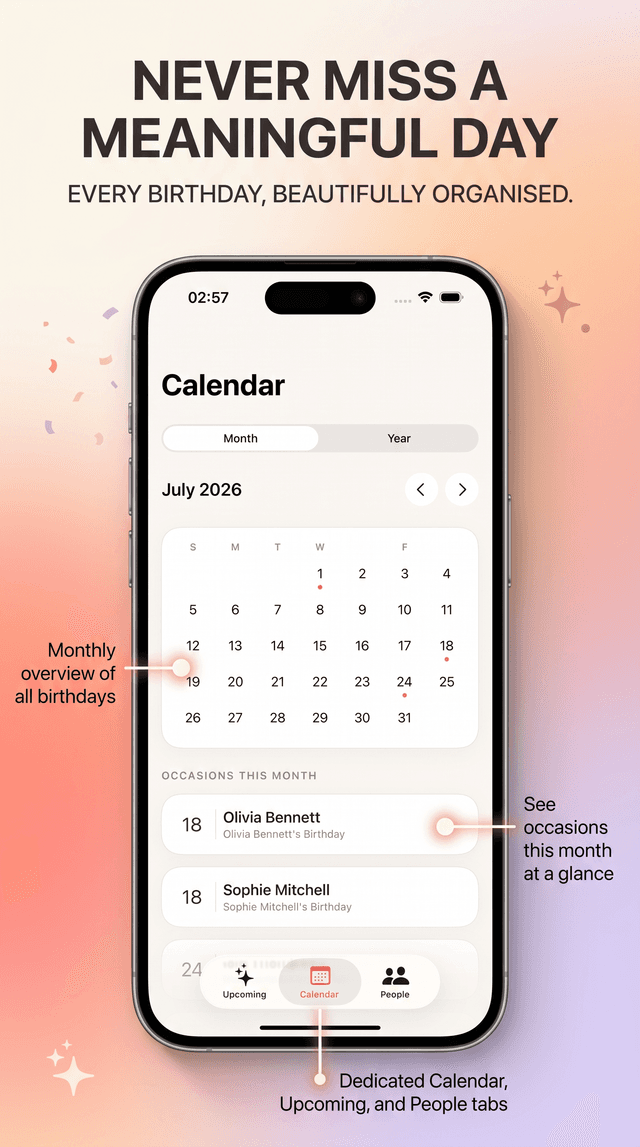
The current App Store listing for Birthday Reminder: Tracker confirms that the app works without an account and supports personal notes and gift ideas, birthday countdowns, a Home Screen widget, and reminders with chosen lead days and alert times. A note can hold the writing cue, while an early alert can give the family time to collect contributions.
Use the birthday reminder timing guide if the card must be bought, passed between family members, or posted. The Birthday Reminder app page shows how those notes and reminders fit together.
Frequently asked questions
Should one person write the whole family message?
Usually, yes. One drafter keeps the greeting coherent. Other family members should supply details, review statements made on their behalf, and add their own signature or short contribution.
What if one family member barely knows the recipient?
Let them sign without claiming a personal connection. They can add a simple wish or no separate sentence at all. Do not invent shared memories or feelings to make every contribution equal.
How should a blended family sign the card?
Use the names and family description you already use. Individual first names are often clearest when surnames differ. A shared family surname is appropriate only when it comfortably represents the participating senders.
Can a toddler be included in the signature?
Yes. Add their name, let them make a small mark or drawing, or accurately transcribe something they said. Avoid attributing polished adult language to them.
Is a text from the whole family acceptable?
Yes. Use the same method: one shared greeting, clear attribution for personal additions, and a closing that names the senders. A text does not require everyone to repeat “happy birthday” separately.
How long should a birthday message from a family be?
For most cards, one short paragraph plus signatures is enough. Add separate lines only when they contribute a distinct memory, thanks, wish, or child’s voice.
A family birthday message succeeds when the recipient can hear both the household and the people inside it. Write one clear greeting, preserve the distinct contributions, and sign only for those the message truly represents.
Browse the other Birthday Reminder guides for more help with birthday writing and planning. Our editorial policy explains how source and product claims are reviewed.