
A birthday message does not need a minimum word count to feel sincere. For most texts and cards, one to four sentences, or roughly 10–75 words, is enough.
Use one or two sentences for a text or public post, two to four for a card, and three to six for an email. A birthday voice note often feels complete after 15–60 seconds. These are practical starting points, not etiquette rules.
The right length depends on the channel, your relationship, and whether the occasion gives you something substantial to say. A short message can feel thoughtful when it contains one recognizable detail. A long message can still feel empty when it relies on stock praise.
The short answer by message type
Use this table when you need a quick decision:
| Message type | Practical starting point | What usually fits |
|---|---|---|
| Text or chat | 1–2 sentences, about 10–40 words | Greeting, one detail, one wish |
| Public post | 1–2 sentences, about 10–30 words | A warm but non-private detail |
| Group card | 1 sentence, about 5–25 words | One distinct thought and your name |
| Personal card | 2–4 sentences, about 25–75 words | Greeting, detail, meaning, wish |
| 3–6 sentences, about 50–125 words | A fuller memory or update | |
| Voice note | About 15–60 seconds | One story or thought in natural speech |
| Milestone letter or toast | About 75–200 words | A focused reflection, memory, and wish |
Stop when the message has done its job. Do not add another sentence merely because the card still has space.
Why a short message can still be thoughtful
Hallmark's guide to what to write in a birthday card includes a dedicated “Short and Simple Birthday Wishes” section with one-line examples. Brevity is presented as a legitimate choice, not a failure to try.
Specificity matters more than size. A Psychology Today article titled Stop Saying “Happy Birthday” argues that a shared memory or genuine expression of appreciation is more memorable than an automatic greeting. The article is explicitly labeled a Personal Perspective, so treat it as editorial advice rather than evidence that everyone prefers the same kind of message.
The useful principle is simple:
Add length only when it adds a fact, feeling, memory, or wish.
“Happy birthday, Nina. I hope you have a great day” is complete. “Happy birthday, Nina. Your Friday playlists rescued more than one difficult shift this year. I hope today sounds much better than the office usually does” is longer because it contains another real idea.
Choose the length for the channel
Each format has its own reading rhythm.
Text or chat
One or two sentences works for most birthday texts. The message should be easy to understand from a notification preview or a quick glance at the conversation.
A basic SMS using GSM-7 encoding holds 160 characters in one segment. Twilio documents that longer GSM-7 messages are divided into 153-character segments and reassembled by the recipient's device. Characters outside GSM-7, including many emoji and non-Latin characters, can switch the message to UCS-2 encoding, reducing the limits to 70 characters for one segment and 67 per concatenated segment.
Those are technical limits, not writing rules. iMessage, RCS, and other chat services behave differently. The practical lesson is only that a concise message is more likely to remain one basic SMS segment.
For wording suited specifically to this channel, see birthday wishes for a text message.
Birthday card
Two to four sentences usually gives you enough room to greet the person, mention one true detail, and add a wish.
Read the printed sentiment first. A card that already carries a long message may need only one handwritten line. A blank card gives you room for a short paragraph. The guide to birthday wishes for a card covers tone, printed wording, and group-card space in more detail.
If the blank page is the problem rather than the length, use the four-part birthday message formula.
Three to six sentences is a useful range when email is a normal way for you to communicate. It allows a greeting, one memory or update, and a closing without turning the birthday message into a newsletter.
Emily Post describes a personal letter as having an opening, body, and ending, with the body sharing news and responding to the recipient. A birthday email can use the same shape in miniature: open warmly, say the real thing, and close.
Public post or group card
Keep the message to one or two sentences. Other people share the space, and a private story can feel misplaced in public.
Use a detail that belongs in front of the whole audience. “Your calm answers helped the team through launch week” works in a work card. A reference to someone’s health, finances, family conflict, or private plans does not.
Voice note
Aim for about 15–60 seconds. One memory or observation is enough. A longer recording can work when you have a complete story, but several unrelated stories make the message difficult to follow.
The guide to birthday voice notes that feel natural covers structure, recording, and privacy in more detail.
Scale the length with the relationship and occasion
Closeness often gives you more genuine material, but it does not create a required word count.
- Close family and friends: Two to four sentences can carry a memory, appreciation, and wish. Write more when you have a second distinct thought.
- Coworkers and acquaintances: One warm sentence is often enough. Avoid compensating for limited familiarity with exaggerated praise.
- People you rarely contact: Two or three sentences can acknowledge the gap without turning the birthday into a demand for a long reply.
- Milestone birthdays: A short reflection may be appropriate when the person enjoys marking the age.
- A difficult year: Use enough space to acknowledge reality gently, but do not assume a sensitive birthday requires a long or optimistic message.
Length should also sound normal coming from you. A sudden page of formal prose may feel less personal than the brief, direct style you use in every other conversation.
If timing is the harder decision, the birthday reminder timing guide treats messages, cards, gifts, and travel separately.
Compare the same detail at two lengths
The clearest way to judge length is to see what the extra sentences contribute.
Scenario: a friend completed her first half-marathon.
Short text:
Happy birthday, Dara! Hope today feels as good as crossing that finish line did.
Longer card:
Happy birthday, Dara. I keep thinking about how you got up at 5 a.m. all winter to train, even on the mornings you clearly did not want to. Watching you finish made me want to take my own stalled goals more seriously. I hope this year gives you another challenge worth that effort.
The card earns its extra length by adding what the achievement meant to the writer.
Scenario: a father turning 70.
Short voicemail:
Happy birthday, Dad. Seventy looks good on you. Talk soon.
Longer card:
Happy birthday, Dad. Seventy years in, and you are still the person people call first when something breaks or something good happens. I think about the midnight drive you made when my car would not start more often than I have told you. I hope this year lets the rest of us take a turn looking after you.
The longer version adds a specific memory, an observation, and a wish. If none of those ideas feels natural, the shorter version is better.
When extra length earns its place
A longer birthday message works when the occasion has more to carry:
- A milestone that invites reflection.
- A private note after an important year.
- A toast built around one complete story.
- A reconnection where you genuinely want to acknowledge the distance.
- A thank-you that you have not expressed clearly before.
Even then, each paragraph needs one job. For a longer message, use this shape:
- Open with the birthday greeting.
- Tell one memory or describe one quality with evidence.
- Explain why it matters to you.
- Finish with a fitting wish.
The guide to planning personal birthday messages explains how to save a useful detail before the date arrives.
Avoid three common length mistakes
Padding a casual relationship. A coworker you rarely speak with does not need manufactured intimacy. “Happy birthday, Ana. Hope you get a quiet lunch today” is warm and proportionate.
Putting several ideas into one long sentence. Break separate thoughts into separate sentences. This makes the meaningful detail easier to notice.
Using length to disguise generic wording. Five sentences of broad praise are still generic. If the message could go to another person unchanged, add one true detail or shorten it.
Also avoid treating a short message as an apology. “Sorry this is brief” draws attention to the word count instead of the birthday.
Run a 30-second check before sending
Ask four questions:
- Does the length fit where the recipient will read or hear it?
- Does every sentence add a new idea?
- Is there one true detail, when the relationship calls for one?
- Would this length and tone sound normal coming from me?
If cutting the message in half removes only repeated praise, cut it. If the shorter version loses an important memory or meaning, keep the fuller version.
You can save a writing cue before the birthday instead of composing the message months early. Apple confirms that Reminders on iPhone can include notes, dates, recurrence, and an Early Reminder, although some features depend on using updated Reminders in iCloud.
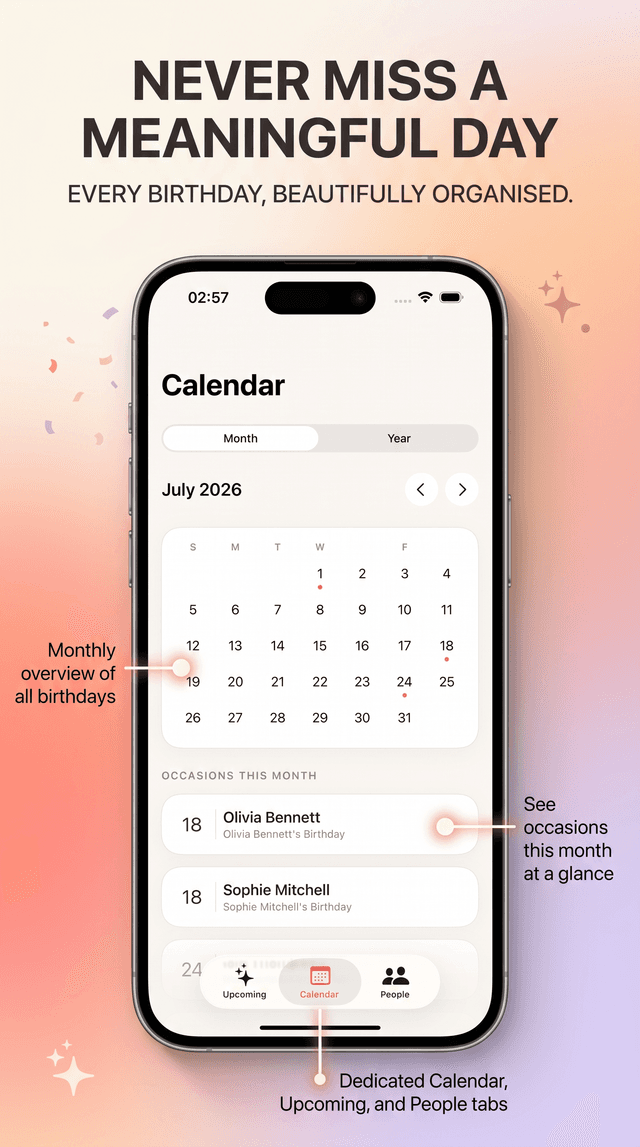
The current Birthday Reminder App Store listing describes personal notes, countdowns, customizable reminder lead days and alert times, and a Home Screen widget. A short cue such as “mention the marathon” can sit beside the birthday record until the reminder arrives.
Frequently asked questions
Is a one-sentence birthday text rude?
No. One warm sentence is complete for many relationships. It may feel too brief only when your usual communication, a close relationship, or the occasion clearly calls for more.
How long should a birthday card message be?
Two to four sentences, or about 25–75 words, is a useful starting point. A crowded group card may need only one line, while a blank card for someone close can hold a short paragraph.
How many words should a birthday text contain?
About 10–40 words works for most birthday texts. This is an editorial range, not a technical limit. Use fewer words when the greeting is casual and more when you have a specific memory or thought to add.
Should a milestone birthday message be longer?
It can be. A milestone may give you room to reflect on a memory, achievement, or the years ahead. It does not require a long speech, especially if the recipient dislikes attention around their age.
Does a longer message show more effort?
Not necessarily. A short message built around a specific memory may require more thought than a long paragraph of general compliments.
What is the safest length when I am unsure?
Use two sentences: a greeting with one recognizable detail, followed by a fitting wish. That length works in most texts, cards, and public posts.
Length is a tool, not a measure of affection. Make the message long enough to hold what you genuinely want to say, then stop.
Visit the Birthday Reminder app page to see how notes, countdowns, and flexible reminders can keep a useful writing cue ready, or browse the other Birthday Reminder guides. Our editorial policy explains how we review source and product claims.