For multiple birthdays in the same week, planning works best when you treat the dates as one temporary workload. List every intended gesture, find the earliest preparation deadline, and complete overlapping errands together.
Do not reduce the week to one generic reminder, though. A card, ordered gift, dinner, and phone call have different deadlines. Use one checkpoint to review the cluster, then keep only the individual alerts that lead to a real action.
Why a crowded week needs its own plan
A normal birthday workflow handles one person at a time. That becomes inefficient when three or four birthdays compete for the same shopping trip, evening, postal deadline, or budget.
The predictable failure is to plan in birthday order. The first person receives attention immediately, while a later birthday with an earlier mailing or booking deadline goes unnoticed.
The better rule is:
Plan in deadline order, celebrate in birthday order.
This article focuses on handling one crowded seven-day period, including dates that cross a month boundary. If your wider problem is maintaining dozens of family records, use the guide to birthday reminders for a large family first. Its family branches and action bands help maintain the full list; the workflow below takes over when several dates bunch together.
Step 1: Build one birthday-cluster sheet
Create a short table before setting alerts. Give each person one row with these fields:
- Birthday: the actual date.
- Gesture: what you intend to do.
- First action: the next physical or digital step.
- Start by: when preparation must begin.
- Hard deadline: the last useful date for mailing, ordering, or booking.
- Status: not started, waiting, or ready.
For example:
| Person | Birthday | Gesture | First action | Hard deadline |
|---|---|---|---|---|
| Lena | Tuesday | Call | Choose a suitable time | Monday evening |
| Dad | Wednesday | Card and call | Confirm address | Previous Wednesday to mail |
| Priya | Thursday | Small gift | Place order | Previous Monday |
| Sam | Saturday | Dinner | Reserve a table | Two weeks before |
Now sort mentally by the first action or hard deadline. Sam's Saturday birthday may need attention before Lena's Tuesday call because the table reservation opens earlier.
Use the birthday reminder timing guide when you need lead times for deliveries, bookings, travel, or milestones. This cluster sheet should record those dates, not replace the detailed timing guidance.
Step 2: Decide the gesture, time, and budget together
A crowded week becomes expensive and tiring when every decision is made separately. Before buying anything, decide three boundaries for the cluster:
- Gesture: message, call, card, gift, meal, visit, or coordinated event.
- Time: what preparation and celebration time you can realistically protect.
- Budget: the total available for the week and any amount already committed.
This is not a ranking of how much people matter. Different people prefer different kinds of acknowledgment, and a milestone or existing promise may require more coordination than a routine birthday.
Make these choices before the first birthday arrives. Otherwise, the earliest date can consume the time or budget needed for a commitment later in the week.
If you collect possible presents during the year, keep the list small and current. The guide to storing birthday gift ideas without saving too much explains how to separate ideas from actual purchase tasks.
Step 3: Batch shared work without making gestures generic
Task batching means grouping similar work into one focused block rather than repeatedly switching between unrelated tasks. For a birthday cluster, that can mean:
- Buying several cards during one shopping trip.
- Placing compatible gift orders in one session.
- Confirming all postal addresses before writing any envelopes.
- Writing and stamping every card at one sitting.
- Reserving call times during one calendar review.
- Wrapping several gifts while the materials are already out.
Batch the preparation, not necessarily the experience. Each card still needs its own message. Each call still needs a suitable time. Two gifts should not become interchangeable merely because they were bought together.
Do not force tasks into a batch when that creates risk. Separate them when:
- One order has a much earlier delivery cutoff.
- A personalized gift requires approval or production time.
- Calls must happen in different time zones.
- One celebration involves other organizers.
- Combining purchases would make returns or tracking harder.
The purpose is to remove repeated setup and errands, not to make every birthday identical.
Step 4: Create a small reminder structure
Use three kinds of alert:
- Cluster checkpoint: Review the full sheet before its earliest start-by date.
- Deadline alerts: Add separate tasks for mailing, ordering, booking, or collecting something when missing the date would change the plan.
- Birthday-day alerts: Keep one final prompt for the message, call, visit, or celebration.
The cluster checkpoint could say:
Birthday cluster begins next week. Check card, gift, booking, and call statuses.
A deadline alert should name the action: “Mail Dad's card today” is better than “Dad's birthday soon.”
Apple Reminders can group cluster tasks with a tag such as #birthday-cluster. Apple documents that custom Smart Lists can filter across lists by tags, dates, and other criteria, including more than one tag. Apple also notes that some features require updated Reminders in iCloud.
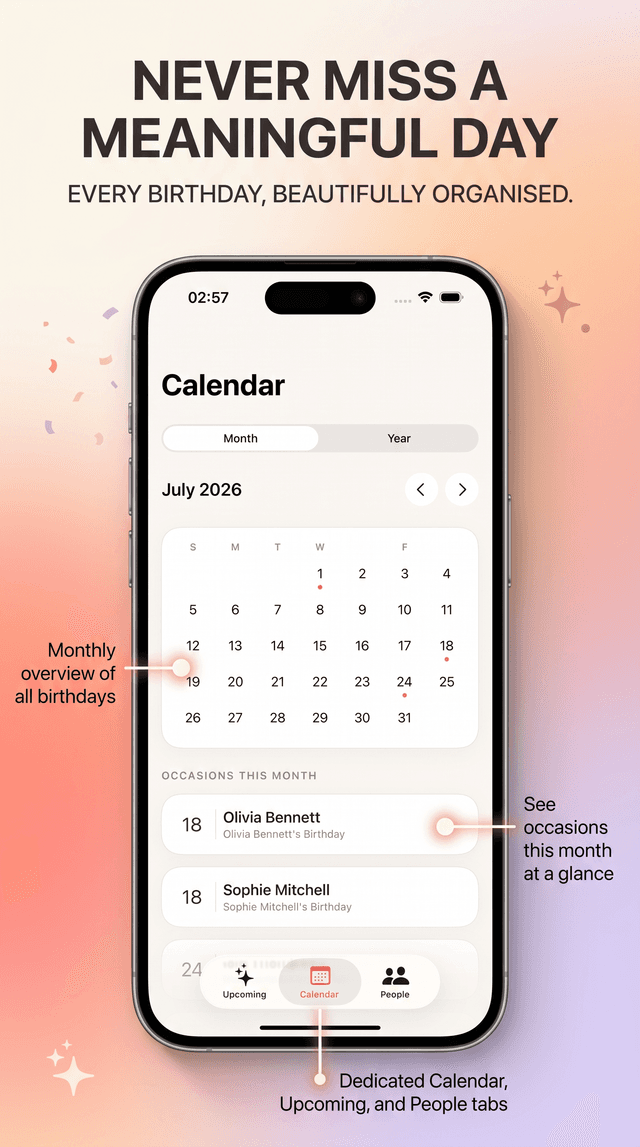
Birthday Reminder serves a different role. Its App Store listing confirms individual countdowns, customizable advance reminders, personal notes and gift ideas, an organized upcoming view, and a Home Screen widget. Keep each person's birthday and concise context there, then use a general task manager for a shared shopping or mailing batch if needed.
This division avoids claiming that one app manages the entire cluster as a project. It also helps prevent the repeated generic alerts discussed in the guide to keeping birthday reminders from becoming notification noise.
A practical cluster-week schedule
Suppose the first birthday is Tuesday and the last is Saturday. A workable plan might look like this:
| When | Action |
|---|---|
| Two weeks before | Identify bookings, personalized gifts, and other early commitments |
| 7–10 days before | Review the cluster sheet, confirm addresses, and place ordinary orders |
| 5–7 days before | Write and mail standard domestic cards; finish shared shopping |
| 2–3 days before | Check deliveries, wrap gifts, and reserve call times |
| Each birthday | Complete the person's planned gesture |
| After the week | Clear completed tasks and record one useful note for next year |
These are planning defaults. Follow the earliest real deadline in your table when a carrier, venue, maker, or other person is involved.
If the cluster contains only same-day messages, keep the system lighter. One review and one birthday-day alert per person may be enough.
Mail cards without turning an estimate into a promise
USPS currently lists First-Class Mail delivery at 1–5 days for qualifying envelopes and postcards. Its service-standards page also says expected delivery times are not guaranteed.
For a standard domestic birthday card, mailing 5–7 days before the birthday is a practical starting point, not an assured arrival date. Add more margin when:
- A weekend or holiday reduces useful mailing time.
- The card is unusually shaped, rigid, or bulky.
- The route is long or the birthday is especially important.
- You would rather have the card arrive early than risk lateness.
When batching cards, plan around the earliest birthday. The detailed birthday card reminder system covers address checks, postage, envelope rules, and separate buy, write, and mail tasks.
Keep what worked for next year
Birthday clusters usually recur, so spend two minutes improving the next cycle:
- Record whether each reminder arrived early enough.
- Remove completed purchase and delivery notes.
- Save one useful preference or future idea.
- Note whether the week's budget and time limits were realistic.
- Move any consistently late first action earlier.
This keeps the cluster-specific learning without building a permanent project. It also fits the broader remember, prepare, and celebrate system.
Frequently asked questions
How many reminders should a week with several birthdays have?
Use one cluster checkpoint, one birthday-day alert per person, and additional alerts only for real deadlines such as mailing, ordering, or booking. The total depends on the actions, not merely the number of birthdays.
Should I buy all the gifts at once?
Batch shopping when it saves an errand and does not compromise the choices. Keep separate orders when delivery cutoffs, personalization, returns, or tracking differ.
What if one birthday needs more preparation?
Put its first action into the sheet and let that deadline determine when planning begins. A Saturday event may need attention before a Tuesday message.
Should the cluster follow a calendar week?
Not necessarily. Use any rolling seven-day period that creates a concentrated workload. This catches clusters that cross from one month into the next.
Does Birthday Reminder replace the cluster sheet?
It can keep each birthday's countdown, customizable reminder, note, and gift idea together and show upcoming occasions. A short table or general task list is still useful for shared errands and cross-birthday deadlines.
What if I discover the cluster late?
List the remaining commitments, protect anything with a hard deadline, and simplify gestures that have not been promised. A thoughtful call or message on time is better than several rushed plans that cannot be completed reliably.
Several birthdays in one week become manageable when you expose the workload before the first deadline. Map the cluster, choose realistic gestures, batch only compatible work, and preserve separate alerts for actions that cannot slip.
Visit the Birthday Reminder app page to see how countdowns, customizable reminders, notes, an upcoming view, and a Home Screen widget can keep individual birthdays visible.