If you need birthday reminders for a large family, do not give every relative the same alerts. Label each person by family branch so the list is easy to audit, then assign an action band based on what you intend to do for their birthday.
A message may need only a same-day alert. A posted card or gift needs earlier notice. Travel or a group celebration needs separate planning deadlines. This keeps a list of 40 or 80 relatives useful without producing several notifications for everyone.
This guide focuses on configuring reminders once you have a family roster. For collecting dates, resolving ownership, and building the master list, start with how to organize family birthdays in one place.
Why one flat reminder schedule fails
A large family creates two different organizational problems:
- You need to know whether every family branch is represented.
- You need alerts that match the work required for each birthday.
One flat alphabetical list does neither job well. It can hide a missing cousin, and it gives a routine message the same urgency as a milestone celebration involving travel.
Too many equal alerts also make priority difficult to see. If 50 people each receive a seven-day and same-day notification, the system generates 100 alerts a year before accounting for gifts, bookings, or clustered birthdays.
The solution is not to rank relatives by affection. Use family branches to check completeness and action bands to control notification volume.
Build the roster by family branch
Give every person one primary branch or household label, such as:
- Your household.
- Mother's side.
- Father's side.
- Partner's maternal family.
- Partner's paternal family.
- Sibling households.
- Adult children and grandchildren.
These labels make auditing easier. You can quickly see whether one household has three recorded people when you expected five.
Apple lets you create additional contact lists on iCloud.com, and one contact can appear in more than one list without duplicating the contact record. Apple notes that this feature requires a tablet or computer.
Use lists as an organizational aid, not as an alert system. Apple's documentation does not say that a custom contact list can apply a reminder schedule or filter the Contacts-powered Birthdays calendar.
Give each relative one master birthday record even if they fit several branches. Add a secondary relationship in a short note instead of creating duplicate dates.
If a date is uncertain, confirm it before activating reminders. The guide to confirming a birthday without making it awkward includes direct scripts and date-format checks.
Assign an action band to each person
Next, decide what normally happens when the birthday arrives. Use three active bands and one quiet option:
| Action band | Typical birthday action | Starting reminder policy |
|---|---|---|
| Acknowledge | Message or short call | Birthday morning or one day before |
| Prepare | Card, gift, meal, or longer call | 7–14 days before, plus a final alert |
| Coordinate | Travel, group event, personalized gift, or milestone | 30–60 days before, with separate deadline tasks |
| Record only | Keep the date without a planned annual gesture | No active alert until circumstances change |
The band describes work, not closeness. A parent who wants only a quiet phone call may belong in Acknowledge. A wider-family milestone may belong in Coordinate because several people and deadlines are involved.
Use the birthday reminder timing guide when cards, international delivery, reservations, or travel require a more precise lead time.
Treat these bands as your planning convention. Do not assume that a calendar or app will create, assign, or update them automatically.
Configure the reminders in batches
Setting reminders one person at a time encourages inconsistent choices. Work through one action band at a time instead:
- Confirm the notification policy for the band.
- Filter or list the people assigned to it.
- Add or edit each birthday record.
- Set the appropriate alert for each person.
- Check that the final alert appears at a time when you can act.
- Mark completed records on a temporary checklist.
- Repeat with the next band.
For a large imported list, review dates and duplicates before enabling alerts. Selective import is safer than treating every contact with a birthday field as an active family reminder. See how to import birthdays without creating clutter for that workflow.
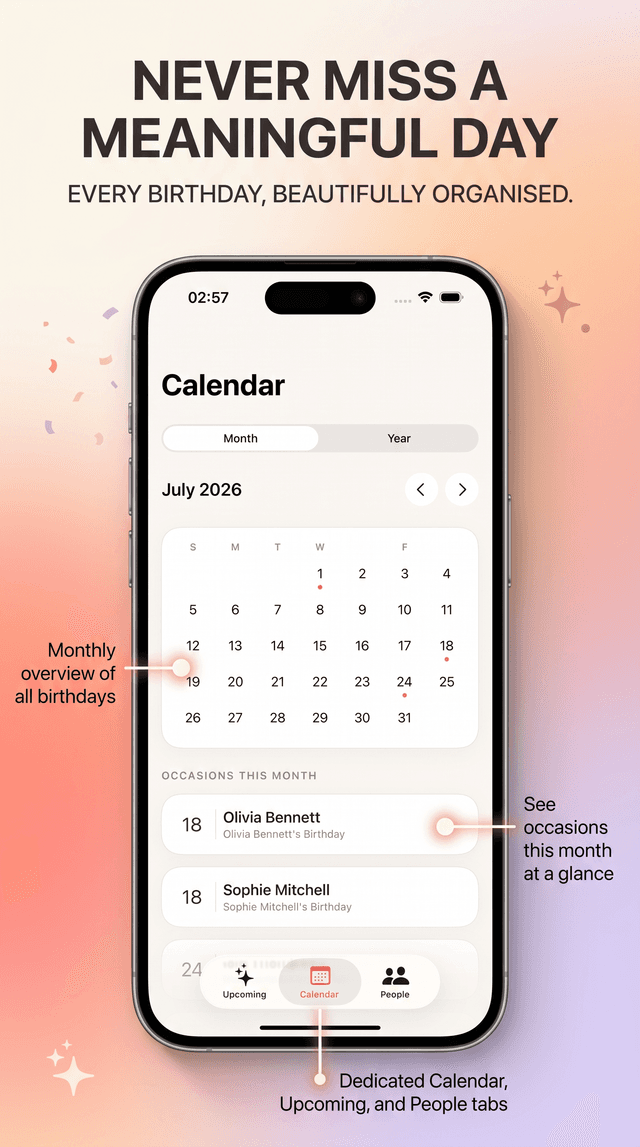
Birthday Reminder supports flexible reminder schedules, so it can hold different lead times for different people. Apply the action-band policy to each relevant record rather than expecting a family-wide rule to be assigned automatically.
Choose one source of truth
Large lists become unreliable when Contacts, recurring calendar events, and an app all compete as editable originals.
Choose one primary system:
| Primary system | Useful when | Important distinction |
|---|---|---|
| iPhone Contacts | Birthday fields are already maintained with contact records | Apple's Birthdays calendar draws from Contacts |
| Manual family calendar | You want birthday events isolated in a calendar you create | Each event must be maintained separately from the contact |
| Dedicated birthday app | One organizer wants countdowns, notes, flexible alerts, and a focused upcoming view | Confirm how imports, backups, and reminders work before relying on them |
Apple supports adding a birthday while editing an iPhone contact. In Calendar, the Birthdays option displays birthdays from Contacts. That special view is different from a manually created calendar named “Family Birthdays.”
Apple also supports creating additional calendars and turning event alerts on or off for them. A manual family calendar can therefore isolate birthday events, but corrections made there do not automatically correct a separate contact record.
Avoid running active alerts for the same person from Contacts, a manual yearly event, and a dedicated app. Choose where edits happen and disable redundant notifications elsewhere.
Keep only the upcoming queue visible
Do not display the full family tree every day. Keep the next few birthdays visible and open the full list only when maintaining it.
A useful upcoming queue contains:
- The next three to five birthdays.
- The number of days remaining.
- The action band or next required step.
- A warning when several birthdays fall in the same week.
A Home Screen widget can provide this glanceable view. Apple also supports widgets on the Lock Screen when an app provides a compatible format. If you use a Smart Stack, remember that automatic rotation is based on signals such as time, location, and activity; it does not guarantee that a birthday widget will be visible when you need it.
For an important month, give the birthday widget a fixed position rather than relying on stack rotation. The guide to making a birthday countdown widget useful explains how to test the visible information and widget size.
Plan for birthday clusters
Large families often have weeks when several birthdays arrive together. The annual total matters less than the busiest seven- or fourteen-day period.
During the monthly review, look for clusters and decide:
- Which cards or gifts can be bought together?
- Which calls need different time slots?
- Does one group celebration replace several separate plans?
- Who is coordinating a milestone?
- Which preparation deadlines occur before the first birthday in the cluster?
Give group events one named coordinator. Keep the birthday records stable, then create separate dated tasks for booking, ordering, collecting money, or confirming guests.
Birthday Reminder can hold the birthday countdown, flexible alert, and a concise note. Use a task or family conversation for collaborative work rather than expecting a private birthday record to show what every relative has done.
This follows the same remember, prepare, and celebrate sequence as the simple birthday planning system, but adds capacity planning for crowded weeks.
Review near-term dates monthly and the full list seasonally
Use two review rhythms:
Monthly six-week scan
Look at birthdays in the next six weeks. Check action bands, milestone ages, delivery windows, travel, and clustered dates.
Seasonal branch audit
Three or four times a year, review the whole roster by family branch:
- Add new family members whose dates have been confirmed.
- Check whether anyone is missing from a household.
- Remove duplicate records.
- Reassign action bands when the intended gesture changes.
- Confirm uncertain dates.
- Check known milestone birthdays six months ahead.
- Archive records that no longer need active alerts.
The monthly scan protects upcoming plans. The seasonal audit protects the accuracy and scope of the larger list.
Frequently asked questions
Should I group relatives by relationship or reminder timing?
Use both, for different jobs. Group by family branch when checking whether the roster is complete. Group by intended action when deciding reminder timing.
Can an iCloud contact list set different birthday alerts?
Apple documents contact lists as a way to organize and find contacts. It does not document them as a way to assign different birthday alerts or filter the Birthdays calendar. Apply reminder policies in the calendar or app you use.
How many alerts should a large family birthday list use?
Use one alert for a simple message, usually on the birthday or the day before. Use an earlier preparation alert plus a final alert for cards, gifts, meals, or calls that require planning. Create additional alerts only for real deadlines.
Do I need a shared family calendar?
No. A private master list works when one person usually maintains the dates. A shared calendar is useful only when several relatives need access and agree on who handles corrections.
What should I do when several birthdays fall in one week?
Review the cluster before the first preparation deadline. Batch shopping or postage where practical, reserve call times, and name one coordinator for any shared celebration.
Can Birthday Reminder handle a large family list?
Birthday Reminder can keep birthday records, countdowns, notes, widgets, and flexible reminder schedules together. Use action bands as your own policy and configure the appropriate timing for each person.
A scalable family reminder system separates completeness from urgency. Audit relatives by branch, schedule alerts by intended action, and keep only the next few birthdays in daily view.
Visit the Birthday Reminder app page for a focused way to manage countdowns, notes, flexible reminders, and widgets, or browse the other Birthday Reminder guides.