The most reliable way to remember birthdays when busy is to make fewer decisions, not to build a more elaborate calendar. Keep the people you intend to contact in one list, use one reminder plan for ordinary birthdays, and customize only the dates that involve a real deadline.
Set up the first version in one short session. After that, let a visible widget provide background awareness and let notifications prompt specific actions. You should not need to open an app every day or maintain a detailed plan for every person.
Why being busy changes the right birthday system
A detailed system may work during a quiet month and fail as soon as work, family, travel, or caregiving becomes demanding. The usual failure points are predictable:
- Birthdays are recorded in several places.
- Each person has a different reminder schedule.
- Alerts announce dates without saying what to do.
- Setup becomes a contact-cleaning project.
- Dismissed notifications provide false reassurance.
Research summarized by the American Psychological Association shows that switching between tasks carries a measurable time cost. Its widely quoted figure that brief mental blocks can cost as much as 40 percent of productive time is an upper-bound comment from one researcher, not an estimate of the time lost to checking birthdays. The relevant lesson is simpler: repeated interruptions and setup sessions create avoidable friction.
Cleveland Clinic describes decision fatigue as a phenomenon rather than a medical diagnosis. Its practical advice includes removing choices from routine parts of life. A birthday system can follow that principle by settling ordinary choices once and keeping only genuine exceptions open.
Build the first version in 15 minutes
Use a timer so the first session does not expand into an afternoon of editing Contacts.
- Choose one home for active birthdays. Use Contacts and Calendar, a dedicated app, or another system you already trust.
- Add the first 10 to 20 people. Begin with people you would call, message, visit, or prepare something for.
- Confirm the dates you know. Mark uncertain dates for later rather than guessing.
- Choose one default gesture. Decide what you normally do, such as sending a message or making a call.
- Set one matching reminder plan. Reuse that decision for ordinary birthdays.
- Identify the exceptions. Add earlier timing only where preparation has a real deadline.
- Make the next date visible. Place a birthday widget somewhere you already look.
Stop when the timer ends. Coverage matters more than polished notes or a perfectly organized address book.
If deciding who belongs on the list is the difficult part, use the separate guide to choosing which birthdays to track.
Choose a default from what you usually do
There is no single reminder schedule that suits every busy person. Choose the lightest plan that supports your most common birthday gesture.
| What you usually do | Practical default |
|---|---|
| Send a message or make a short call | One alert on the birthday morning |
| Send a card or buy a simple local gift | One alert 5–7 days before and one on the birthday |
| Use a mixture of quick and prepared gestures | One alert 3–5 days before and one on the birthday |
These are starting points, not delivery or preparation guarantees. Adjust them for your location and circumstances.
The key is to make the decision once. If most birthdays receive a message, do not create a seven-day preparation alert for every person. If you normally post cards, a same-day alert alone is too late.
Birthday Reminder supports reminders for individual occasions. A default in this system means reusing the same timing choice while configuring ordinary birthdays; it does not imply a bulk setting that changes every record automatically.
For detailed lead times covering gifts, bookings, international delivery, travel, and milestone events, use the birthday reminder timing guide. Keep those details there rather than rebuilding a custom timetable for everyone.
Add dates in a batch instead of one interruption at a time
Batching the initial entry work prevents birthday setup from interrupting unrelated tasks throughout the week.
Apple confirms that you can add a birthday while editing a person's contact card on iPhone. If useful birthdays already exist in Contacts, reuse that information instead of typing every date from scratch.
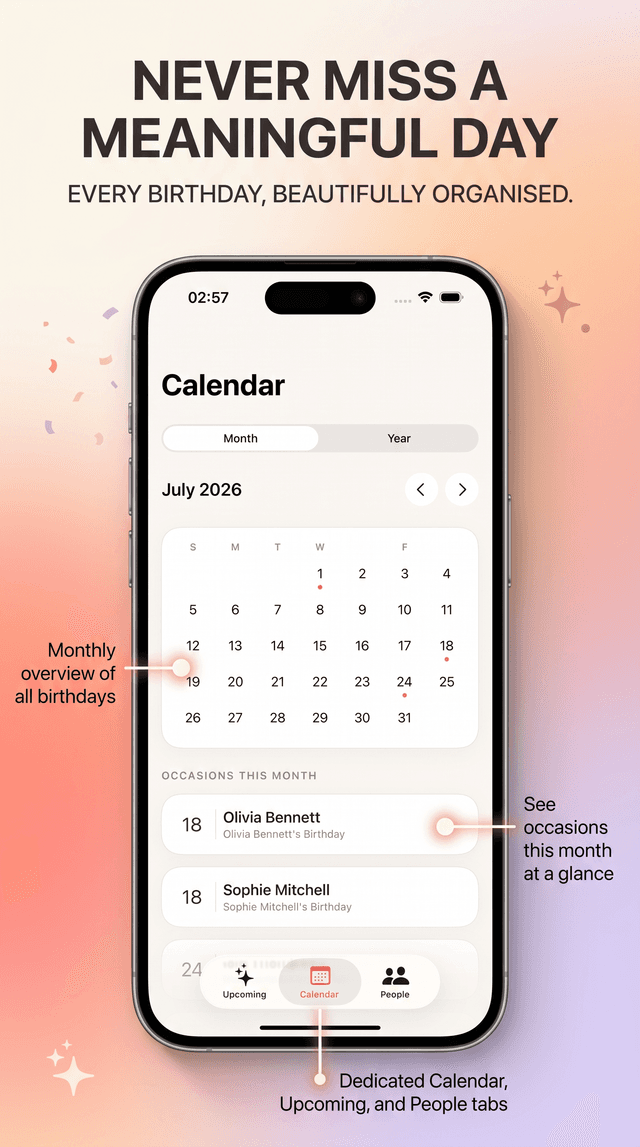
Birthday Reminder's optional Contacts import lets you review available birthdays and select the people you want to add. Treat the preview as a choice screen, not an invitation to copy your whole address book. Contacts may include former coworkers, businesses, duplicate cards, and people whose birthdays would not lead to any action.
Use this short import process:
- Note any people already entered manually.
- Open the Contacts import.
- Review names and dates.
- Select only the people you intend to track.
- Inspect the completed list for duplicates or uncertain dates.
- Configure reminders after the list is clean.
The dedicated guide to importing birthdays without creating clutter covers contact permissions, duplicate cards, and date verification in more detail.
After this first batch, add new people when their birthdays arise naturally. That takes less effort than repeatedly searching your entire address book for missing dates.
Keep a default list and a short exception list
A busy system needs two lanes.
The default lane contains birthdays covered by your normal gesture and reminder timing. Once configured, these dates should require almost no planning.
The exception lane contains birthdays with an external deadline or a larger commitment, such as:
- A card that must be posted.
- A personalized gift with production time.
- A restaurant or activity that requires booking.
- International delivery.
- Travel, childcare, or time off work.
- A milestone or group celebration.
For each exception, add only the next useful action. “Dad's birthday in 30 days” still leaves the planning unresolved. “Ask siblings about dinner dates” tells you what to do.
Your exception list does not need a fixed number. It needs to remain short enough to scan quickly. If most birthdays become exceptions, move to the fuller remember, prepare, and celebrate system rather than forcing a lightweight workflow to manage complex plans.
Use a widget for awareness and an alert for action
Apple describes widgets as a way to view current app information at a glance. iPhone supports widgets on the Home Screen, Lock Screen, and Today View, although each app decides which formats it provides.
Birthday Reminder provides a Home Screen widget that can keep an upcoming birthday or countdown visible without requiring you to open the app. Put it on a page you already see. A widget hidden in a rarely visited screen or rotating stack will not provide dependable awareness.
A notification has a different job. It should arrive when you can take a specific action:
- Order the gift.
- Post the card.
- Confirm the booking.
- Choose a time to call.
- Send the birthday message.
Keep a birthday-day alert even when an earlier preparation alert exists. The early alert protects the deadline; the final alert protects the gesture.
The guide to birthday widgets versus notifications explains how each signal can fail and how to test a two-signal setup.
Use a 60-second rule when an alert arrives
A reminder system fails when every alert is dismissed until it becomes background noise. When a birthday alert appears, make one decision within about a minute:
- Do it now if the action is genuinely quick.
- Schedule it for a specific time if it needs focused attention.
- Record the next step if another person, shop, or service is involved.
- Simplify the gesture if the original plan no longer fits the time available.
- Remove the reminder if you no longer intend to act on it.
Do not repeatedly clear the same vague notification. That preserves the decision without preserving the time needed to carry it out.
For example, an alert to “prepare for Maya's birthday” is easy to dismiss. “Order Maya's book after work today” can be scheduled immediately. If delivery is no longer realistic, change the plan to a call or message rather than carrying an impossible task forward.
Maintain the system without another weekly chore
A low-effort birthday system should not require a Sunday review.
Use event-based maintenance instead:
- Add a date when someone shares it.
- Correct an error as soon as you confirm it.
- Change reminder timing after a card or gift arrives late.
- Add a milestone exception when you learn about the plan.
- Remove duplicate or unwanted alerts when you notice them.
During an existing monthly admin session, scan only the exception list and the next 30 to 45 days. This is not a full review of every birthday. You are checking whether a booking, delivery, or travel deadline needs action.
When several birthdays fall in the same week, use the separate birthday-cluster planning method to batch compatible shopping, writing, and mailing without making the individual gestures generic.
What to do when you start too late
Even a good system will occasionally be set up after a useful deadline has passed. Use a simple recovery order:
- Protect anything still time-sensitive, such as a reservation or scheduled call.
- Replace impossible plans with a gesture you can complete reliably.
- Set the final birthday-day alert.
- Move next year's preparation reminder earlier.
- Continue with the rest of your day.
Do not turn one late card into an emergency shopping project or abandon the whole reminder system because the first attempt was imperfect. The goal is dependable acknowledgment, not elaborate preparation for every person.
Frequently asked questions
What is the fastest way to start remembering birthdays?
Choose one trusted place, add the first 10 to 20 important people, use one reminder plan for ordinary birthdays, and put the next birthday on a visible Home Screen widget. Stop before setup turns into a full contact cleanup.
Should every birthday have two reminders?
No. A same-day message or call may need only one alert. Use an earlier preparation reminder when a card, gift, booking, delivery, or journey creates a separate deadline.
Can I use the same reminder timing for everyone?
Use the same timing for people whose birthdays lead to the same kind of action. Create an exception when the intended gesture needs more preparation. The default reduces decisions; it should not hide real deadlines.
Do I need to review birthdays every month?
Not necessarily. If most birthdays need only a message or call, alerts and a visible widget may be enough. Use a brief monthly scan when you have exceptions involving gifts, delivery, travel, bookings, or milestones.
What if I rarely notice widgets?
Keep a direct birthday-day notification enabled. A widget provides passive awareness only when you view its screen; it does not replace an alert that prompts action at a chosen time.
Does Birthday Reminder apply one default schedule to every birthday?
Birthday Reminder supports reminders for individual occasions. This article's default is a personal rule: choose the same timing while setting up ordinary birthdays, then customize the exceptions that need earlier notice.
A useful birthday system should become quieter after setup. Batch the initial work, settle ordinary decisions once, and spend attention only on the birthdays that require something different.
Visit the Birthday Reminder app page to see how Contacts selection, countdowns, reminders, notes, and a Home Screen widget support this approach. Our editorial policy explains how product and research claims are checked.