A private birthday app needs surprisingly little personal information. To provide a useful reminder, it needs a name or label, the month and day, and a reminder rule. The rule can be a shared default rather than a separate setting for every person.
Everything else should have a clear purpose and remain optional. A birth year can calculate age. A short note can preserve a gift idea or time zone. Precise location, browsing history, and an advertising identifier do not help a basic birthday notification arrive on time.
This guide evaluates data fields and storage models. For the separate question of accounts and social features, see the comparison of birthday apps without accounts or social feeds.
Disclosure: Daily Life Apps publishes Birthday Reminder: Tracker, discussed below. Its public listing and privacy policy were checked on 11 September 2026. Our editorial policy explains how we review claims involving our own products.
What should a private birthday app store?
Use this as a field-by-field starting point:
| Data | Needed for a basic reminder? | Safer default |
|---|---|---|
| Name or recognizable label | Yes | Store only enough to identify the person |
| Month and day | Yes | Add the year only when age matters |
| Reminder lead time and alert time | Yes | Use a shared default or customize when needed |
| Birth year | No | Leave blank if you do not track ages or milestones |
| Relationship or group | No | Add only when it helps organize the list |
| Short note or gift idea | No | Keep it practical and remove stale details |
| Photo | No | Add only when visual identification is useful |
| Phone number or email address | No | Keep only if a deliberate contact feature needs it |
| Precise location or advertising identifier | No | Question why the app requests or collects it |
Notification permission is necessary if you want alerts, but permission is not itself a birthday-record field. You should still be able to inspect and organize birthdays without granting unrelated permissions.
The birthday reminder timing guide explains how to choose the reminder rule once the record is in place.
Privacy labels, local storage, and permissions answer different questions
Privacy discussions become confusing when several separate ideas are treated as equivalent.
- Storage: Does the record live on the device, in a provider's cloud, or both?
- Developer collection: Does the developer or a third-party partner receive and retain information from the app?
- Permission access: Can the app read Contacts, Photos, Location, or another device data source?
- Backup and sync: Can Apple or another provider copy the data for restoration or use on another device?
- Security: Is access protected when another person can unlock or use the device?
Apple defines collection for its App Store disclosures as transmitting data off the device in a form the developer or a partner can access for longer than needed to service a request. Apple also says data processed only on the device is not collected for this label.
A Data Not Collected label therefore does not mean the app stores nothing, requests no permissions, makes no network requests, or has no device backup. It means the developer reports no collection under Apple's disclosure rules. Apple describes the information as self-reported, and App Store listings state that Apple has not verified it.
Optional fields should earn their place
The UK's Information Commissioner's Office summarizes data minimisation as keeping information that is adequate, relevant, and limited to what is necessary for the stated purpose. That principle provides a useful practical test even when you are choosing fields for your own private list.
Ask:
- Would the reminder be less useful without this field?
- Does the field help you identify, prepare for, or celebrate the person?
- Could a shorter or less revealing version do the same job?
- Will you review and delete it when it stops being useful?
A relationship label can help organize a large family. A time-zone note can prevent a badly timed call. A gift idea can save a useful thought from being forgotten. None should become a permanent personal profile.
Local storage reduces exposure to the developer, but it does not make a sensitive note harmless on an unlocked or shared phone. Keep notes brief and practical. The guide to storing birthday gift ideas without saving too much gives a focused cleanup method.
Data categories worth questioning
Apple's privacy-label taxonomy includes location, contacts, browsing history, search history, identifiers, usage data, advertising data, and diagnostics.
Some categories can have a defensible purpose outside the core reminder:
- Diagnostics may help a developer investigate crashes.
- Usage data may support product analytics.
- Coarse location might be used by an unrelated regional feature.
- Advertising identifiers may fund an ad-supported free version.
Those explanations do not make the data necessary for birthday reminders. They describe an app's wider feature or business model.
Precise location, browsing history, advertising data, and cross-app tracking are not required to store a date or schedule a local birthday alert. If a label includes them, read the stated purpose and decide whether that trade is acceptable. Their presence is a reason to investigate, not proof that the app is malicious.
Compare the storage model, not just the feature list
| Option | Likely data footprint | Main privacy consideration |
|---|---|---|
| Paper list | Whatever names, dates, and notes you write | Physical access, loss, and lack of automatic backup |
| Spreadsheet | Custom fields chosen by you | Cloud hosting, shared links, file permissions, and uncontrolled copies |
| iPhone Contacts and Calendar | Birthday plus other details already on the contact card | The configured iCloud, Google, Exchange, or other contact account may sync it |
| Cloud birthday service | Birthday records plus an account identifier | Provider-side storage, account security, sharing, retention, and deletion |
| On-device birthday app | Fields supported by the app | Device access, permissions, backup behavior, and any optional cloud features |
No model is automatically private. A spreadsheet shared by an open link can expose more than a carefully configured cloud service. An on-device app can minimize developer access while still leaving records visible to someone who uses the same unlocked phone.
If shared-device access matters, use the specific guide to keeping birthday reminders private on a shared iPhone.
How to inspect an app before adding your full list
Use a small test record before importing contacts.
- Read the App Privacy section. Look beyond the summary for data linked to you, data not linked to you, and data used to track you.
- Open the privacy policy. It should describe local and server storage, permissions, third parties, retention, deletion, backup, and sync.
- Check each permission at the moment it appears. Ask whether the feature works through manual entry or limited access instead.
- Add one test birthday. Confirm that the basic record and reminder work before entering private notes.
- Find the exit path. Check how to delete a record, remove all app data, create a backup, or obtain a portable export.
- Recheck periodically. Apple lets developers update privacy answers without submitting a new app version.
On-device storage does not necessarily mean there is no cloud copy. Apple says iCloud Backup can include downloaded-app data that is not already syncing through iCloud. App-level sync, whole-device backup, and a portable export are three different mechanisms.
Before changing phones or deleting an app, follow the full guide to backing up and exporting birthday reminders.
What Birthday Reminder currently documents
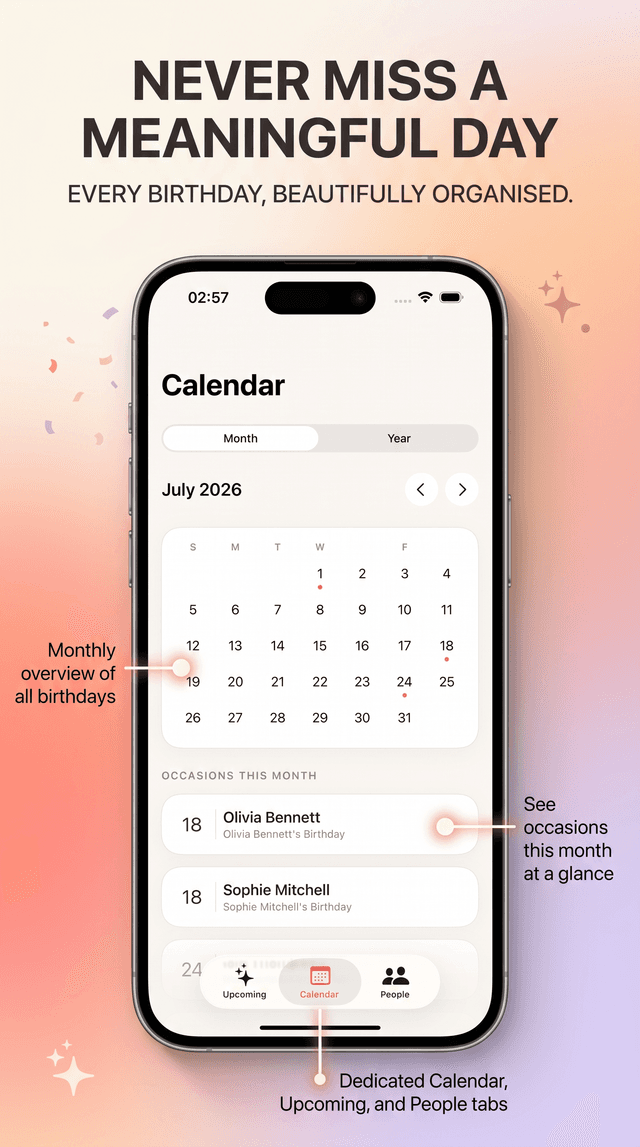
As checked on 11 September 2026, the App Store listing for Birthday Reminder: Tracker says no account is required, birthday information stays on the device, and contact access is optional. Its App Privacy section shows Data Not Collected, based on the developer's declaration.
The app's privacy policy provides more detail. It says locally stored information may include names, birthdays, anniversaries, other occasion dates, photos, contact details, relationships, notes, favourites, and gift ideas. Reminders use local notifications.
Optional contact import has a broader access path than manual entry. The policy says the app reads accessible contact names, birthdays, photos, phone numbers, email addresses, and contact identifiers so the user can review candidates. Selected information is stored locally and is not sent to Daily Life Apps.
That distinction matters. The functional minimum remains small, while optional import may inspect additional fields to present and identify contacts. Readers who do not want contact access can avoid the import workflow. The separate guide to contact import benefits and risks covers that permission in detail.
The current listing and policy make Birthday Reminder a natural option for someone seeking an account-free, on-device birthday list. The Data Not Collected label is consistent with those published practices, but it remains a developer-supplied disclosure rather than an independent audit.
Set your own data policy
A simple personal policy keeps the list useful:
- Store the month and day for everyone.
- Store a birth year only when age or milestone planning matters.
- Prefer a relationship label over unnecessary contact details.
- Keep at most one short practical note or a few current gift ideas.
- Remove old notes, duplicate records, and people you no longer track.
- Review permissions and backup behavior after major app updates.
This preserves enough context to act without turning a reminder list into an archive of personal information.
Frequently asked questions
Does Data Not Collected mean nothing is stored on my phone?
No. Apple's label addresses collection by the developer and its partners. An app can store and process birthday records locally while declaring Data Not Collected.
Should a birthday app store the birth year?
Only if you want age calculations or milestone reminders. Month and day are enough for an annual birthday alert. See how to set reminders without saving a birth year.
Is an on-device birthday app automatically private?
Not automatically. On-device storage limits developer access, but you should still consider permissions, shared-device access, backups, exports, deletion, and any optional sync.
Does contact import mean my address book is uploaded?
Not necessarily. An app can read contacts locally, but implementations differ. Check which fields the policy says it reads, whether selection is available, and whether anything is transmitted or retained off the device.
Should a private birthday app ask for location?
Location is not needed for the basic job of storing a birthday and scheduling an alert. If an app requests it for another feature, read the explanation and decide whether that feature is worth the additional access.
A trustworthy birthday app does not merely claim privacy. It explains which fields it stores, why each one exists, what leaves the device, and how you can delete or move your records.
Visit the Birthday Reminder app page to review its current private, account-free approach, or browse the other Birthday Reminder guides for setup and planning help.