The best professional birthday wishes are short, sincere, and pitched at the right level of formality. Greet the person by name, mention one real thing from your work together, and close with a wish for the day or year ahead. One to three sentences is enough. Leave out age, appearance, and private-life details, and send it privately unless you know they enjoy public attention.
What changes from one work relationship to the next is not the structure but the register: how formal the greeting is, how personal the detail is, and how relaxed the close is. This guide shows how to set that level for senior leaders, direct reports, clients, and peers, with original examples at each level. If you need wording for one specific relationship, our guides to birthday wishes for a coworker and birthday wishes for your boss go deeper.
The three-part structure behind every professional wish
- Greeting with their name. "Happy birthday, Hannah."
- One detail from work. A skill, a habit, or a recent project you have actually seen.
- A forward-looking close. A wish for the day, the weekend, or the year ahead.
For example: "Happy birthday, Hannah. Your summary of the supplier review turned a messy decision into an easy one for everyone. I hope you have a restful day."
What makes it professional is where the detail comes from and how the tone matches the relationship. A message built from shared work never feels intrusive, and the specific detail stops it from sounding like it was written for anyone.
Set the formality level first
Decide how formal to be before choosing words. Four levels cover almost every workplace situation:
| Level | Use it for | Greeting | Detail | Close |
|---|---|---|---|---|
| Formal | Executives, external partners, clients you rarely speak to | "Dear Ms. Mensah," or "Happy birthday, Dr. Ruiz." | Thanks for the working relationship | "Best wishes for the year ahead." |
| Professional-warm | Your manager, senior colleagues, regular clients | "Happy birthday, Daniel." | One concrete contribution | "I hope you have a great day." |
| Collegial | Teammates and direct reports you work with daily | "Happy birthday, Farid!" | A habit or shared moment | "Enjoy the day." |
| Light | Peers who already joke with you | "Happy birthday!" | A shared work situation | A gentle joke about that situation |
Small signals move a message up or down a level. Titles, "Dear", full sentences, no exclamation marks, and email all raise formality. First names, exclamation marks, and chat lower it. If you are torn between two levels, choose the more formal one. You can always be warmer next year.
The same wish at three levels
- Formal: "Happy birthday, Mr. Adeyemi. Thank you for your support throughout this year's budget process. Best wishes for the year ahead."
- Professional-warm: "Happy birthday, Tunde. Your patience during budget season kept the whole team on track. I hope you have a great day."
- Collegial: "Happy birthday, Tunde! Budget season would have flattened me without your spreadsheets. Enjoy today."
The detail stays the same. Only the register changes.
Check the situation before you write
Some people would rather not be celebrated at work. SHRM has reported that workplace birthday celebrations have led to lawsuits over age and religious discrimination, and notes that Jehovah's Witnesses, for example, do not celebrate birthdays. More recent SHRM coverage quotes HR leaders saying celebrations should be opt-in, and that managers need guidance in advance on whether each employee wants their birthday recognized.
That is guidance for organizations, not a rule for every individual message. But the practical lessons apply to everyone:
- Default to a private message (a direct message, an email, or a quiet word) unless you know the person enjoys public attention.
- Don't announce someone's birthday in a team channel if they haven't shared it there themselves.
- Never mention the year or their age, even jokingly.
- If someone has said they don't celebrate, respect that completely.
Gallup's research with Workhuman found that recognition preferences differ, including between younger and older employees, which is why it is worth finding out what each person prefers. A birthday message is a small form of recognition, so the same principle applies.
How to personalize without getting personal
The safest source of personal detail is work you have shared. You don't need to know someone's hobbies to write something that feels meant for them. Look for:
- A project they led, rescued, or quietly held together.
- A skill others rely on, such as clear writing, calm in a crisis, or careful review.
- A habit that improves the team, such as tidy handovers or well-timed questions.
- Something they taught you.
Use personal details only if the person shares them openly at work. "I hope you get out on the trail this weekend" is fine if they talk about hiking in team meetings. It is not fine if you learned it from their private social media.
| Use this | Not this |
|---|---|
| "Your notes from the Q3 review were the clearest I've read." | "You don't look a day over 30." |
| "Hope you get a proper break today." | "Don't let the boss see you leave early!" |
| "Thanks for making new starters feel so welcome." | "How does it feel to be another year older?" |
| "Enjoy the long weekend away you mentioned." | Any reference to family, health, or relationship status |
Birthday wishes for senior leaders and executives
With someone senior, general praise sounds like flattery. Thank them for one concrete thing instead, and keep it brief.
- Formal: "Happy birthday, Ms. Lindqvist. Thank you for the clear direction you have given the department this year. I hope you have an enjoyable day."
- Formal, for a leader you rarely work with: "Wishing you a very happy birthday, Dr. Mensah, and every success in the year ahead."
- Professional-warm: "Happy birthday, Daniel. Your advice before my first board presentation stuck with me, and I still use it. I hope today is a good one."
Send it by email or direct message rather than replying to a company-wide announcement, unless the leader has invited that.
Birthday wishes for employees and direct reports
From a manager, a birthday message carries extra weight, so two things matter: consistency and restraint. SHRM warns that celebrating some employees' birthdays while forgetting others hurts morale. If you send one direct report a message, make sure everyone on your team gets one, unless they have opted out.
Recognize the person, not their output targets, and don't link the wish to workload.
- Formal: "Happy birthday, Nadia. Thank you for everything you bring to the team. I hope you have a wonderful day."
- Professional-warm: "Happy birthday, Chris. Watching you take the lead on the migration this year has been a highlight for me. Enjoy your day, and please don't check email this evening."
- Collegial: "Happy birthday, Wren! Your patience with every new joiner shows. Have a relaxing day."
If your team offers a birthday half-day or a similar benefit, mention it plainly and leave it at that.
Birthday messages for clients and external contacts
Client birthdays call for the most restraint. Only write if you have a genuine working relationship, and keep the message completely separate from sales. A birthday email with a discount code reads as marketing, not goodwill.
- Formal: "Dear Ms. Patel, wishing you a very happy birthday. It has been a pleasure working with you this year."
- Formal, partnership focus: "Happy birthday, Robert. Thank you for the partnership on the spring rollout. Best wishes for the year ahead."
- Professional-warm: "Happy birthday, Lucia! Our Thursday check-ins are a highlight of my week. I hope you're celebrating somewhere sunny."
Send it from your own account, in your own words, and don't ask for anything in return. Some organizations restrict gifts from suppliers, so a message or card is the safest gesture.
Formal birthday email and card wording
Email is the most formal channel, and small choices show it.
- Subject line: "Happy birthday, Robert" or "Best wishes on your birthday." Keep it plain so it isn't mistaken for a newsletter.
- Opening: "Dear [Name]," for formal contacts, or simply their first name for professional-warm messages.
- Body: The three-part structure, nothing more. No project updates or requests.
- Sign-off: "Best wishes," or "Warm regards," followed by your name. Skip "Cheers" with senior or external contacts.
For a physical card, write on the inside rather than adding a sticky note. If many people at the organization share your first name, sign with your full name.
Peers, team channels, and group cards
With teammates you can drop a level or two, but the same rules apply. For a crowded group card, one specific line beats "HBD!" under twenty identical messages: "Happy birthday, Kai. It's been great working with you on the support rota." For ideas sized for shared cards and team messages, see birthday message ideas for a group card and birthday messages from a team.
For remote colleagues, send the message during their working morning, not yours. Contributions to any gift collection should be clearly optional, and don't start a group song on a video call without checking with the person first.
What to avoid in workplace birthday messages
- Age. No ages, birth years, "over the hill" jokes, or comments about getting older. Our guide to birthday wishes without mentioning age has alternatives.
- Appearance. Leave out compliments about looks, even kind ones.
- Workload humor. "Enjoy it, because the deadline won't move" turns a kind gesture into a reminder of stress.
- Private information. Family, health, relationships, and anything learned outside work.
- Unwanted attention. A public post, song, or surprise for someone who hasn't opted in.
- Copy-paste sameness. If your message could go to anyone unchanged, add one specific detail.
Remembering work birthdays and preferences
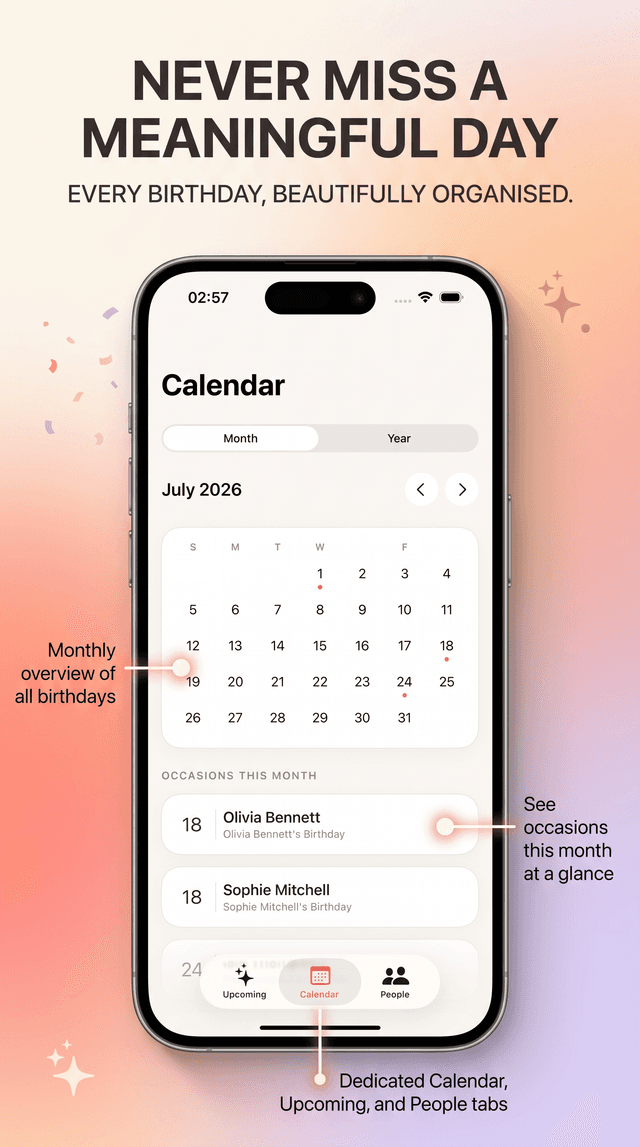
The hardest part of a professional birthday wish is often remembering the date, and remembering how the person likes to be acknowledged. A short note next to each date covers both: "Prefers a private message", "Doesn't celebrate", "Formal: use Dr.", or "Mentioned the Lisbon trip". Apple Reminders lets you add notes to a reminder, and the Birthday Reminder app keeps notes, countdowns, and flexible alerts together in a private, account-free list on your iPhone.
For ideas on what to write in those notes, see how to add useful context to birthday reminders. To keep colleagues' dates off shared work tools, read how to remember work friends' birthdays privately. A morning reminder is usually enough for a message. If you are organizing a card, the guide on when to set birthday reminders explains how much lead time to allow.
Frequently asked questions
How long should a professional birthday wish be?
One to three sentences suits almost every work situation: a greeting, one specific detail, and a short close. Longer messages suit only close colleagues or milestones they have chosen to share.
How do I make a birthday message more formal?
Use their title and surname, open with "Dear" in an email, write in full sentences without exclamation marks, thank them for the working relationship rather than a personal quality, and sign off with "Best wishes" or "Warm regards."
Should I post birthday wishes in a team channel?
Only if the person has shared their birthday there or your team has an agreed opt-in practice. Otherwise, a direct message is the safer and often more meaningful choice.
What if a colleague doesn't celebrate birthdays?
Don't send a birthday message. If you want to recognize them, thank them for their work at another time, unconnected to the date.
What if I missed a colleague's birthday?
Acknowledge it briefly and move on: "Belated happy birthday, Grace. I hope it was a good day, and thanks again for your help with the audit." A long apology makes the message about you. Our guide to belated birthday wishes has more wording.
These examples are original editorial suggestions, not quotations from any source. Read how we research and review guides in our editorial policy, or browse more Birthday Reminder guides.