
If you are wondering what not to write in a birthday card, the short list is: jokes about their age or appearance, comments on health or weight, comparisons to siblings or colleagues, anything about money or the gift, criticism disguised as humor, and filler so generic it could be addressed to a stranger. A birthday card has one job, which is to make a specific person feel seen. Anything that embarrasses, audits, or could belong to anyone else works against that job.
The good news is that most card mistakes are easy to avoid once you can name them. Below are the ones that cause the most trouble, why they fail, and what to write instead.
Why birthday card messages go wrong
Most bad card messages are not cruel. They are careless. The writer reaches for the first familiar line, and familiar lines tend to be age jokes, stock compliments, or "have a great day."
Professional card writers treat the relationship as the starting point. Hallmark's writers advise letting your relationship with the recipient guide the message, and Grammarly's writing guidance recommends saving humor for people you know well and keeping workplace cards about the person rather than the job. The practical advice below follows the same principle: the person in front of you matters more than the joke in your head.
Do not make their age the punchline
Age jokes are the most common card mistake because they are the most available. "Over the hill." "You are how old?" "Another year closer to the retirement home." They work only when three things are true: you know the person well, they joke about their own age first, and the joke would land the same way if they read it alone at the kitchen table.
That last test catches most failures. A teasing line that feels warm when you hand it over with a grin can read cold in writing. And some birthdays are genuinely tender: a first birthday after a diagnosis, a milestone someone feels behind on, an age at which they lost a parent. You rarely know which one you are writing into.
Milestone birthdays deserve particular care. Card companies treat round-number ages as celebrations in their own right, and you can honor the number without mocking it: "Fifty years of being the person everyone calls first."
Do not comment on appearance, health, or how their year went
"You don't look a day over forty" is still a comment about how old they look. So are "you've barely changed" and "still got it." The same rule covers health: "hope this year is healthier than the last one" reminds them of the hard year on the one day meant to be easy.
The exception is when they have told you, in their own words, that they are proud of something. If a friend trained for a marathon at fifty, "I watched you run every dark morning this winter and it was something to see" is about their effort, not their body. The test is whether the line celebrates what they did or evaluates how they look.
Keep money, gifts, and comparisons out of the card
Three small topics cause outsized awkwardness:
- Money. "Sorry there's no cash in here" makes the card about the absence of a gift. So does apologizing for a modest present or joking that they owe you one next month.
- The gift itself. "This card cost less than your present" and "the real gift is my presence" both ask the recipient to react to your spending instead of enjoying their day.
- Comparisons. "You're aging better than your brother" insults the brother. "You're the fun one in the family" quietly ranks everyone else. Compliment the person in front of you without demoting anyone else.
Do not use the card to raise a grievance
A birthday card is the wrong envelope for anything unresolved. "Even though we haven't spoken much this year" turns the card into a summary of the distance. "Maybe this year you'll finally settle down" is advice nobody requested. "Hope your husband remembers this year" imports someone else's failure into your message.
If the relationship is strained, the honest options are a short, warm message with no history in it, or no card at all. Hallmark's writers suggest simple, sincere lines for complicated relationships precisely because just enough is the right amount. "Thinking of you today and wishing you a genuinely good year" keeps a door open without pushing it.
Avoid lines that could be sent to anyone
"Have a great one!" is not offensive. It is empty. The recipient can tell the difference between a line that required knowing them and a line that required a pen. Generic filler fails quietly: it does no harm, but it does none of the good a card can do.
The fix is one specific detail, not a whole letter. American Greetings' card writers note that messages do not have to be lengthy, only sincere. One true sentence does the work:
- A shared memory: "I still think about the flat tire on the way to the coast. Nobody I would rather be stranded with."
- A quality you actually see in them: "You remember everyone's coffee order and everyone's bad week. It does not go unnoticed."
- A hope for their year: "May this be the year the garden finally beats the squirrels."
If generic lines are your default, our guide to planning birthday messages without making them generic shows how to keep a small bank of personal details ready before the day.
Match the message to the relationship
The same sentence can be perfect in one card and wrong in another. Set the tone from the relationship before you write a word.
| Relationship | Tone | What to avoid |
|---|---|---|
| Close friend or partner | Playful, personal, sentimental | Anything they would not want read aloud |
| Parent or grandparent | Warm, grateful, specific | Teasing about memory, health, or technology |
| Coworker | Friendly and brief | Work complaints, age jokes, anything too personal |
| Boss or client | Courteous and short | Jokes, pet names, commentary on their private life |
| Child | Simple and excited | Sarcasm and jokes aimed at the adults in the room |
| Complicated relationship | Simple and sincere | History, guilt, requests |
Grammarly's guidance for workplace cards is blunt: the card is about them, not the job. "Working with you is the easiest part of my week. Hope the day is a good one" is enough for a colleague. For a boss, shorter still. For ready-to-personalize starting points in each category, see our birthday card message examples by relationship.
What to write instead: a three-line formula
When you sit down with the pen, use three moves:
- Name them. Use their name or the name only you use for them. It signals this card could not go to anyone else.
- Say one true thing. A memory, a quality, or something they did this year that you noticed.
- Wish them something specific. Not "all the best," but "a year with more lake days in it" or "quiet mornings and a tomato harvest worth bragging about."
For a parent: "Thank you for the Sunday calls that always run an hour long. I hope today gives some of that time back to you."
If you want a fuller structure, our four-part birthday message formula expands each move with worked examples.
For a belated card, own the delay briefly and move on: "This is late because I am me, not because you are forgettable. I hope the day was good to you." Card writers generally agree a late wish lands better than silence, so send it without turning the apology into the whole message. If the card is very late, our guide to belated birthday wishes that acknowledge the delay has more options.
Remember what works for next year
The best card writers are usually just the best note takers. When a friend mentions she hates age jokes, or your dad lights up about his allotment, that is next year's opening line. Keep one short note beside each person's birthday so you are not starting from zero every October.
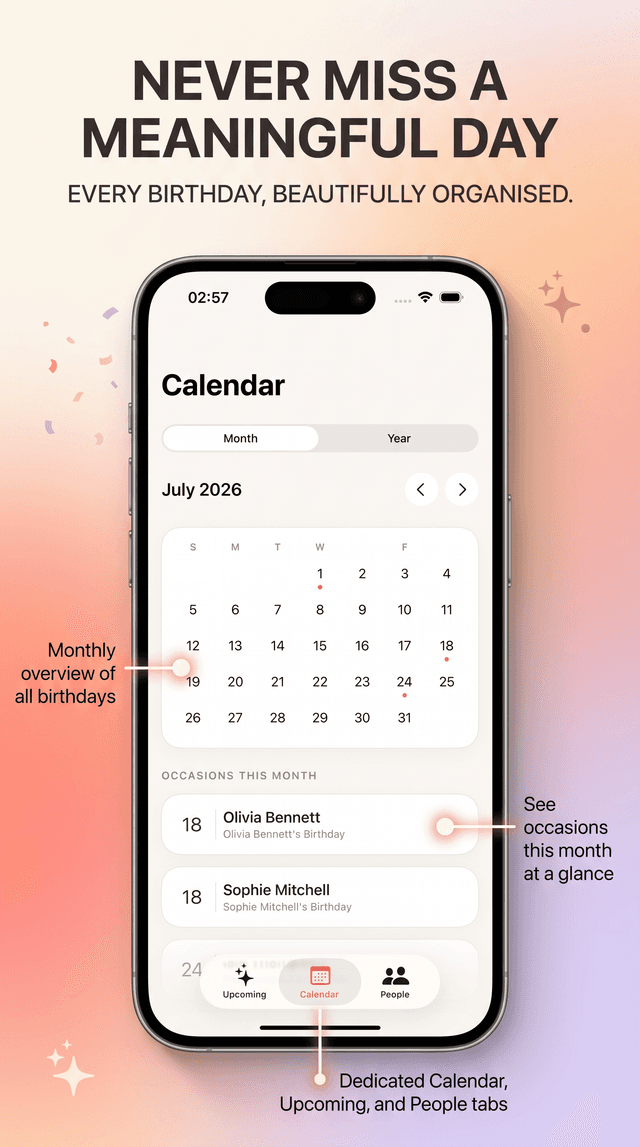
A birthday tracker with a notes field is built for exactly this. Birthday Reminder keeps a private note next to each person's date and countdown, so "hates age jokes, loves crosswords" is waiting beside their name when the reminder arrives. If you are building that list from scratch, our guide to remembering birthdays without social media covers the setup, and the birthday reminder timing guide shows how far ahead to start so a card actually arrives on the day. The three-stage planning system helps when a card is part of a bigger celebration.
You can read how we separate sourced facts from practical advice in our editorial policy, and browse all of our Birthday Reminder guides for more message and planning help.
Frequently asked questions
Is it rude to joke about age in a birthday card?
It depends entirely on the recipient. If they joke about their own age and you know them well, a gentle tease is fine. If you are unsure, or the birthday follows a hard year, skip it. Age humor lands colder in writing than it does in person.
Is it OK to just sign a card that already has a printed message?
For acquaintances, office group cards, and distant relatives, a signature under a printed message is normal and appropriate. For anyone you love, add one specific sentence. The gap between a signature and a single true line is small to write and large to receive. Our guide to how to sign a birthday card covers closings and signatures in more detail.
What should I write for someone I do not know well?
Keep it short, warm, and general without being hollow: "Hope the day brings you something you love" works. Skip jokes, age references, and personal observations you cannot back up.
Are belated birthday cards rude?
No. A late card with one brief, light line acknowledging the delay is better than no card at all. Do not let the apology take over the message.