A private vaping tracker on iPhone should protect two different boundaries. One is access through your phone, notifications, Apple Account, purchases, backups, and exported files. The other is information collected or transmitted by the app.
For the strongest practical setup, prefer on-device storage, no required account, an app lock, and export and deletion controls you can use yourself. Then review the iPhone settings around the app before recording anything sensitive.
A log can help you see when, where, and why vaping happens. It cannot assess nicotine dependence or replace a pharmacist, clinician, quit service, or crisis support.
Compare the main ways to keep a vaping log
Each option handles privacy differently:
| Option | Main advantage | Main privacy question |
|---|---|---|
| Paper | No network or account | Who could find or read it? |
| Notes or spreadsheet | Flexible and already available | Does it sync to an account or shared folder? |
| Vape-device companion app | May record use automatically | What does the device transmit, and is an account required? |
| Local habit or craving tracker | Structured manual entries | Do local-storage and no-account claims hold up? |
There is no universal winner. Paper avoids network collection but is easy to find. A synced document may appear on another device. Automatic device tracking reduces effort but creates a hardware connection that needs its own privacy review. A local tracker limits developer access only if its published practices are accurate.
Separate household access from developer collection
Start by naming the risk you are trying to reduce.
The device and account layer includes anyone who can unlock the phone, see a notification preview, use the Apple Account, inspect purchase history, or open an exported file.
The developer layer includes app accounts, analytics, advertising, server storage, community features, and other network connections.
An app can perform well at one layer and poorly at the other. On-device storage does not protect an unlocked phone. An app lock does not change what a developer collects.
Check iPhone and Apple Account visibility
Use a device passcode that other people do not know. Review Lock Screen notification previews for the tracker, and enable the app's own lock if it provides one.
Apple documents several less obvious points:
- Purchase Sharing: When it is enabled, family members can access shared purchases. The family organizer can also review purchases made by members. Ask to Buy can require approval for a child's purchase or free download.
- Hidden purchases: Hiding an app removes it from the App Store purchase list and prevents family members from redownloading it through shared purchases. It does not remove the app from devices, and the app and its in-app purchases remain in complete purchase history in Settings.
- iCloud Backup: Backups include data for downloaded apps when that data is not already synced through iCloud. Apple lets you stop backing up an individual app.
Purchase visibility and backup storage are separate issues. Membership in a Family Sharing group does not by itself mean another member can browse an app's backup data. Still, decide whether you want the log included in your own backup, and protect access to your Apple Account.
Check what the app collects and contacts
Apple says the privacy information on an App Store page is self-reported by the developer. The label distinguishes data linked to you from data used to track you across other companies' services. Apple also permits limited cases in which a collected data type does not need to be disclosed.
Treat “Data Not Collected” as a useful developer declaration, not an independent audit.
On iOS 15.2 or later, turn on Settings > Privacy & Security > App Privacy Report before testing an app. Apple says the report starts gathering information only after activation, is encrypted and stored on the device, and shows recent sensor access and domains contacted during the past seven days.
Use the tracker normally for several days and review its entry. A contacted domain deserves investigation, but it does not prove that a vaping entry was uploaded. Opening help content can contact a website, and an app can use information locally without the developer collecting it.
What dated vaping-app research can tell you
A peer-reviewed study published in 2022 examined eight free vaping-cessation apps found in the Canadian Apple and Google stores in December 2020. It assessed app quality and content, not present-day privacy.
Six apps offered in-app purchases. Three included community forums, another offered an optional private Facebook group, and one required a Bluetooth-enabled vape device for real-time monitoring without manual entry. Several apps adapted from smoking asked for cigarette and pack-cost information during sign-up.
That sample cannot describe today's store. It does identify features worth checking: registration, social spaces, connected devices, data fields designed for another habit, and paid boundaries.
Use this checklist before choosing an app
Ask seven questions:
- Can you use it without an email address, phone number, or social sign-in?
- Does the policy say where entries are stored and whether they are transmitted?
- Does it include a community, coach, watcher, or connected device?
- What does the App Store privacy label disclose?
- Can you protect the app from casual access?
- Can you delete one entry, erase the full record, and export it yourself?
- Which useful features are free, and which require a subscription?
If an answer is unclear, do not fill the log with sensitive detail while testing it.
Keep the vaping record small and clearly defined
A vape has no fixed endpoint like a cigarette, so decide what one entry means. A practical unit is a session from picking the device up to putting it down. Keep resisted urges as a separate entry type.
A short entry can contain:
- clock time and time since waking,
- place and preceding activity,
- session or resisted urge,
- urge strength on one consistent scale,
- what you tried next.
For example: “Tuesday 10:40pm; 16 hours awake; sofa after the episode; session; urge 7/10.”
Review several entries together. The guide to tracking vaping by hour explains how to define sessions, record mornings, and compare time windows. If an entry contains more detail than you want to retain, follow the steps for deleting one craving entry without erasing the rest.
Where Hard Bit fits
Hard Bit is an iPhone craving tracker, not vaping treatment. Its current UK App Store listing requires iOS 17 or later, carries an 18+ age rating, and displays the developer-reported label “Data Not Collected.” Apple states that it has not verified that privacy information.
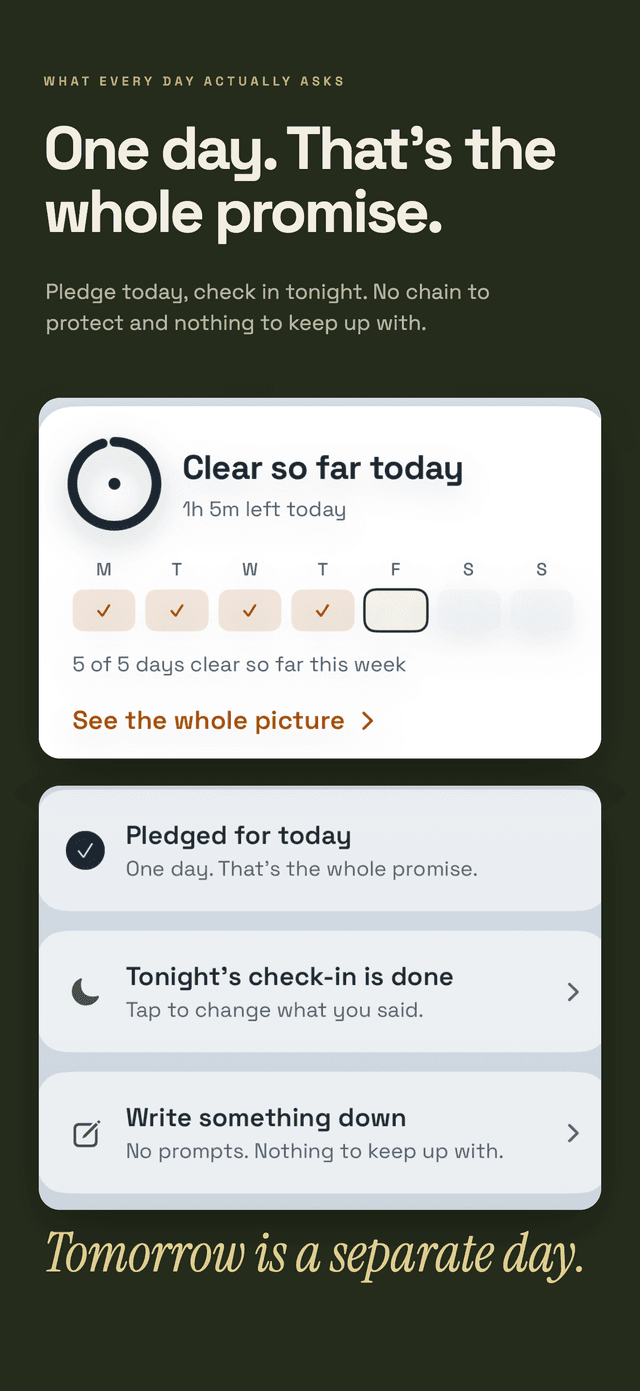
Hard Bit's privacy policy says entries and forecasts stay on the device. It requires no account and includes no advertising, third-party analytics, or social feed. It provides an optional app lock, plain-file export, individual entry deletion, and complete deletion. Once you save or send an export elsewhere, that copy has its own privacy risk.
You can track vaping separately from other habits and choose to stop or cut down. The counter, hard-moment flow, personal sentence, logging, journal, milestones, help links, export, and deletion are free. A subscription adds the on-device forecast and advance warning, patterns and calendar views, widgets, and short reads.
The forecast makes no prediction below five entries and relies fully on personal history at around 20. Those are product rules, not clinical predictions. The Hard Bit overview explains the workflow, while the Hard Bit support notes document privacy controls and the free and subscription boundaries.
Keep qualified quit support in the plan
The NHS lists strong cravings, irritability or low mood, trouble concentrating, increased hunger, and difficulty sleeping among possible nicotine-withdrawal symptoms. Its gradual options include lowering nicotine strength, increasing the time between sessions, and creating vape-free spaces.
For UK readers, the current NHS page states that Nicorette QuickMist is the only approved nicotine-replacement product for quitting vaping and advises discussing suitable nicotine replacement with a pharmacist or stop-smoking adviser. It also advises people who used vaping to stop smoking to quit vaping only when confident they can do so without returning to cigarettes.
In the US, the CDC says scientists are still studying the best ways to help people quit vaping. It offers confidential trained quit coaches at no cost through 1-800-QUIT-NOW and recommends discussing withdrawal support with a healthcare provider.
Hard Bit's App Store age rating is 18+. Younger readers can use the quit-planning, craving, trigger, withdrawal, and mood resources from Smokefree Teen and involve a trusted adult or clinician. If you are pregnant or significant mood symptoms develop, seek individualized clinical advice. Use urgent local help for severe distress or thoughts of self-harm.
For a short response to an active urge, read how to handle a craving in the moment. Our editorial policy explains how health guidance and product claims are reviewed, and the Hard Bit guide library contains more source-reviewed planning articles.
Frequently asked questions
Does no account mean my vaping entries stay on my phone?
Not necessarily. An app can work without registration and still contact analytics, advertising, support, or other services. Check the privacy label and policy, then review recent domains in App Privacy Report.
Can Family Sharing members see that I installed a vape tracker?
Purchase Sharing can expose an app through shared purchases, and the family organizer can review purchases made by members. Hiding the purchase reduces visibility in the App Store list but does not remove it from complete purchase history or an installed device.
Can App Privacy Report prove that an app uploaded my entries?
No. It reports sensor access and contacted domains, not the contents of each transmission. Use it as one check alongside the privacy policy, App Store label, account requirements, and the app's stated storage design.
Is a private vaping tracker enough to help me quit?
No. A log may show repeated times, cues, and resisted urges. It cannot assess nicotine dependence, select nicotine replacement, monitor symptoms, or provide counseling. Use qualified cessation support when you want help cutting down or quitting.