A useful answer to how to handle a craving begins with making the problem smaller. You do not need to solve the rest of your life while an urge is loud. Pause, name what is happening, move away from the cue if possible, slow your breathing, and choose one action for the next few minutes. If the craving involves withdrawal risk, immediate danger, or a situation you cannot manage safely, contact professional or emergency support instead of relying on a self-help routine.
The aim is not to win an argument with the craving. It is to create enough distance to make the next decision deliberately.
Start by naming what is happening
Say something plain: “I am having an urge to drink,” “I want to open the betting app,” or “I keep reaching for the vape.” This wording separates you from the impulse. It describes a present experience rather than predicting what you will do.
Avoid turning the moment into a character judgment. “I have no discipline” gives you nothing practical to act on. “The urge started after I came home and sat in this chair” gives you a cue, a time, and a possible next move.
If you already keep a log, note three details:
- the time,
- what happened immediately before the urge,
- how strong it feels on a simple scale.
You can review those details later with the method in How to Identify Your Craving Triggers and Difficult Times. During the craving, one short line is enough.
Change the cue before you test your willpower
Many urges are connected to a place, device, person, activity, or routine. Smokefree.gov recommends changing what you are doing and going somewhere smoking is not allowed when handling a nicotine craving. The exact move will differ by habit, but the principle is useful: make the automatic next step less automatic.
Try one physical change:
- stand up and move to a different room,
- leave the phone outside the bathroom or bedroom,
- take a route that does not pass the usual shop,
- close the app and put the device on charge away from you,
- step outside without your wallet,
- sit near another person rather than staying alone with the cue.
The best move is not the most impressive one. It is the one you can do quickly. If leaving is unsafe, stay where you are and contact someone who can help.
Slow the next minute down
WithYou describes cravings as experiences that can build and pass, and suggests noticing the feeling rather than fighting it. Breathing can support that pause, but it should not be sold as a switch that makes every urge disappear.
Try this simple pattern:
- Put both feet on the floor.
- Let your exhale take a little longer than your inhale.
- Notice where you feel tension without trying to force it away.
- Repeat for five slow breaths.
If focusing on breathing makes you more distressed, use an external anchor instead. Name five things you can see, hold a cold glass, walk to a well-lit public space, or describe the room aloud. The purpose is orientation, not perfect calm.
Choose one prepared action
A long menu is hard to use when attention has narrowed. Pick one default action in advance and make it easy to start. Useful options include:
- drink water and eat something if hunger is part of the pattern,
- walk around the block,
- shower without taking your phone,
- make tea and sit in a different chair,
- start a short household task with a clear end,
- message one person with a prewritten sentence,
- listen to one saved audio track,
- remove access to money, apps, or supplies for the evening.
MedlinePlus advises planning ahead, avoiding temptation, distracting yourself, and reminding yourself of reasons for quitting in its smoking-craving guidance. Those ideas should be adapted to the habit and your circumstances. A replacement action is not proof that you are “doing recovery correctly.” It is simply a bridge to the next decision.
You can keep the bridge short. “I will wash the dishes before deciding” is often easier to use than “I will never do this again.”
Bring back the reason you chose earlier
Motivation written during a craving can become harsh or unrealistic. A sentence written earlier is usually clearer. Keep it specific enough to matter:
- “I want tomorrow morning to belong to me.”
- “I do not want to hide another payment.”
- “I want to be present when my child talks to me.”
- “I am trying to sleep without losing two hours to the feed.”
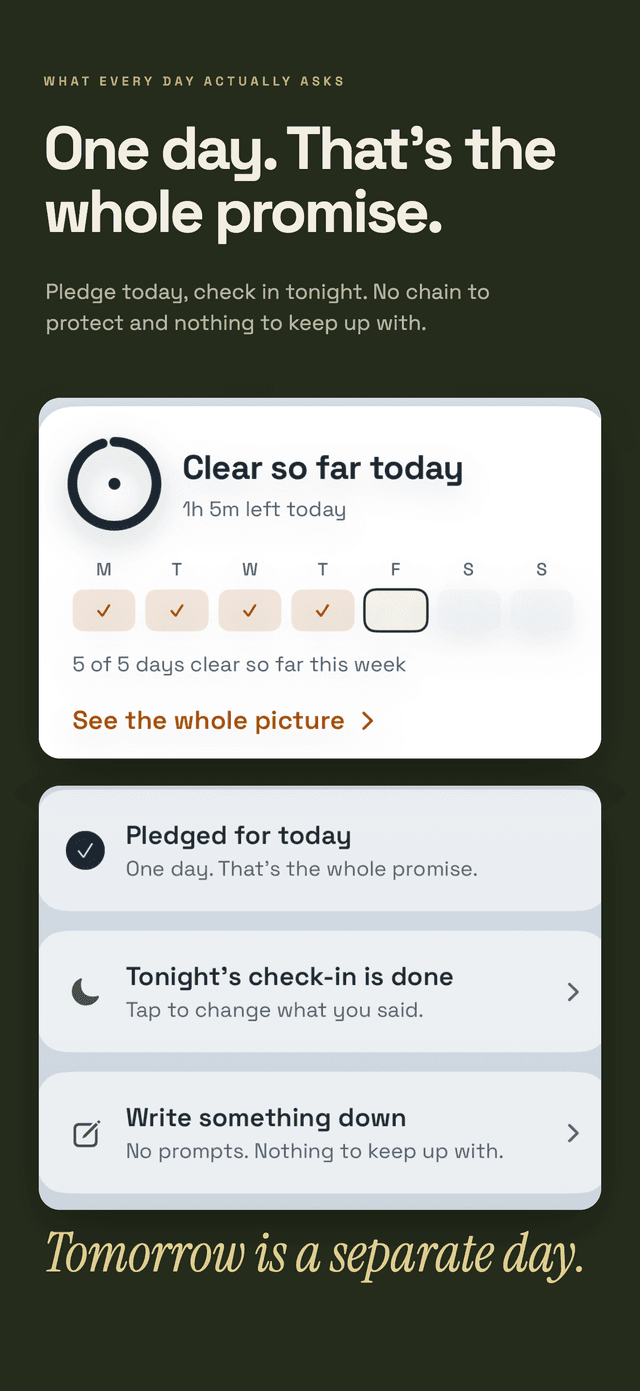
Hard Bit lets you save your own reason and brings it into the hard-moment flow. The Hard Bit app overview explains how that sits beside private logging and the learned difficult-hour pattern. The app is optional; the useful principle is to prepare your words before you need them.
Do not use a sentence that insults or threatens you. Shame may intensify the same stress you are trying to escape.
Decide whether you need another person now
Some cravings are manageable with a short plan. Others occur alongside withdrawal, debt, self-harm thoughts, violence, unsafe driving, severe distress, or repeated loss of control. Those situations need more than a timer or tracker.
Contact a trusted person, a clinician, a local support service, or emergency services as appropriate. If you may be physically dependent on alcohol or sedatives, do not assume that abruptly stopping is safe. Seek medical guidance about withdrawal.
For smoking and vaping, official quit services can explain evidence-based support and medicines. For gambling, practical barriers such as bank controls, self-exclusion, and specialist support may be more important than trying to distract yourself. A private log can help you describe the pattern, but it cannot replace qualified help.
Our editorial policy explains how Daily Life Apps separates general information from product promotion and reviews health-related sources.
Record what happened after the intensity changes
When the moment has shifted, add a brief note. Record what you tried, what helped a little, what made things worse, and whether you used the habit. An honest entry is more useful than a flattering one.
If you did act on the urge, do not delete the whole record. Read What to Do After a Slip Without Erasing Your Progress and look for the point where the plan stopped fitting the situation.
Over time, the question changes from “Why am I like this?” to “What tends to happen at this hour, in this place, after this cue?” That is a question you can prepare for.
Make the next craving easier before it arrives
Afterward, reduce the plan to four lines:
- My early sign: what tells me the urge is starting?
- My first move: where will I go or what will I close?
- My bridge action: what will I do for the next few minutes?
- My support: who or what service will I contact if the plan is not enough?
Save the plan somewhere visible but private. Rehearse it once when you are calm. If the same plan fails repeatedly, change the environment or add support rather than simply demanding more willpower.
You can find more practical, source-reviewed articles in the Hard Bit guides.
Frequently asked questions
How long does a craving last?
There is no single reliable duration for every person, substance, or behaviour. Intensity can rise and fall, and some urges return in waves. Use a short delay to create decision space, not as a guarantee that the craving must be gone by a particular minute.
Should I distract myself or sit with the urge?
Either may help. Some people benefit from noticing the urge without acting on it; others need to leave the cue and become absorbed in a practical task. Choose the safer option for the situation and keep professional support available when self-management is not enough.
What if I cannot stop thinking about it?
Reduce the task further. Change rooms, remove immediate access, contact someone, and decide only what you will do next. Persistent or dangerous urges deserve professional support, especially when withdrawal, debt, self-harm, or another urgent risk is involved.
Is a craving tracker enough?
No. Tracking can reveal times, cues, and repeated patterns. It cannot assess medical risk or provide emergency, clinical, financial, or psychological care. Use it as one source of information within a wider support plan.