To measure gambling progress without streaks, keep several indicators side by side: gambling-free days, sessions, money, time, observable harm, and protective actions. Compare them over equal periods, such as four complete weeks.
A current streak can stay on the page if it motivates you. It simply should not be allowed to erase the rest of the record when gambling happens.
Why a streak gives an incomplete answer
A streak answers one question: how long has it been since the most recent gambling day? It cannot show whether sessions became less frequent, money losses fell, urges ended differently, protective barriers were added, or relationships and bills were affected.
It also makes two very different periods look the same after a reset. One gambling day during an otherwise stable month and a month of escalating sessions both produce a current streak of zero days.
Keep the difficult day visible without treating it as the only fact. The guide to responding after a slip without erasing your progress explains how to review the event and change the next plan.
Build a six-part gambling scorecard
Use a period long enough to contain your usual weekdays and weekends. Four weeks is a practical option, not a clinical standard.
Track these six measures:
- Gambling-free days: write this as a count out of observed days, such as 25 of 28.
- Sessions: define a session consistently, then count completed sessions.
- Money: record deposits, stakes, and net losses separately where possible.
- Time: include the session and, if relevant, substantial time spent checking odds, balances, or results.
- Observable harm: note missed bills, borrowing, concealment, conflict, disrupted work, or severe distress.
- Protective actions: record self-exclusion, payment blocks, support contacts, or urges that ended without gambling.
A short dashboard might read:
Period: 1–28 September
Observed days: 28
Gambling-free days: 24
Sessions: 5
Net loss: £160
Time: about 7 hours
Harm: one bill paid late
Protective actions: bank block enabled; two urges ended without gambling
This is not a recovery score. Its purpose is to prevent one improving number from hiding another that is worsening.
GamCare provides a gambling diary, mood diary, SMART Goal Planner, support-network worksheet, and an Access, Time and Money worksheet. Those resources similarly separate the record into several parts.
Measure money without creating false precision
Deposited, staked, and lost are not interchangeable:
- Deposited is money moved into a gambling account.
- Staked is the total placed on bets, which may include money won and reused.
- Net loss is the difference between what you started and finished with over the chosen period.
If operator records provide all three, keep them in separate columns. If you only know one figure, label it accurately rather than calling it “money spent.”
Add consequences that a currency total can miss:
- Was rent, food, a bill, or a debt payment affected?
- Did money come from credit, borrowing, or savings?
- Did you hide a transaction?
- Did you chase a loss with another deposit or session?
A systematic review of gambling treatment studies notes that no standard unit of gambling expenditure can represent harm for everyone because consequences depend on the person's financial circumstances. Compare your record with your own obligations and earlier periods, not with another person's amount.
The NHS recommends paying important bills on payday, using direct debits or standing orders, and addressing debt rather than ignoring it. A bill that is now paid and protected is meaningful information even when another measure is imperfect.
Count responses as well as outcomes
Outcome measures describe what happened. Process measures describe what you did before or after it.
Possible process measures include:
- urges recorded,
- urges that ended without gambling,
- support contacts used,
- payment or access barriers activated,
- repeated cues prepared for,
- time between an unplanned session and the next protective action.
These are personal planning indicators, not validated clinical measures. Do not use them to cancel out rising losses or harm.
If the same period keeps appearing, use the guide to tracking the hours you are most likely to gamble. If you want to keep the wording factual rather than punitive, see how to track gambling without shame.
Compare equal periods and show missing days
Compare four weeks with another four weeks, not a difficult month with your best weekend. Keep the day boundary and session definition consistent.
Mark days you cannot classify as not observed. Do not count them as gambling-free. If the record is incomplete, state that beside the result.
A simple comparison could look like this:
| Measure | Earlier 28 days | Latest 28 days |
|---|---|---|
| Observed days | 28 | 26 |
| Gambling-free days | 20 | 22 |
| Sessions | 11 | 6 |
| Net loss | £240 | £190 |
| Time | 14 hours | 8 hours |
| Missed essential payments | 0 | 1 |
Several activity measures improved in this example, but the missed payment means financial harm did not improve across the board. The correct conclusion is not “success” or “failure.” It is that sessions, time, and losses fell while one serious consequence appeared and needs attention.
Use a brief weekly entry if that helps you remember events, then make the fuller comparison at the end of the fixed period. If frequent checking increases distress or becomes compulsive, review less often, simplify the record, or discuss another approach with a gambling support service.
Keep the goal separate from the measurement
A dashboard can record progress toward stopping or cutting down. It cannot decide which goal is safe or workable for you.
For a stopping goal, gambling-free days, access barriers, and the response after any gambling day may be especially relevant. For a cutting-down goal, session and money limits also matter, but lower totals do not prove that harm is under control.
Do not use an improving chart to override advice from a clinician or gambling service. If limits repeatedly fail, losses or debt rise, or gambling continues despite serious consequences, add qualified support rather than making the spreadsheet more complicated.
Read harm before celebrating a better number
Research supports using more than one domain. A systematic review of 34 gambling treatment studies found 63 different outcome measures. Almost nine in ten studies included secondary measures involving mental health, psychological processes, or wider functioning and wellbeing. The review describes recovery measurement as multidimensional, but it does not validate this personal scorecard or define one universal standard.
Give harm indicators priority when reading your record. Act promptly if you see:
- chasing losses,
- borrowing or using credit to gamble,
- missed essential payments,
- concealment or relationship conflict,
- worsening mental health,
- repeated failure of payment or access barriers.
The NHS has a nine-question gambling self-assessment. It says a score of 8 or more suggests that you or people close to you are likely to be experiencing gambling-related harms. A score from 1 to 7 may still indicate a negative impact. This is a prompt to consider support, not a diagnosis or a progress score.
Know when tracking should lead to help
In Great Britain, the NHS recommends options including GAMSTOP self-exclusion for six months, one year, or five years, Gamban blocking software, and bank gambling-payment blocks. It also points people experiencing debt to National Debtline.
The National Gambling Helpline, run by GamCare, is free on 0808 8020 133, 24 hours a day, seven days a week. Specialist NHS gambling clinics in England accept self-referrals. Elsewhere, contact an appropriate local gambling-support, health, or debt-advice service.
Seek urgent mental-health support if gambling is seriously affecting your mental health. Contact emergency services immediately if you are thinking about suicide, may harm yourself or someone else, or anyone is in immediate danger.
Do not wait to complete another tracking period before getting help.
Where Hard Bit fits
Hard Bit is an optional iPhone craving tracker. It is not a gambling blocker, treatment service, diagnostic tool, financial adviser, or betting-performance tracker.
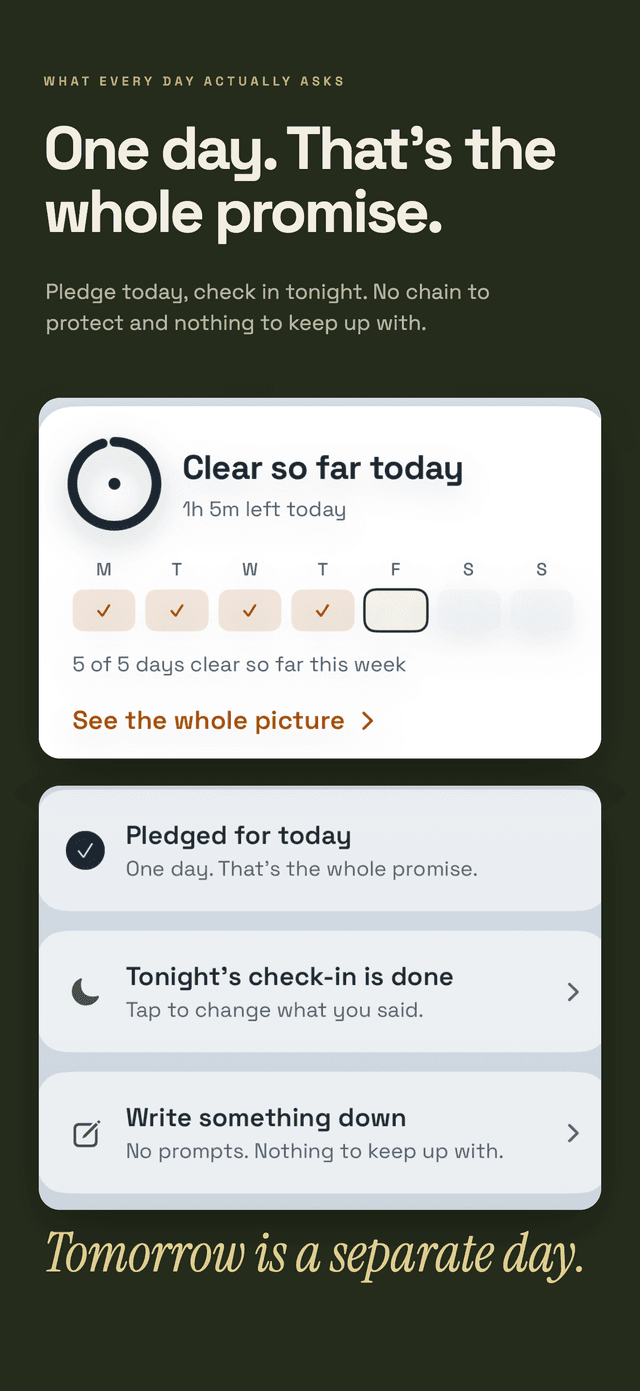
The app keeps each habit in a separate on-device record. You can choose stopping or cutting down, and logging gambling changes the counter wording instead of deleting earlier gambling-free days.
The counter, logging, journal, milestones, hard-moment flow, personal sentence, help links, export, and deletion are free. Hard Bit Plus adds the on-device difficult-hour forecast and warning, patterns and calendar, widgets, and short reads. Its forecast makes no prediction below five entries and relies fully on your own history at around twenty. Those are product rules, not clinical thresholds.
Hard Bit requires no account and has no advertising, social feed, third-party analytics, or server copy of your entries. The Hard Bit overview explains the workflow, while the support page documents privacy controls and free and subscription features.
Our editorial policy explains how health guidance and product information are reviewed.
Frequently asked questions
Should I delete my streak counter?
No, not if it helps you. Keep it beside fixed-period counts, money, time, harm, and protective actions so one reset does not become the whole assessment.
What should happen to the record after gambling?
Record the event and continue the same timeline. Note the session, money, time, immediate cue, consequences, and next protective action. Do not delete the earlier gambling-free days.
Is spending less proof that I am recovering?
No. Lower losses are one relevant change, but debt, concealment, distress, time, or relationship harm may still worsen. Read the measures together and seek qualified assessment when needed.
How often should I review progress?
A weekly note and a comparison between equal four-week periods is one manageable approach, not a clinical rule. Choose a schedule that captures events without encouraging constant checking.
Can I use the NHS questionnaire to track improvement?
Do not treat it as a clinical outcome scale or diagnosis. It can help identify possible harm and prompt a conversation with a gambling service or clinician.
Do I need an app?
No. Paper or a spreadsheet can hold the same scorecard. An app may make private logging and export easier, but it does not replace blocking tools, debt advice, professional support, or emergency help.