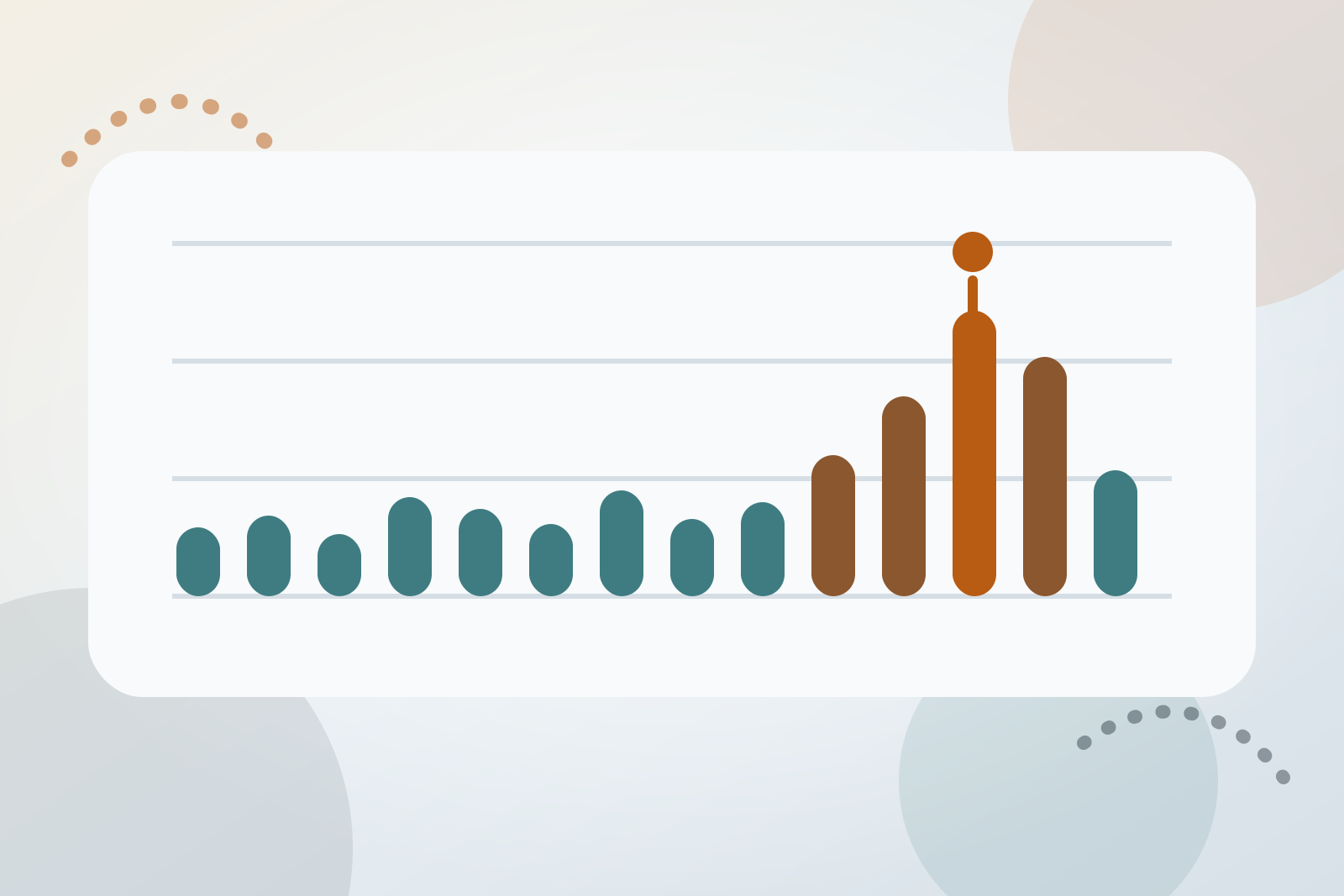
To track time of day gambling, combine records of what happened with notes about what nearly happened. Operator account history can show completed gambling. A short personal log can capture urges that ended without a deposit or session.
Group both kinds of entry into equal time windows and count how often each window was genuinely observed. The result is not a prediction about what you will do. It is a practical way to find one period that deserves an earlier plan.
Start with the account history you already have
In Great Britain, the Gambling Commission says gambling websites must provide access to historic account activity showing when you gambled, how much you spent and what you gambled on. The regulator recommends reviewing that activity to identify patterns, including increases in gambling.
Check every operator you use for:
- account or playing history,
- transaction and deposit history,
- session or login information, where available,
- downloadable statements or exports,
- receipts and notifications that contain a date or time.
Record the date, weekday, time and amount shown. Also note what the entry represents. A deposit, login, bet and withdrawal are different events and should not be treated as interchangeable.
Check the detail available before relying on it. Some records show an exact clock time; others show only a date. A session can also begin in one hour and continue into another.
Bank, card and ATM records can help fill gaps, especially for cash withdrawals or deposits. They are supporting clues rather than complete session records. A bank entry may show when money moved, not when gambling began or ended, and some statements do not display an exact time.
If you gamble with cash or at venues, your own notes may be the clearest record.
Add the urges that did not become sessions
Account and payment records omit an important event: wanting to gamble and deciding not to.
Gambler's Help describes gambling triggers as cues connected to routines developed over time. Examples include payday, a lunch break, withdrawing cash, a sporting fixture or drinking with friends. These cues can occur at a repeated time even when no bet follows.
Use a short urge log with six fields:
- Day and clock time
- Where you were
- What happened immediately before
- Urge strength on your own consistent scale
- What you did next
- Money and time involved, if any
For example:
Tuesday, 12:45pm; work car park; checked a score notification; urge 5/10; closed the app; £0.
Saturday, 9:20pm; sofa after the match; saw an odds advert; urge 8/10; deposited £60; session lasted about forty minutes.
GamCare provides free self-guided materials including a gambling diary and an Access, Time and Money worksheet. Paper, a notes app or a dedicated tracker can also work. Choose a method you can use honestly and safely.
Do not log while driving or when completing the entry would delay an urgent safety step.
Build an hour map without filling in missing data
About two weeks is a practical starting period because it includes each weekday twice. It is not a clinical threshold, and sparse or unusual weeks may require longer.
Use one-hour windows when your records contain reliable times. Use broader two-hour windows if the source data is less precise. Keep the window size consistent.
| Time window | Days observed | Sessions | Urges without gambling | Context |
|---|---|---|---|---|
| 12–1pm | 10 | 1 | 4 | Work breaks |
| 8–9pm | 12 | 2 | 5 | Live sport |
| 10–11pm | 9 | 6 | 3 | Alone with phone |
The observed-days column prevents a common mistake. Six events across nine observed evenings mean something different from six events during a period observed only six times.
Mark a window as unobserved if you cannot classify it reliably. Do the same for missed days, disrupted routines or records that show only a date. Missing data is not a gambling-free period.
Record ordinary days too. If you log only after losing money, the result will exaggerate the consistency of the pattern and hide conditions that helped on other days.
For broader cues involving feelings, places and people, use the guide to identifying craving triggers and difficult times.
Read the pattern as a question, not a forecast
Review the map once a week rather than checking it constantly. Look for:
A repeated period. Which window contains the most sessions or urges relative to the days observed?
An earlier sign. Does the urge usually appear before the deposit or session? That gap may offer the easiest place to intervene.
A repeated condition. Is the period connected to payday, a fixture, a shift ending, being alone, alcohol, stress or easy access to money?
A protective difference. What was different on similar days when no gambling occurred?
Use provisional language: “This period appeared repeatedly in the last two weeks.” Avoid “I always gamble at ten.” The clock may mark a routine, but it does not cause the gambling or determine your next decision.
If no hour repeats, group the same entries by weekday, place, access point or preceding event. Your pattern may be situational rather than time-based.
Turn one repeated period into an earlier change
Choose one change that begins before the repeated period:
If I receive match alerts on Saturday evening, I will turn them off and put my phone on charge outside the living room before the match ends.
Other options include:
- arrange to be with someone during the period,
- plan food or another realistic activity beforehand,
- take a route that avoids a gambling venue,
- remove stored payment methods,
- leave cards or cash out of immediate reach,
- turn off odds, score and promotional notifications.
Then add a barrier that does not depend only on how you feel. NHS guidance includes GAMSTOP self-exclusion, Gamban blocking software, bank gambling-payment blocks, paying important bills on payday and seeking debt help when needed. GAMSTOP periods are six months, one year or five years.
The Gambling Commission also describes reality-check alerts and operator clocks that show time spent signed in. These tools can help during a session. Your hour map serves a different purpose: making a change before the likely period arrives.
If an urge is already strong, use the in-the-moment craving sequence. If gambling occurs, keep the entry and use the guide to responding after a slip without erasing your progress.
Where Hard Bit fits
Hard Bit is an optional iPhone craving tracker. It is not a gambling blocker, treatment service or betting-performance tool.
The app can keep gambling in its own private record with logs, a counter, a personal reason and a difficult-hour pattern. It requires no account, stores entries on the device and has no social feed, advertising or third-party analytics.
Logging, the journal, counter, hard-moment flow, help links, export and deletion are free. Hard Bit Plus adds the learned forecast, advance warning, patterns, calendar and widgets. The forecast uses your logged history and should be treated as a summary of repeated entries, not a prediction of your next decision.
The Hard Bit overview explains the workflow. The support page documents its privacy controls and free and subscription features. If phone privacy is a concern, read the private gambling tracking guide before choosing where to keep the record.
Know when tracking is not enough
Stop or simplify the exercise if reviewing it becomes compulsive, increases shame or delays stronger protective action.
The NHS publishes a nine-question gambling self-check. It says a score of 8 or more means gambling-related harms are likely for you or those close to you. A score from 1 to 7 may still indicate a negative effect. This is a prompt to seek support, not a diagnosis.
Act promptly if the record shows rising spending, chasing losses, increasing borrowing, missed bills or repeated failure of barriers. In Great Britain, the National Gambling Helpline run by GamCare is available free on 0808 8020 133, 24 hours a day, seven days a week. The NHS also lists specialist gambling clinics in England that accept self-referrals and points to National Debtline for debt support. Elsewhere, use a local gambling-support or health service.
If gambling is seriously affecting your mental health, seek urgent mental-health support. Contact emergency services if you are in immediate danger or thinking about suicide.
Our editorial policy explains how health guidance and product information are reviewed.
Frequently asked questions
How long should I track before comparing hours?
About two weeks is a practical starting point, not a guaranteed minimum. Extend the period if records are sparse or illness, travel, shift changes or unusual fixtures dominated it. Always compare events with the number of days observed.
Does a repeated time cause the gambling?
No. The time may mark another condition, such as a shift ending, money arriving, a fixture starting, being alone or having easy access to an account. Use the hour to locate the routine, not to explain it by itself.
What if I gamble with cash or in a venue?
Record when you left, arrived and began gambling as closely as you safely can. ATM records, receipts and membership records may provide supporting clues. Do not assume that a withdrawal time is the exact start of a session.
What if no repeated hour appears?
Group entries by weekday, place, preceding activity, emotional state, access point or people present. A missing time pattern does not mean the exercise failed; the more useful pattern may be contextual.
Can an app predict when I will gamble next?
No app can know your next decision. A tracker can show which periods have repeated in the information you recorded. Treat that output as a planning prompt, not certainty or a substitute for blocking tools and professional support.