To track pornography without shame, separate three things: what happened, what practical effect it had, and how you felt about it. Record each in its own field. Use the same short template every time, review it once a week, and pause if tracking becomes a form of punishment or compulsive checking.
The purpose is to answer a practical question about your recent pattern. It is not to prove that you are good, bad, addicted, or cured.
Give the log one job
Before recording anything, write one question the log should answer:
- When does unplanned use usually begin?
- What tends to happen immediately beforehand?
- Is the time involved changing?
- Which situations pass without use?
- What consequence am I trying to reduce?
One question keeps the record from becoming a general file of accusations. If your main question concerns cravings rather than use, the separate guide to mapping porn cues without shaming yourself provides a more detailed urge template. If the question concerns time of day, use the guide to tracking the hours porn use feels most automatic.
Tracking can provide useful information, but evidence about its downsides matters too. In a study involving 1,768 participants, people reacted to proposed eating- and alcohol-tracking storyboards. They identified possible benefits such as awareness, reflection, and concrete information. They also described tracking as tedious, and one participant called calorie counting “oppressive and punishy.”
Those were reactions to hypothetical systems, not evidence that logging pornography causes either benefit or harm. The reasonable lesson is narrower: design the record so you can stop or simplify it if it starts feeling punitive.
Separate behaviour from moral or emotional distress
Pornography use, its consequences, and your judgment of it are related, but they are not interchangeable measurements.
The World Health Organization’s ICD-11 entry for compulsive sexual behaviour disorder lists pornography use as one possible expression of a wider pattern. It also says that distress entirely related to moral judgments or disapproval is not enough to meet the diagnostic requirement. Assessment considers persistent difficulty controlling repetitive sexual behaviour together with marked distress or impairment.
That does not make moral conflict unreal or unimportant. It means a tracker should not collapse every concern into a diagnosis.
A nationally representative US survey of 2,075 adult internet users found that roughly 11% of men and 3% of women expressed some agreement with the statement that they were addicted to pornography. Self-reports were associated with frequency of use, religiousness, and moral incongruence. The study was cross-sectional, so it cannot show what caused those perceptions, and agreement with one statement is not a diagnosis.
Keep separate lines for:
- Observed behaviour: “Used twice this week.”
- Practical impact: “Went to sleep about an hour later.”
- Emotional or moral response: “Felt ashamed afterward because this conflicts with my values.”
All three may matter. Keeping them separate makes it harder for one feeling to rewrite the factual record.
Use the same six fields every time
A short entry can contain:
- Date and rough time
- Situation immediately before
- State, such as tired, bored, lonely, stressed, or unclear
- Action, including an urge without use
- Practical consequence, if there was one
- Emotional response, in one sentence
For example:
Thursday, about 11:40pm; in bed after answering a work message; tired and restless; watched for about 40 minutes; slept later than planned; felt disappointed because I had intended to leave the phone outside.
This entry does not minimise the consequence. It identifies the time, access point, state, action, and impact without assigning a permanent trait to the person.
Avoid saving search terms, URLs, images, or graphic details unless a qualified professional has given you a specific reason to do so. They usually add privacy risk without improving a simple pattern review.
Include comparable no-use situations when you observe them:
Friday, about 11:30pm; in bed after a long day; tired; noticed an urge, left the phone charging outside, and slept.
Quiet comparisons help prevent the log from implying that every difficult evening ends the same way.
Set wording rules before a difficult night
Use rules that can survive disappointment:
- Name the action rather than assigning yourself a trait.
- Replace “always” and “never” with dates and counts.
- Record consequences precisely without exaggerating or hiding them.
- Give every entry roughly the same amount of space.
- Do not diagnose yourself in the notes.
Useful rewrites include:
- “Relapsed like an idiot” becomes “used on Friday night.”
- “Wasted the whole evening” becomes “about 40 minutes, from 10pm.”
- “I have no willpower” becomes “the phone was beside the bed.”
- “Ruined everything” becomes “12 clear days, then one use day.”
Neutral wording is not approval. It preserves information that an insult cannot provide.
Count progress without erasing the record
A current streak can be one measure, but it should not be the only one. Also consider:
- clear days out of observed days,
- uses per week,
- approximate time involved,
- urges recorded without use,
- consequences such as delayed sleep,
- how quickly you returned to the plan.
Keep definitions consistent. Missing days are unobserved, not automatically clear or difficult.
If use occurs, retain the earlier clear days and the new event in one timeline. Responding after a slip without erasing progress explains how to change one part of the plan without pretending the rest of the record disappeared.
Do not infer a stable pattern from a few entries. Describe early results as questions: “Late Thursday has appeared twice,” not “Thursday makes me use.”
Review once a week, then close the log
Choose a regular, private review time rather than analysing the record immediately after use. Count first and interpret second.
Ask:
- What happened, in plain numbers?
- Which situation appeared more than once?
- What was different during comparable no-use periods?
- What practical consequence matters most?
- What one condition will I change before the next similar situation?
Finish with one testable plan:
If I take my phone toward the bedroom after 10:30pm, I will charge it in the kitchen and use a separate alarm clock.
Then close the record. A weekly review is a practical schedule, not a clinical prescription. The full weekly craving-log review offers a longer checklist when you need one.
Choose privacy before you begin
A pornography log is sensitive. Decide who could see the device, notebook, backup, notification, or exported file before creating entries.
A private paper notebook or locked note may be enough. If you want an iPhone app, compare accounts, device storage, app locking, backups, notification previews, export, and deletion. A private way to track pornography on iPhone explains those checks and the difference between a self-log, blocker, and accountability service.
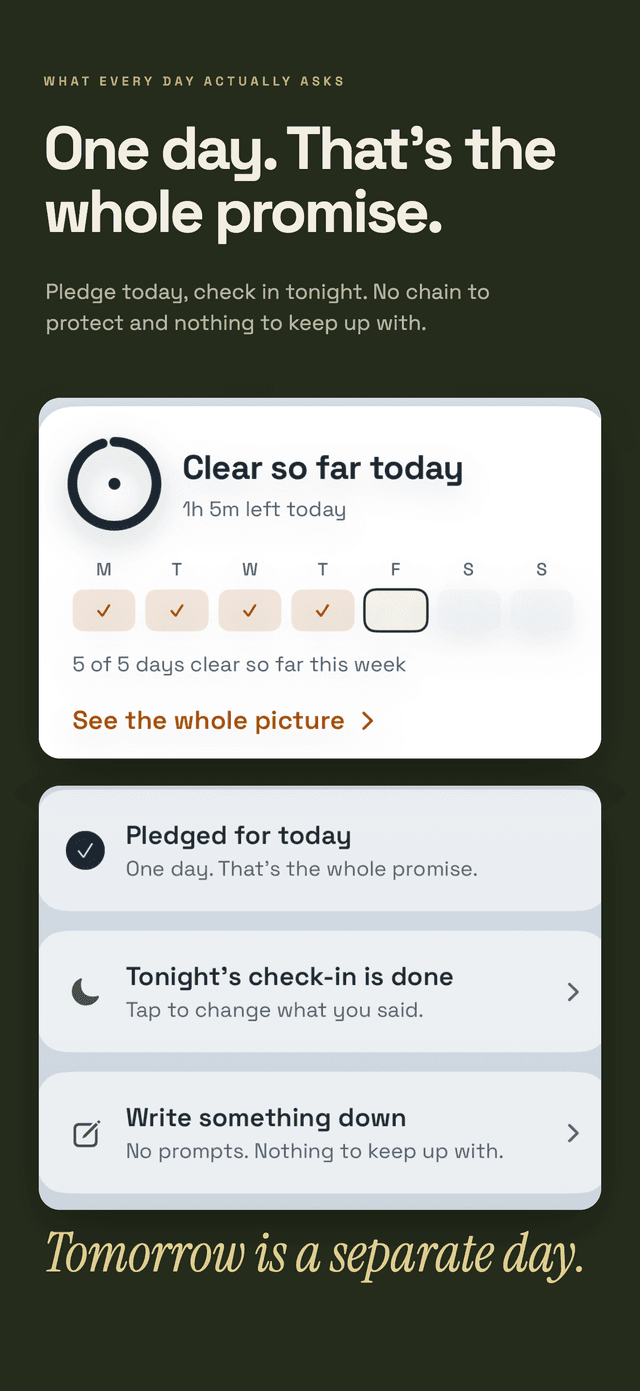
Hard Bit is an optional iPhone self-log. It works without an account, keeps entered history and forecasts on the device, and provides export and deletion controls. Logging, the counter, journal, personal sentence, hard-moment flow, export, and deletion are free. Hard Bit Plus adds the forecast, warning message, patterns, calendar, widgets, and short reads.
The forecast makes no prediction below five entries and relies fully on personal history at around twenty. Those are product rules, not clinical thresholds. The Hard Bit overview explains the workflow, and Hard Bit support documents current feature boundaries.
Stop tracking when the method becomes the problem
Pause, reduce, or stop the log if you notice:
- checking it repeatedly through the day,
- writing mainly to insult or punish yourself,
- deleting entries because they spoil the record,
- avoiding the log specifically after difficult events,
- increasing preoccupation or distress,
- no useful decision emerging from repeated reviews.
Possible adjustments include one weekly summary, fewer fields, no minute counts, or a complete pause. Tracking is optional.
Seek qualified support if use repeatedly feels difficult to control, continues despite significant harm, or is affecting sleep, work, relationships, finances, sexual wellbeing, or mental health. In England, eligible adults experiencing anxiety or depression can self-refer to NHS talking therapies; a GP can advise when you are unsure or need a different service. Elsewhere, contact an appropriate primary-care or registered mental health professional.
If pornography use or the tracking process is accompanied by thoughts of harming yourself or someone else, contact local crisis or emergency services now. If behaviour involves children, non-consensual material, or another person’s safety, step away from access and seek specialist professional help immediately.
A tracker cannot diagnose, assess risk, or provide treatment. Our editorial policy explains how health information and product descriptions are reviewed.
Frequently asked questions
Does tracking pornography make the problem worse?
There is no universal answer. Tracking may clarify a pattern, but it can also become tedious, punitive, or preoccupying. Keep the record brief and purpose-led. Simplify or stop if distress or compulsive checking increases.
Should I record every urge?
Only if urges are relevant to your chosen question and recording them remains manageable. Otherwise, log use and one brief daily check. Record urges separately from use so the log does not imply that every urge led to action.
Should pornography and masturbation be one entry?
Track the behaviour you intend to understand. If pornography is the target, distinguish pornography use from masturbation without pornography rather than assuming they are the same event.
Can the log tell me whether I have a disorder?
No. A log can describe frequency, context, perceived control, and consequences. It cannot apply diagnostic requirements, consider alternative explanations, or determine what care you need. A qualified clinician can assess the wider pattern.
What if neutral entries still make me feel ashamed?
Neutral wording does not erase moral conflict or distress. Keep the emotional response in its own field, shorten or pause the record if necessary, and consider discussing the conflict with a qualified professional who can explore it without assuming that pornography use alone establishes a disorder.