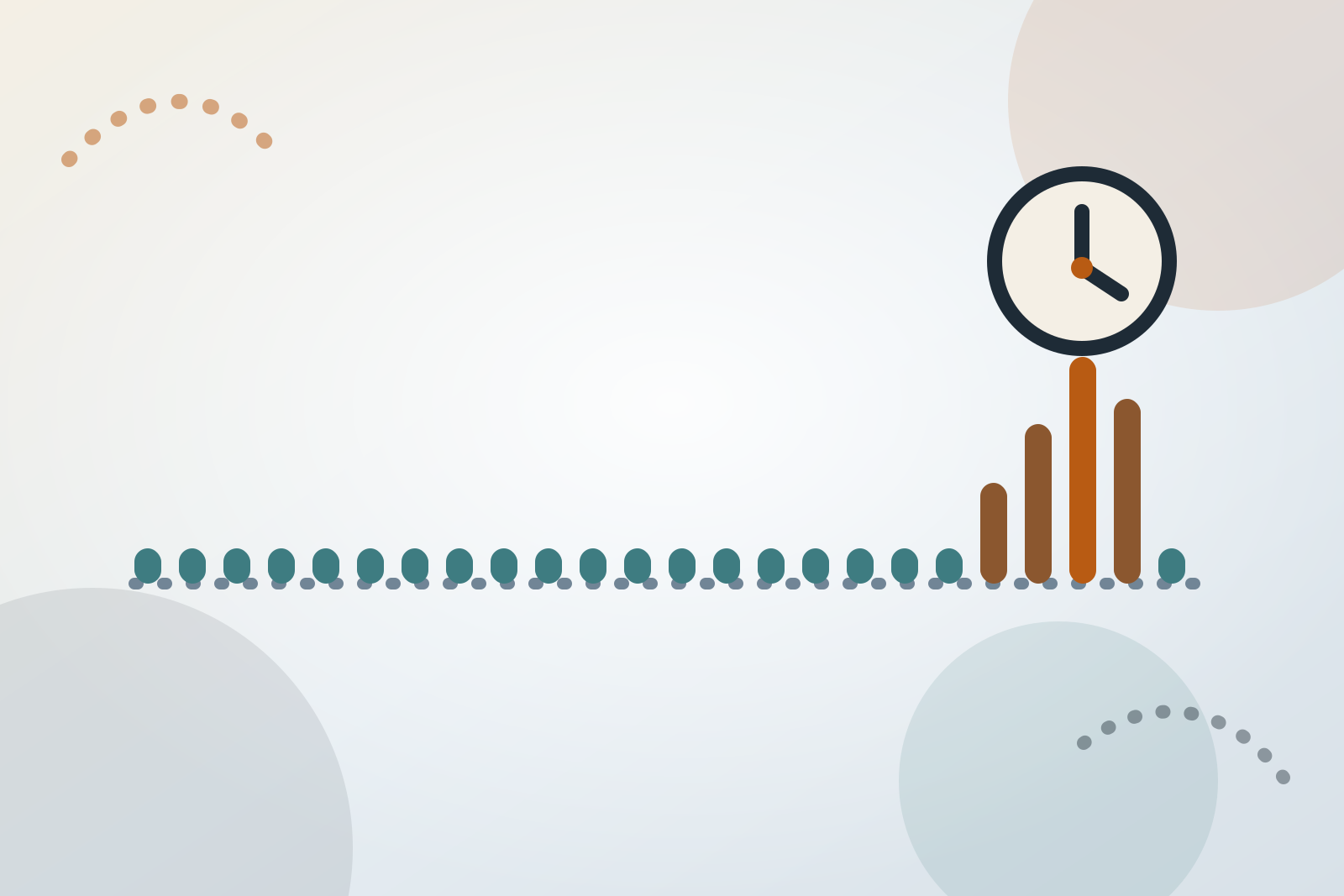
To track time of day smoking, record two times for each cigarette: the clock time and how long you had been awake. Keep workdays, days off, and different shifts separate. Then group the entries into two-hour windows and compare each window only across days when you were awake to observe it.
This can show where smoking clusters in your day. It cannot diagnose nicotine dependence or predict that you will smoke at a particular hour.
Start with a small, honest record
Use paper, a note, or a tracker that you can reach quickly. Record the cigarette when it happens or at the next safe opportunity. Do not type while driving or during another activity that needs your attention.
Five fields are enough:
- clock time,
- time since waking,
- place or activity,
- urge strength on one consistent scale,
- whether you smoked or the urge passed.
An entry might say:
7:05am; 15 minutes after waking; coffee in kitchen; urge 8/10; smoked.
Another might say:
3:40pm; 8 hours after waking; difficult call ended; urge 6/10; walked to another room.
Seven ordinary days can provide a first sample because they include different day types. It is not a clinical threshold. Extend the record if illness, travel, visitors, or an unusual shift changed the week.
If you are ready to quit, do not postpone quitting just to complete a baseline. Continue by logging urges and any cigarettes instead.
Record clock time and time since waking
A clock-only log can hide a consistent morning pattern. If you wake at 6am on workdays and 10am on a day off, the same “first cigarette 15 minutes after waking” pattern appears in different clock-time windows.
The National Cancer Institute notes that nicotine levels fall during six to eight hours of sleep and that many people smoke soon after waking. The NHS also lists waking up as a common routine trigger.
Record both measures:
- Clock time: 7:05am.
- Time since waking: 15 minutes.
The second measure is an editorial tracking method, not a clinical test. Its purpose is to let you ask two different questions: “Which clock hours contain the most cigarettes?” and “How soon after waking does smoking begin?”
For a wider review of people, places, feelings, and activities, use the guide to identifying craving triggers and difficult times.
Separate different kinds of day
The CDC describes quitting as dealing with nicotine withdrawal while also changing routines that used to include smoking. Those routines may differ substantially between a workday and a day off.
Create separate groups for:
- workdays,
- days off,
- each shift type,
- any other recurring schedule that changes your opportunities to smoke.
Label days by what actually happened rather than by weekday name. A Tuesday spent at home may resemble a Sunday more than a usual workday.
This prevents a work-break cluster from being diluted by days when that break never occurred.
Compare windows by observed days
Divide the waking day into equal windows. Two hours is usually broad enough for a small sample.
For each window, count:
- the cigarettes recorded, and
- the days when you were awake for most or all of that window.
A sample workday table might look like this:
| Window | Cigarettes | Days observed | Cigarettes per observed day |
|---|---|---|---|
| 6–8am | 9 | 5 | 1.8 |
| 8–10am | 3 | 5 | 0.6 |
| 10am–12pm | 7 | 5 | 1.4 |
| 12–2pm | 4 | 5 | 0.8 |
| 8–10pm | 6 | 5 | 1.2 |
| 10pm–12am | 2 | 2 | 1.0 |
The last row illustrates why the denominator matters. Two cigarettes may look unimportant, but that late window was observed on only two days.
Keep the interpretation modest. “Nine cigarettes across five observed mornings” describes the record. It does not mean that nine cigarettes will occur in the next five mornings.
If the counts are sparse, use fractions instead of decimals. “Smoking occurred in this window on three of five workdays” is often clearer than presenting a precise-looking rate.
Review the first cigarette separately
Sort the first cigarette of each day by time since waking.
A tight cluster may show that the first cigarette moves with your waking time. A scattered result tells you to inspect the accompanying activity, place, and cue rather than assuming the clock is the main factor.
The NCI suggests preparing a different morning routine, making cigarettes unavailable, placing an alternative where cigarettes were kept, and beginning with a planned activity. Choose a change that is safe and realistic for your morning.
Time to first cigarette can be useful information to share with a clinician or quit adviser, but this home log does not assess dependence.
Prepare for the two busiest windows
Choose no more than two windows with the clearest repeated pattern. For each one, write an if-then plan tied to the actual routine.
For example:
- “If the 10:30am break begins, I will refill my water bottle and use the main exit instead of going to the smoking area.”
- “When I make morning coffee, the gum will be beside the mug and the cigarettes will not be in the kitchen.”
Smokefree.gov lists waking, coffee, driving, meals, work breaks, television, and bedtime as common pattern triggers. It recommends changing the routine or transferring the activity to a replacement for the mouth, hands, or body. The NHS similarly suggests changing break times or commute routes and using gum or brushing teeth after meals.
To map the smaller movements between a cue and smoking, read how to separate a smoking cue from the next action.
Keep the same windows after quitting
After a quit date, record urges as well as any cigarettes. Keep the same windows so you can compare the shape of the day without pretending the two records measure exactly the same event.
The NHS says cravings can be especially strong at times when a person previously smoked and are often hardest during the first 28 days. The NCI says withdrawal symptoms are usually worst in the first week, often peak during the first three days, and generally ease during the first month. Some people experience symptoms for longer.
NHS inform reports that a cigarette craving usually lasts three to five minutes. That is not a guarantee for an individual urge. Use a short delay to create space, not as a countdown that every craving must follow.
If you smoke, keep the entry. The guide to responding after a slip explains how to retain the information and revise the plan.
Choose where the record lives
A smoking record is personal. With paper, consider who might find it. On a phone, check the passcode, shared accounts, cloud syncing, notification previews, and exported files.
A private way to track smoking on iPhone compares those privacy questions.
Hard Bit is one optional iPhone tracker. It keeps each habit’s counter, logs, reason, and difficult-hour pattern separate. Logging, the journal, counter, hard-moment flow, milestones, help links, export, and deletion are free. Hard Bit Plus adds the on-device forecast, advance warning, patterns, calendar, widgets, and short reads.
The forecast makes no prediction below five entries and relies fully on a person’s history at around twenty. Those are product rules, not clinical predictions. There is no account, advertising, social feed, third-party analytics, or server-side history. The Hard Bit overview and support page document the workflow and feature boundaries.
Pair tracking with quit support
A timing log is preparation, not treatment. A clinician, pharmacist, or trained quit adviser can discuss nicotine replacement therapy and other stop-smoking medicines based on your health and circumstances.
The NCI says combining a nicotine patch with a shorter-acting product such as gum or a lozenge can be helpful for withdrawal. It also lists varenicline and bupropion as prescription options. Availability and prescribing rules vary.
The CDC states that the medicines in its guidance are approved for adults quitting cigarettes. Anyone who is pregnant, breastfeeding, or under 18 should speak with a doctor before using them.
In England, local NHS Stop Smoking Services are free and delivered by trained advisers. Separate official services cover Wales, Scotland, and Northern Ireland. In the United States, 1-800-QUIT-NOW provides free quitline support, and the NCI offers counseling and referrals at 1-877-44U-QUIT.
Seek urgent medical help for severe breathing difficulty, a tight or heavy chest, thoughts of self-harm, or another emergency. Contact a clinician if low mood, anxiety, sleep problems, or other withdrawal symptoms are severe, persistent, or difficult to manage. Our editorial policy explains how health and product information is reviewed.
Frequently asked questions
How many days should I track?
Seven ordinary days can provide a useful first view, but they do not establish a permanent pattern. Continue longer if the entries are sparse or the week was unusual.
Do I need the exact minute?
No. Rounding to the nearest five or ten minutes is adequate for two-hour windows. Consistency matters more than minute-level precision.
What if smoking is spread evenly across the day?
Re-sort the same entries by time since waking, place, preceding activity, people present, or time since the previous cigarette. An even clock-time pattern can still contain a repeated routine.
Should I count cigarettes or cravings?
Record both when practical. Cigarettes show when smoking occurred. Urges also preserve difficult moments that did not end in smoking. Label them separately rather than combining them into one total.
Does this method work for shift work?
Yes. Anchor time-since-waking to each sleep period and keep each shift type in a separate group. Avoid averaging day and night shifts into one timetable.