
To track vaping money saved honestly, you need three numbers: what you actually spent per week, what you spend now, and the difference between them. Work out the first from your real purchases, turn it into a daily or weekly savings rate, and record that rate against your progress. Then put the saved money somewhere you can see it.
The method below works whether you have stopped completely or are cutting down, and it survives imperfect weeks. That last part matters more than most calculators admit.
Start with your real weekly spend, not a national average
Online calculators can show a dramatic figure in seconds, but a number built from someone else's habit is easy to dismiss on a hard day. Your own baseline is harder to argue with.
Gather evidence from the last month or two:
- bank or card statements, filtered for vape shops, tobacconists, and the corner shop you always use,
- online order confirmations for pods, coils, e-liquid, or devices,
- cash purchases you remember, estimated honestly,
- delivery or subscription charges tied to vaping supplies.
Add everything, then divide by the number of weeks the records cover. Include the things that are easy to forget: replacement coils, a new device after the old one broke, the disposable bought at a petrol station, the extra pods ordered because a flavour was on offer.
Reference points can help you sanity-check the result. A US university extension estimate from Auburn University put regular pod-style vaping at roughly $20 per week, about $1,008 per year, and refillable e-liquid use at roughly $30 per week, around $1,512 per year. Your figure may be lower or higher, and prices have moved since that estimate. What matters is that your number comes from your own spending.
Turn that number into a personal savings rate
Once you have a weekly baseline, convert it into units you can track:
- Daily rate: divide the weekly figure by seven.
- Monthly rate: multiply the weekly figure by 52 and divide by 12, so longer and shorter months stay consistent.
- Annual projection: multiply the weekly figure by 52.
Write all three down. The daily rate gives you something concrete for today. The monthly figure matches how most bills and budgets work. The annual projection shows what a year of the old habit was quietly costing.
Smokefree.gov's official savings calculator uses the same idea, projecting savings from a single day up to twenty years and assuming tobacco prices keep rising over time. You do not need to model price rises precisely. The point is that the money adds up whether or not you watch it, so watching it costs nothing and gives you a real number to work with.
If you track several habits, keep the vaping figure separate. A combined total hides which change is actually saving you money.
Count honestly whether you stop or cut down
The clean version of savings tracking assumes a full stop: baseline minus zero equals savings. Real life is often messier, and the method still works.
Use this rule: savings for any period equal your baseline minus what you actually spent.
- A fully vape-free week at a £25 baseline saves £25.
- A week where you bought one £6 disposable after two clear months still saves £19 against the baseline.
- A cut-down week at half your usual spend saves half your baseline.
This framing does two things. It lets people who are cutting down see genuine progress instead of a binary pass-or-fail. And it means a slip reduces one week's savings slightly rather than wiping the whole total back to zero, which is how a streak-based money counter can quietly discourage people after one difficult night.
For more on measuring change in ways that survive imperfect weeks, read How to Measure Vaping Progress Beyond a Perfect Streak.
One caution: keep the baseline fixed for at least a few months. Recalculating it downward every time you vape less flatters the savings figure and quietly erases the record. Recalculate only when your circumstances genuinely change, such as moving to a country with different prices.
Make the saved money visible
A number in a notes app is easy to ignore. Money you can see is harder to hand back.
Pick one mechanism:
- A separate savings pot or account. Set up a standing transfer of your weekly baseline, or move the money manually each week you stay under it.
- A named goal. Attach the pot to something specific: a flight, a course, a piece of equipment, a debt payment. A named target gives the weekly transfer a direction.
- A physical jar for cash spenders. If you used to buy disposables with cash, put the equivalent notes aside where you can watch them accumulate.
The NHS includes savings visibility in its official quit support for a reason: its Personal Quit Plan helps people see how much money they could save, and its quit app shows users their running savings total. Public quit services treat the money figure as a genuine motivational tool, not a gimmick.
Keep the reward healthy. A goal that involves the thing you are avoiding, or that requires spending the whole pot at once on a risky celebration, works against the point of the exercise.
Let the number motivate you without becoming pressure
A savings total can support you, or it can become another way to criticise yourself. The difference is in how you use it.
Helpful uses:
- checking the total when an urge appears, as one concrete reason among several,
- noticing milestones, such as the first month that paid for a phone bill,
- comparing this month's spend with the baseline during a calm weekly review.
Unhelpful uses:
- checking the figure several times a day,
- treating a dip as proof of failure rather than information,
- raising the baseline or the goal to make the challenge harder when things are going well.
If tracking starts to feel like a scoreboard you are losing, step back from the numbers for a week and track only whether each day was clear. How to Track Vaping Without Turning It Into Shame covers how to keep a record that informs you without punishing you.
Money is also only one measure. Sleep, morning cough, concentration, and the simple absence of a purchase errand are all real returns that never appear in the total.
Where Hard Bit fits in the process
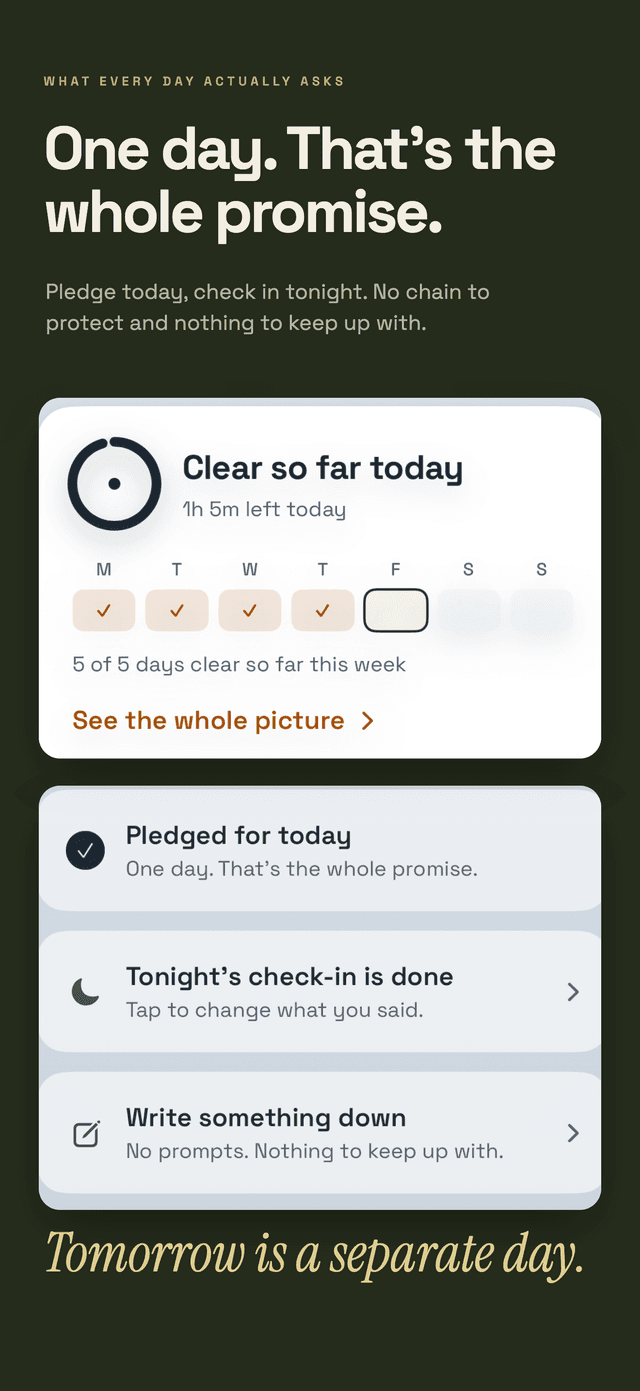
A spreadsheet or notebook can hold this entire system. If you want the record on your phone and private, Hard Bit is built around exactly this kind of honest logging.
You set vaping as a habit, choose stop or cut down, and each entry stays in the history whether the day was clear or not. The journal gives you a place to note what you spent and what you would have spent, and milestones mark the passing weeks. You can export the record at any time, and there is no account, feed, or server copy of your history. The Hard Bit app overview explains the workflow, and A Private Way to Track Vaping on iPhone walks through the vaping setup in detail.
The app is optional. The non-negotiable parts of the system are the honest baseline, the fixed savings rate, and a visible place for the money to go.
When the money question points to more support
For many people, the money exercise does its real work in the first calculation. Seeing that a £20-or-so weekly habit was costing over a thousand a year is often the moment a vague intention becomes a decision.
If the decision is there but the quitting itself is proving difficult, that is normal, and it is what cessation support exists for. Official services can explain options with real evidence behind them, including nicotine replacement and structured quit programs. In the UK, the NHS Better Health quit service is the natural starting point. In the US, Smokefree.gov covers nicotine quitting broadly, and Truth Initiative runs This is Quitting, a free text program designed specifically for people stopping vaping, alongside the BecomeAnEX quit plan developed with the Mayo Clinic.
A savings tracker records your progress. It cannot replace that support, and the two work well together: the services help you stop, and the record shows you what stopping is worth. Our editorial policy explains how this site separates general information from product features and health guidance.
You can find more practical, source-reviewed guides in the Hard Bit guide library.
Frequently asked questions
How much money does vaping cost per year?
It depends entirely on what you use and how often. One dated US estimate put regular pod-style vaping at roughly $1,000 a year and refillable e-liquid use at roughly $1,500 a year. Disposable-heavy habits in the UK can run to a similar order of magnitude. Calculate your own weekly spend from recent purchases and multiply by 52 for a figure you can trust.
Should I reset my savings total after a slip?
No. A slip means you spent something that week, so that week's savings are smaller. It does not retroactively spend the money you already kept. Keep the running total, note the purchase honestly, and let the record show both.
Can I track savings if I am cutting down rather than stopping?
Yes, and you should. Savings equal your fixed baseline minus what you actually spend. Cutting a £24 weekly habit to £8 saves £16 a week, which is real progress you will never see if the only number you watch is a full-quit counter.
Is tracking money enough to help me quit vaping?
For some people the financial motive is a strong push, but it works best as one part of a wider plan. Evidence-based support, such as official quit services and programs like the NHS quit offer or This is Quitting, improves the chances of stopping for good. Use the savings figure as motivation alongside that support, not instead of it.