
To track vaping without shame, write down what happened without adding a verdict about what it means about you. Record the time, place, immediate cue, one consistently defined vaping unit, and what happened next. Keep feelings in their own field and mark unrecorded days as not observed.
The aim is an honest record you will still be willing to open next week.
Give the log one narrow purpose
A vaping log can show when, where, and after what vaping tends to happen. It cannot tell you whether you are disciplined, weak, or trying hard enough.
Write one purpose at the top:
This record exists so I can find two repeated situations and prepare for them.
If the log starts feeling like a test, remove fields rather than forcing more detail. Three fields you use consistently are better than eight you avoid.
Define one vaping unit before counting
A vape does not have a fixed endpoint like a cigarette. Decide what one entry means:
- a session from picking the device up to putting it down,
- each reach for the device,
- a device-reported puff count,
- pods or millilitres used per week.
Use the same definition across comparison periods. Do not convert puffs into cigarette equivalents because there is no agreed conversion.
The guide to tracking the hours you are most likely to vape explains how to define sessions and compare time windows.
Use neutral fields
A useful entry needs only:
- Time and day
- Place or activity
- What happened immediately before
- Your defined use unit
- What happened next
- Optional feeling and personal rating
For example:
Tuesday, 11:10pm; bedroom; work message while scrolling; one session; device moved to kitchen; restless 6/10.
The rating helps compare your own entries. It is not a clinical measure of nicotine dependence.
Log at the moment or at the next safe opportunity. Do not type while driving or during anything requiring your full attention.
Record close to the day
Vaping can be difficult to reconstruct because events may be brief, frequent, and spread throughout the day.
One study included 401 college-student e-cigarette users who completed a retrospective web survey and seven days of ecological momentary assessment. Their end-of-day reports averaged 18.33 use events per day, while the earlier retrospective estimate averaged 1.55. An adjusted model estimated that the assessment-period count was 8.5 times the retrospective count.
Those figures are not a target or prediction. Participants were undergraduates who vaped at least weekly and were not planning to quit in the next 30 days. The study also did not establish why the measures differed.
The limited practical lesson is to record during the day or at one fixed end-of-day check-in. Do not rebuild an entire week from memory and then treat the estimate as exact.
Keep feelings, but remove verdicts
Replace character judgments with observations:
- “Failed again” becomes “Vaped after the late work message.”
- “No willpower” becomes “Device was beside the bed.”
- “Ruined the week” becomes “Vaped on four of five observed days.”
- “Disgusting habit” becomes “One session; restless 7/10.”
Neutral wording does not hide an increase. It keeps the number and context visible without adding an insult.
Research on smoking stigma offers indirect support for caution. A longitudinal study in Mexico and Uruguay found mixed associations: perceived stigma was linked with more quit attempts in Uruguay but lower successful quitting in Mexico. It did not study vaping, private logs, or internalized shame, and it cannot establish cause. It does show that feeling judged should not be assumed to be a reliable quitting tool.
Mark missing days as missing
Use three labels:
- observed and vape-free,
- observed with vaping,
- not observed.
If two days are missing, report “vaping on four of five observed days,” not “four of seven days.” Label the week incomplete rather than filling gaps with guesses.
Keep an unplanned session visible too. Measuring vaping progress beyond a perfect streak covers measures that survive an imperfect week. The guide to responding after a slip covers the next steps.
Notice what tracking does to you
Self-monitoring can affect more than the record.
In a randomized study of 117 daily smokers, 88 participants recorded negative thoughts about smoking up to five times daily during two one-week periods. Compared with 29 controls, they reported less posttest worry about smoking-related medical conditions and harming others. Perceived risk did not differ.
The study concerned smoking, not vaping. It monitored negative thoughts rather than vaping events and did not establish a behavioral effect. Treat it as evidence that repeated questions can influence feelings, not as a prediction about your log.
Simplify or pause tracking if you begin hiding entries, checking compulsively, or using the record to attack yourself. Consider discussing another approach with a clinician or quit adviser if distress persists.
Review situations once a week
Compare equal periods and ask:
- Which situation repeated most?
- What differed on days with fewer sessions?
- Where was the earliest realistic point to change the sequence?
- What is one change to test next week?
- Do I need more support?
Write one factual summary:
Five of seven days observed; vaping on four; most sessions between 10pm and midnight at home; longest gap four hours.
Note travel, illness, shift changes, device changes, and nicotine-strength changes beside the numbers. One comparison shows a difference, not a settled trend.
Keep the record private enough to be honest
Check notification previews, shared devices, backups, exported files, and who knows your passcode. The guide to private ways to track vaping on iPhone explains those boundaries.
Privacy does not mean avoiding people who can help. It means the log does not need to perform for an unintended audience.
Pair tracking with qualified quit support
A log cannot assess nicotine dependence or select treatment.
The NHS lists strong cravings, irritability or low mood, trouble concentrating, increased hunger, and difficulty sleeping as possible nicotine-withdrawal experiences. Its gradual options include lowering nicotine strength, increasing the gap between sessions, and creating vape-free spaces. It advises people who used vaping to stop smoking to quit vaping only when confident they can do so without returning to cigarettes.
The current UK NHS page identifies Nicorette QuickMist as the only approved nicotine-replacement product for quitting vaping. Ask a pharmacist or stop-smoking adviser what is suitable for you.
In the US, Smokefree.gov says the FDA has not approved nicotine-replacement therapy, varenicline, or bupropion specifically for quitting vaping. It recommends discussing medication with a healthcare professional and offers trained support through 1-800-QUIT-NOW.
If you are pregnant, seek individualized professional advice before choosing a cessation product. If you are under 18, involve a trusted adult, clinician, or youth quit service. Seek urgent local help for severe distress or thoughts of self-harm.
Where Hard Bit fits
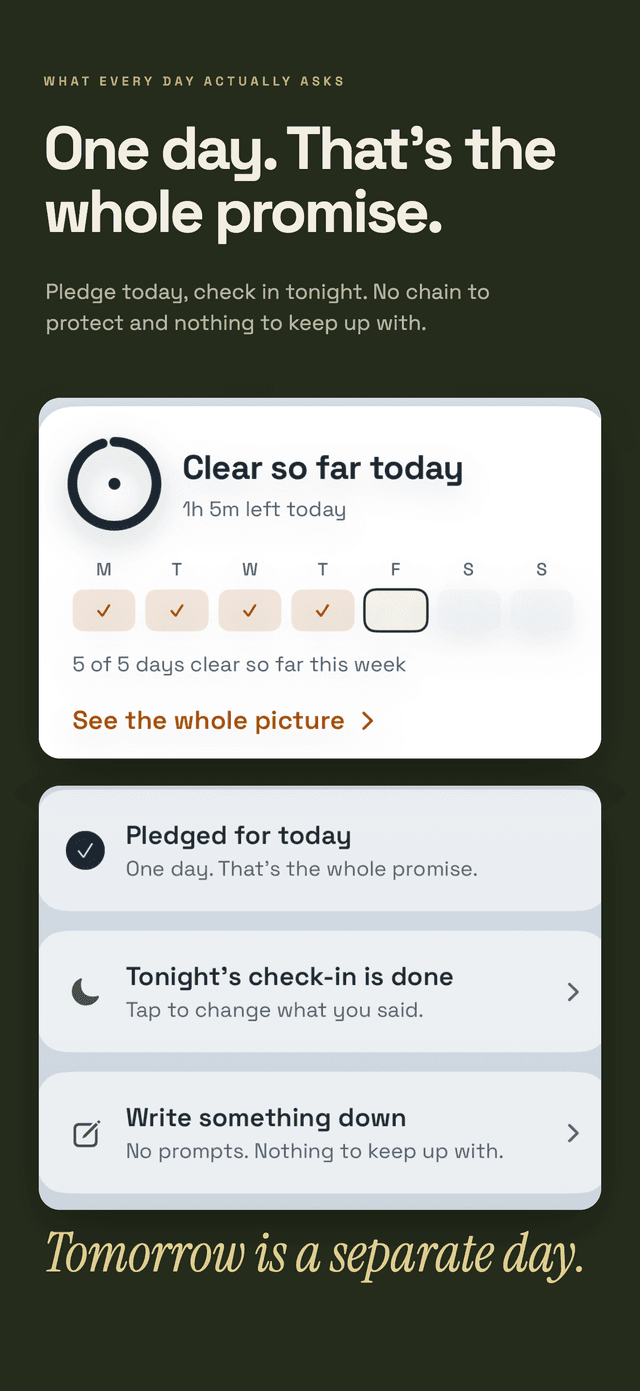
Hard Bit is an optional iPhone craving tracker rated 18+. It is not medical advice or treatment.
It keeps each habit in a separate on-device record. Logging a use changes the counter wording instead of deleting the surrounding history. The counter, hard-moment flow, personal sentence, logging, journal, milestones, help links, export, and deletion are free. A subscription adds the forecast and advance warning, patterns and calendar, widgets, and short reads.
The forecast makes no prediction below five entries and relies fully on your history at around twenty. These are product rules, not clinical thresholds. The published privacy policy says there is no account, advertising, social feed, third-party analytics, or server copy of your entries.
The Hard Bit overview explains the workflow, and the support page documents current feature boundaries. Our editorial policy explains how health and product claims are reviewed.
Frequently asked questions
Does tracking vaping help you quit?
A log may reveal repeated times, cues, and situations. The studies discussed here do not establish that this logging method helps people quit. Use tracking as one planning tool alongside suitable support.
Should I count puffs or sessions?
Choose the unit you can record consistently. Sessions usually require less effort. Device-reported puffs can be an additional column, but do not convert them into cigarette equivalents.
Should I delete an entry that embarrasses me?
You can replace insulting wording with a factual description while keeping the event. If you want the data removed entirely, delete it deliberately rather than during a difficult moment.
What if I stopped recording for a week?
Mark the week as not observed and begin again today. Use the next complete period for comparison rather than estimating the missing days from memory.
Is neutral wording avoiding the truth?
No. Neutral wording should preserve uncomfortable facts, including rising frequency, shorter gaps, returning cigarette use, or repeated difficulty stopping. Those patterns are reasons to contact a clinician, pharmacist, or quit service, not reasons to insult yourself.
More source-reviewed planning articles are available in the Hard Bit guide library.