If you searched for porn trigger accidental content after an explicit image, clip, advert or message appeared unexpectedly, start with the next physical action. Leave the item instead of continuing to watch, put the device down, and move into a short task away from the screen. Once the immediate pull is quieter, change or report the route that delivered it.
The appearance was not a choice. Continuing to watch would be a separate decision that has not already been made.
Take the first few minutes off the screen
An unexpected cue and the next decision often occupy the same screen. Create distance before trying to reason with the urge.
Use this sequence:
- Close the tab, clip or app. If a report control is already visible, you can use it without opening the content further.
- Put the device somewhere that requires you to stand up or change position before reaching it again.
- Begin one ordinary activity with a clear end, such as filling a glass, washing a plate, changing clothes or stepping outside.
If you cannot leave your seat, close the content, place the phone face down and focus on one visible task. The aim is not perfect calm. It is to stop the same screen from supplying both the cue and the response.
Smokefree.gov recommends changing routines, moving and using replacement activities for smoking-related pattern triggers. That source is about cigarettes, not pornography, but the limited practical principle transfers: changing the immediate setup can be more useful than remaining beside a cue to test your willpower.
For a broader in-the-moment sequence, see how to handle a craving.
Separate the exposure from the next choice
A common thought after an unwanted exposure is, “I have already seen it, so the day is ruined.” That sentence combines an accidental event with a decision that has not happened.
Use a factual replacement:
Something appeared. I left it. I am deciding what to do with the next few minutes.
This does not deny that the content affected you. It keeps the event from becoming permission to continue.
Avoid assigning yourself a permanent trait. “The clip appeared after autoplay” identifies a route you can change. “I am weak” does not.
Reduce the chance of another exposure
Once you feel able to use the device deliberately, inspect the delivery route rather than the sexual content.
Depending on the service, useful controls may include:
- blocking or muting the account, channel, group or keyword,
- choosing “not interested,” “hide” or the closest equivalent,
- reporting content that violates the service’s rules,
- turning off autoplay or video previews where that option exists,
- leaving or muting a group that repeatedly shares unwanted material,
- reviewing privacy and contact settings,
- closing saved tabs or sessions that make the route easy to reopen.
These controls cannot promise that nothing similar will appear. They can remove a known source and make your preference clear to that service.
If several phone routes lead to the same problem, use the phone-based porn-trigger audit to map them separately.
Switch to reporting when the content may be abusive or illegal
Some material is not primarily a habit-management issue.
If content appears to show the sexual abuse or exploitation of a child, do not search for it again, download it, save it, forward it or create another copy. Use the platform’s reporting control and the appropriate child-protection reporting service or police route for your country. If someone appears to be in immediate danger, contact emergency services.
Australia’s eSafety Commissioner lists webpage addresses, account profiles, usernames and information about where suspected illegal material is located as useful reporting details. Its guidance also says to stop searching for illegal or restricted content. Follow the instructions of the reporting service in your own jurisdiction.
If an intimate image or video was shared without the person’s consent, report it to the service. Australia’s eSafety scheme also accepts defined image-based-abuse reports directly. Other countries have their own reporting bodies and legal thresholds.
If someone is threatening to share intimate content or demanding money, stop contact, do not pay, and report what is happening. If you are under 18, tell a safe adult or contact an official child-safety service. If the first adult is involved or does not feel safe, contact another safeguarding professional, healthcare professional or the police.
Do not reopen disturbing material merely to decide whether it was “bad enough.” Give the available location and account details to the service responsible for assessing it.
Record exposure separately from chosen viewing
A short note can preserve the useful information without calling an accidental appearance a use.
Record:
- the approximate time,
- the app, site, message or other route,
- how strong the pull felt,
- what you did next.
For example:
Tuesday, about 10:40pm; autoplay after a programme; pull 7/10; closed the app, put the phone in the kitchen and made tea.
If you deliberately continued watching, record that part honestly as a separate action. The distinction is not a loophole. It keeps the record from implying that an unwanted thumbnail and an intentional session were identical events.
Repeated entries may reveal one app, group, situation or hour that needs preparation. Tracking pornography without turning it into shame offers a fuller neutral template.
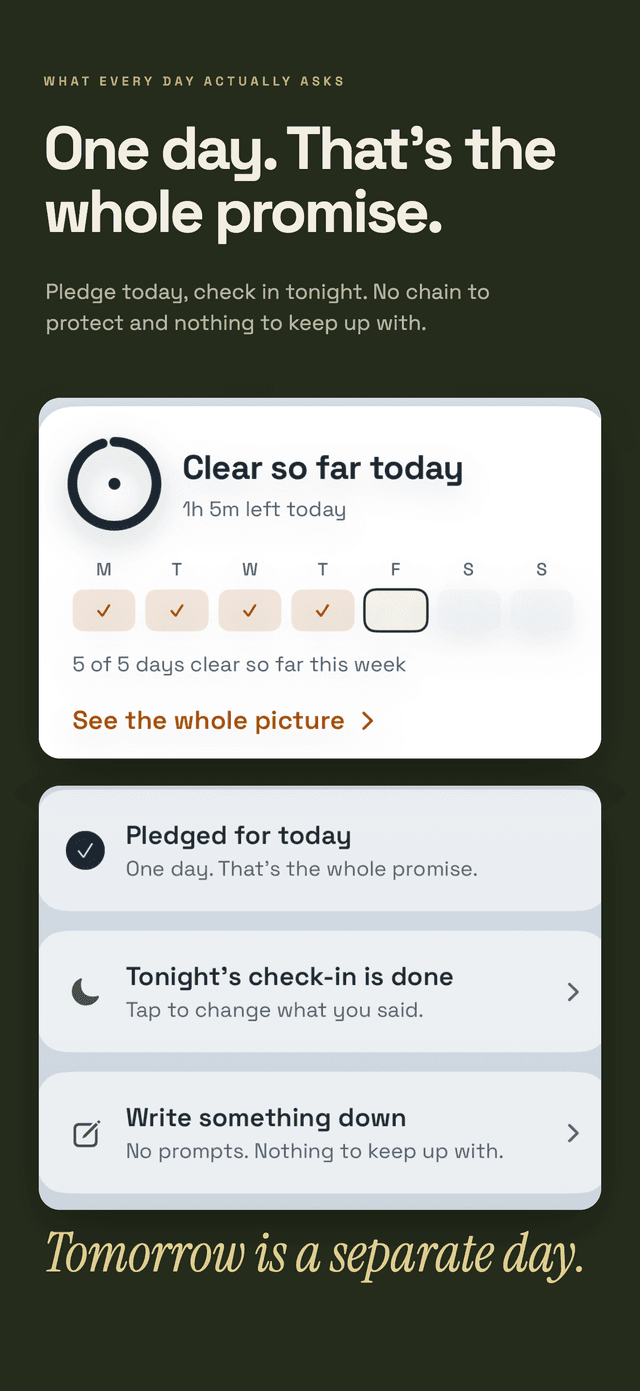
Hard Bit is one optional iPhone log. Its free tools include logging and the hard-moment flow, so you can record a difficult moment without adding a use. The paid Hard Bit Plus tier adds the on-device difficult-hour forecast. It makes no prediction below five entries and relies fully on personal history only at around twenty. The service works without an account, and entered history is not uploaded unless you choose to export a file. The Hard Bit overview documents the current boundaries.
Paper or a private note can keep the same distinction.
If the urge remains, change how you respond to it
Closing the content does not always quiet the urge immediately.
The U.S. Department of Veterans Affairs describes urge surfing as noticing where a craving is felt in the body and observing how those sensations change. Its stated purpose is not to force the craving to disappear. It is to experience the craving in a different way.
Try a short version:
- Put both feet on the floor.
- Notice one area where you feel tension, warmth, restlessness or another sensation.
- Describe the sensation without arguing with it.
- Notice whether its location or intensity changes.
- Choose the next safe action rather than making a promise about the entire future.
If inward attention makes you more agitated, use an outward anchor instead. Walk, call someone, sit in a shared space or complete a task with a clear ending. There is no fixed duration that every urge must follow.
Prepare one response for next time
Write a four-line plan while you are calm:
- Cue: Sexual content appears without me looking for it.
- First move: Close it, stand up and put the device down.
- Source move: Block, mute, hide or report the route.
- Record: Note the time, route, pull and next action.
If one hour repeatedly appears beneath these exposures, track the hours porn use feels most automatic. Early entries suggest a question, not a prediction.
Know when to involve another person
Consider speaking with a doctor or qualified mental health professional if distress continues, the image repeatedly returns to mind, sleep is affected, use feels difficult to control, or the pattern is harming work, money, relationships or sexual wellbeing.
A 2018 World Psychiatry article describing the proposed ICD-11 criteria for compulsive sexual behaviour disorder stressed that moral disapproval alone was not enough for that diagnosis. It also warned that people who call themselves “porn addicts” may not show the disorder’s clinical characteristics. A qualified clinician can assess the wider pattern; a label applied after one exposure cannot.
If you may harm yourself or someone else, contact local crisis or emergency services now. If urges involve children, non-consensual material or another person’s safety, step away from access and seek specialist help rather than relying on a tracker.
Our editorial policy explains how health information and product facts are reviewed. More practical articles are available in the Hard Bit guide library.
Frequently asked questions
Does accidentally seeing sexual content count as a relapse?
There is no universal definition. If the content appeared without your choice and you left it, recording an accidental exposure separately from chosen viewing usually preserves a clearer personal record. If you intentionally continued, record that decision as well.
What if similar content appears again after I block it?
One control may cover only one account, post or route. Check related follows, groups, autoplay, previews, contact permissions and saved tabs. Use the controls the service provides, but do not read their use as a promise that every similar item will disappear.
Should I delete the exposure from my log?
Keep it if the entry helps identify a route or repeated hour and does not make tracking punitive. Use a short factual note without graphic details, search terms, images or saved links. Pause tracking if it increases distress or repeated checking.
What if the image is still bothering me days later?
Do not keep reopening it to test your reaction. If distress persists, sleep is disrupted or the image keeps returning to mind, speak with a doctor or qualified mental health professional about suitable support.