
To learn how to write a birthday message that sounds like you, start with language you already use. Open with your normal greeting, add one true detail, say what you mean in plain words, make a fitting wish, and read the result aloud.
You do not need a special birthday-writing voice. In fact, inventing one is often what makes a sincere message sound stiff. The goal is to preserve the recognizable way you already communicate with this person.
Use this five-step voice method
Write the first draft with five small decisions:
- Greet them normally. Use the name, nickname, or opening you would use in conversation.
- Add one true detail. Mention a recent achievement, shared moment, habit, or action you appreciated.
- Say what you mean. Explain why the detail matters, if the relationship supports it.
- Make a fitting wish. Wish for something they might genuinely enjoy rather than the largest possible outcome.
- Read it aloud. Replace anything you would not naturally say.
For example:
Happy birthday, Maya. I am still impressed that you finished the 10K after training through all that rain. Dinner is on me this weekend.
The message is personal because the detail and wording belong to a real relationship, not because it is elaborate.
If you need help arranging the sentences, use the separate four-part birthday message formula. This guide focuses on making that structure sound like it came from you.
What “sounds like you” actually means
Your voice is the recognizable pattern in how you communicate. It includes:
- The greetings and nicknames you use.
- Whether you write fragments or complete sentences.
- How directly you express affection.
- Your usual humor and references.
- Your punctuation, capitalization, and emoji habits.
- The length of message you normally send.
Grammarly describes writing voice as the words, phrases, sentence patterns, and other style choices that make writing identifiable as yours. Tone is related but different: it is how a particular message comes across in a particular situation.
Your voice may stay dry and concise, for example, while your tone becomes warmer for a close friend or more restrained for a coworker. You do not have to choose between sounding like yourself and respecting the relationship.
Find your baseline in real messages
If you are unsure what your voice sounds like, do not try to describe it from memory. Open a recent conversation with the recipient and look for patterns.
Ask:
- How do I usually address them?
- Do I tease them, thank them, or get straight to the point?
- Do I use one sentence or several?
- Which words and punctuation appear repeatedly?
- How do I normally end a conversation?
Use those answers as your baseline. If you usually write “Hey, happy birthday!” a formal “Wishing you abundant joy on this special occasion” will probably feel borrowed. If you normally write in complete, thoughtful paragraphs, forcing the message into a breezy one-liner may feel equally false.
Hallmark gives similar advice in its card-writing guidance: write as you talk, including habitual wording, so the recipient can hear your voice in the message.
Keep your voice while adjusting the tone
A birthday still has a setting. You may need to adjust warmth, formality, or humor without changing who appears to be speaking.
| Your usual pattern | Keep it recognizable by |
|---|---|
| Short and understated | Using one or two direct sentences rather than adding ceremonial language |
| Warm and expressive | Naming the feeling plainly instead of reaching for a quotation |
| Playful | Using an established shared joke rather than a stock joke about age |
| Formal or reserved | Choosing measured appreciation without forcing intimacy |
| Emoji-heavy | Using the emoji you normally use rather than decorating every sentence |
Do not use “being authentic” as an excuse to ignore the recipient. A joke can sound exactly like you and still be wrong for a private person, a difficult year, or a public group card.
For examples focused on situational tone, see the birthday text examples by tone.
Replace stock phrases with plain language
Merriam-Webster defines a cliché as a trite phrase or expression, a hackneyed theme, or something overly familiar or commonplace. A familiar birthday phrase is not automatically bad, but it does little to reveal who wrote it.
Try translating a stock line into language you might actually use:
| Stock phrase | Plainer alternative |
|---|---|
| “Wishing you a magical day filled with joy.” | “Hope today is a genuinely good one.” |
| “Another year wiser and more fabulous than ever.” | “Glad you exist. Have a good one.” |
| “May all your dreams come true.” | “Hope this year gives you more time for the things you enjoy.” |
| “You light up every room.” | “You made that terrible meeting bearable last week.” |
The alternatives are not universal replacements. Their purpose is to show the editing move: lower the ceremony, use ordinary words, and add evidence when you have it.
A simple “Happy birthday, hope you have a good day” is also valid. A short honest greeting is better than a supposedly personal message built from invented intimacy.
Add one detail without overdoing it
One recognizable detail is usually enough to make the message belong to the recipient:
- Something they recently completed.
- A small action you appreciated.
- A harmless habit or running joke.
- A shared plan that is genuinely arranged.
- Something they are currently enjoying.
Keep the detail proportionate to the channel. A private card can hold a reflective memory. A work group chat usually needs something lighter and safe for others to read.
Avoid details about health, money, fertility, relationships, weight, grief, or private conflict unless the recipient has clearly welcomed that subject and the channel is appropriate.
If your message depends on a shared event, the guide to turning a shared memory into a birthday message explains how to keep the story brief.
Run a one-minute voice check
Read the finished message aloud. Grammarly recommends this technique for emails and texts because wording that looks acceptable on screen can sound stilted when spoken.
Then ask:
- Would I say this to them in person?
- Does it sound as warm or restrained as our real relationship?
- Could someone else have written every sentence?
- Did I add anything merely because birthday messages are “supposed” to contain it?
- Is the detail safe in this channel?
Change only the lines that fail. Do not polish the message until every trace of your natural rhythm disappears.
See the same occasion in two honest voices
These examples use the same fact: a close friend recently completed her first 10K.
An understated writer:
Happy birthday. Still impressed about the 10K. Dinner is on me this weekend.
An expressive writer:
Happy birthday!! I am still thinking about you crossing that finish line after training through months of rain. You worked so hard and somehow never made a big deal of it. I hope you are properly celebrated today.
The second message is not more sincere because it is longer. Each works because its rhythm, warmth, and punctuation match the person supposedly writing it.
Do not copy either version unchanged. Notice which choices resemble your real messages, then write with your own facts.
Common ways a message stops sounding like you
- Copying a quote because it sounds more polished than your own words.
- Becoming unusually formal as soon as you open a card.
- Adding emoji or exclamation points you rarely use.
- Forcing a joke when the occasion calls for gentleness.
- Writing a long paragraph only because the person is important.
- Reusing one finished message for several people.
- Making a promise, such as “we must meet soon,” without intending to arrange it.
- Treating age, appearance, marriage, or parenthood as safe joke material.
The problem is not sentiment. It is a mismatch between the words, the writer, the recipient, and the setting.
Keep a cue, not a finished script
You do not need to compose the message months early. Save a short cue such as:
- “Mention the 10K.”
- “Thank him for the airport lift.”
- “Ask about the new apartment.”
- “Use the camping story.”
Apple confirms that Reminders on iPhone can hold notes, dates, and other details. Some features depend on using updated Reminders in iCloud.
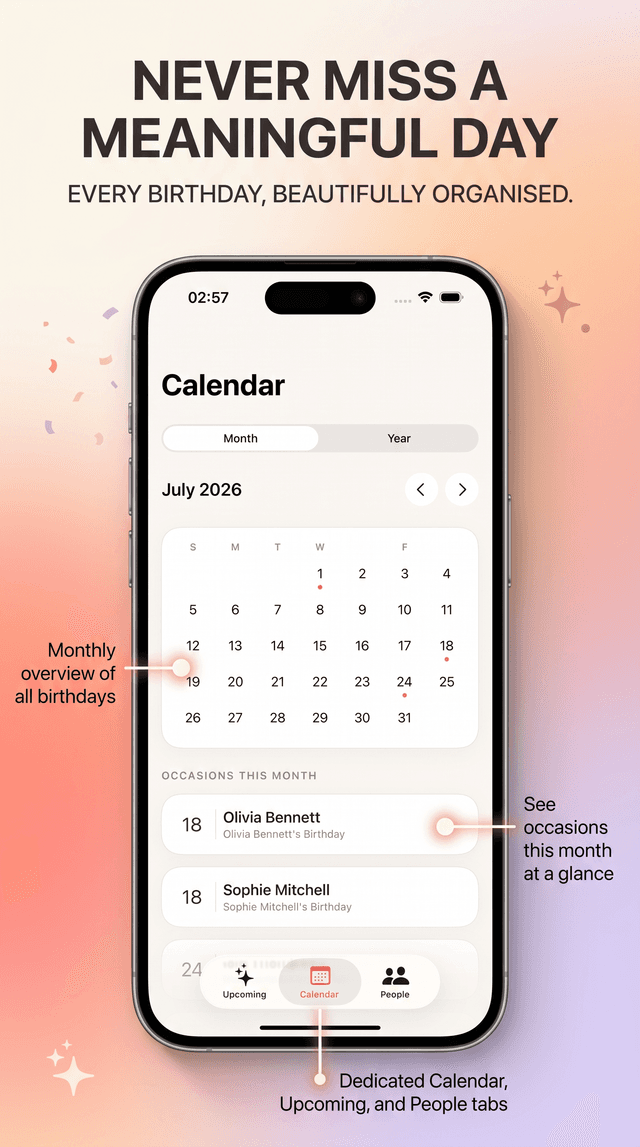
The current Birthday Reminder App Store listing confirms support for personal notes and gift ideas, countdowns, customizable reminder lead days and times, a Home Screen widget, and use without an account. A short, non-sensitive cue can therefore stay beside the birthday until you need it.
The guide to planning birthday messages without making them generic covers that advance-planning workflow. Use the birthday reminder timing guide if a card must be written and posted before the date.
Frequently asked questions
What if my normal style feels too casual for a birthday card?
A card gives you more room, but it does not require a different personality. Keep your normal greeting and vocabulary, then add one extra sentence if you have something meaningful to say.
Is it okay to use a quote?
Yes, if the quote matters to you and you explain why you chose it. A quote should support your own words rather than replace them.
How do I write to someone I do not know well?
Keep it brief and proportionate: “Happy birthday, Sam. Hope you have a good day.” Use a shared work, school, or community detail only if it is true and appropriate.
Can emoji still sound authentic?
Yes, when they already appear in your conversations. Use them as you normally would rather than adding them to manufacture enthusiasm.
What if I do not know what my voice sounds like?
Read several recent messages you sent to the recipient. Your repeated greetings, sentence lengths, jokes, punctuation, and sign-offs provide better evidence than trying to invent a style description.
How long should the message be?
Match the relationship and your usual habits. One or two sentences can be enough. If length is the main problem, use the guide to how long a birthday message should be.
A birthday message does not need polished language to feel sincere. It needs words you would genuinely use and, when possible, one detail that could belong only to this person.
Visit the Birthday Reminder app page to see how notes, countdowns, and reminders can keep a writing cue ready, or browse the other Birthday Reminder guides. Our editorial policy explains how product and factual claims are reviewed.