The best way to keep a birthday list updated is to correct the existing record when reliable new information arrives. Do not depend on remembering the change until a future cleanup.
Use one source of truth, follow the same short edit sequence every time, and keep one temporary queue for changes you cannot make immediately. Monthly and quarterly checks then become small safety nets instead of rescue projects.
This article covers maintenance after you already have a usable list. If you are starting from scratch, begin with how to build a birthday list that stays accurate.
Choose one record as the source of truth
A birthday may appear in Contacts, Calendar, a widget, and a dedicated app. That does not necessarily mean you have four synchronized copies.
Choose one record that answers this question:
If a date changes, where will I correct it first?
Your rule might be:
- Correct birthdays in Contacts first, then check any app record imported from Contacts.
- Maintain Birthday Reminder as the master list and use its widgets and alerts as displays.
- Maintain a family spreadsheet as the master, then copy confirmed changes into reminder tools.
Write the rule somewhere visible. “Contacts first” is enough. The point is to prevent one date from being corrected while an older copy remains active elsewhere.
If you have not chosen a master yet, the birthday-list spreadsheet versus reminder-app comparison explains the trade-offs.
Define the events that trigger an update
Do not treat maintenance as a vague intention. Use recognizable triggers.
| Trigger | Update to make |
|---|---|
| Someone confirms or corrects their birthday | Replace the date in the existing record |
| You learn a birthday for someone already on the list | Add the confirmed month and day to that record |
| A person changes their name | Edit the same record rather than creating another |
| Someone moves | Update a useful location or time-zone note |
| A contact or app import finishes | Check for an existing record before keeping the imported copy |
| A relationship or celebration preference changes | Revise or remove the old planning note |
| You no longer want an active reminder | Disable or archive it using the smallest appropriate change |
Only record information that helps you identify the person or act thoughtfully. A birthday list does not need a detailed personal profile.
When a date is uncertain, label it “needs confirmation” rather than silently choosing one. The guide to confirming birthday dates without making it awkward offers simple ways to ask.
Use a 60-second update sequence
Apply the same five steps whenever a change arrives:
- Search. Look for the person by first name, surname, nickname, and any former surname.
- Verify. Make sure you have the correct person and reliable information.
- Edit. Change the existing record instead of adding a replacement.
- Save. Reopen the record and confirm that the new value remained.
- Check copies. Update any separate app, calendar, or spreadsheet record that does not synchronize automatically.
A short confirmation note can help when dates have previously conflicted. “Confirmed with Noor, October 2026” is usually sufficient. Avoid saving screenshots, private conversations, or unnecessary personal details.
On iPhone, Apple says you can open a contact, tap Edit, update details including the birthday, and tap Done. For a detailed correction workflow, see how to correct a wrong birthday date on iPhone.
Keep one temporary update queue
Immediate editing is ideal, but it is not always practical. You may learn a date while driving, working, or talking to someone.
Use one temporary queue for those moments. It can be a single note or task called “Birthday updates.” Add only enough information to complete the edit safely, such as:
- “Check Priya’s birthday: she said 18 November.”
- “Update Leo’s surname.”
- “Add Mina after confirming the day.”
- “Check whether Sam already exists after contact import.”
Clear the queue at one dependable time, ideally later that day. Search for the person before editing, make the change in the master record, verify it, and delete the temporary note.
Do not scatter pending changes among email drafts, message threads, paper scraps, and several task lists. A temporary queue works because it has one location and a short lifespan.
Edit existing records instead of creating replacements
Creating a second record is not an update. It gives you two places that can disagree.
Before adding anyone:
- Search common spelling variations.
- Check nicknames and former surnames.
- Compare a phone number or email when names are ambiguous.
- Look in each relevant Contacts account.
- Check the birthday app before importing the person again.
Apple says iPhone Contacts may show View Duplicates for cards with the same first and last name. You can review and merge genuine matches. If automatic detection misses two cards for the same person, Apple also provides Link Contacts.
Linking needs careful wording: linked cards appear as one unified contact, but Apple says their underlying source-account records are not merged. Verify the birthday after linking rather than assuming every conflict has disappeared.
Use the focused guide to finding duplicate birthday entries on iPhone when the same person appears twice.
Reconcile imported and copied records
An import may create a separate stored record rather than a live connection to its source. Do not assume that correcting Contacts will update every app previously populated from Contacts unless the product explicitly documents ongoing synchronization.
After changing an imported birthday:
- Correct the master record.
- Open the destination app.
- Search for the person.
- Edit the existing app record if it still shows the old information.
- Check its reminders and notes.
- Avoid importing the person again merely to obtain the correction.
Birthday Reminder’s current public information confirms optional contact import, but it does not promise continuous contact synchronization. Treat an imported birthday as a record to verify separately. The selective contact-import guide explains how to avoid manual and imported copies of the same person.
Give shared lists a clear update path
A shared family calendar or spreadsheet needs one person to approve changes, even when several people can view or suggest them.
Use a simple message format:
- Person: the recognizable name.
- Change: add, correct, archive, or update a note.
- New information: the proposed value.
- Confirmation: who supplied or verified it.
One owner then searches for the current record, applies the correction, and reports that it is complete. For a large family, one owner per branch can work, provided everyone knows which master list receives the final update.
Birthday Reminder is designed as a private, account-free organizer, not a collaborative family-editing system. If several people must edit the same calendar, choose a tool that explicitly supports shared editing. See how to organize family birthdays in one place for the full ownership model.
Use two scheduled checks as safety nets
Daily updates and scheduled checks solve different problems.
Monthly planning check
Once a month, look six weeks ahead. Confirm that upcoming dates are present, decide which birthdays need preparation, and act on any visible uncertainty.
This is planning, not a full database audit. The 10-minute monthly birthday review provides a focused agenda.
Quarterly accuracy check
Every three months, inspect the quality of the records:
- Search for duplicate names and aliases.
- Clear the temporary update queue.
- Review every “needs confirmation” note.
- Check whether imported copies match the master records.
- Remove stale planning notes.
- Archive reminders you no longer intend to act on.
If this takes a long time, use the separate old birthday-list cleanup process. Routine maintenance should remain short.
Make updates easy in Birthday Reminder
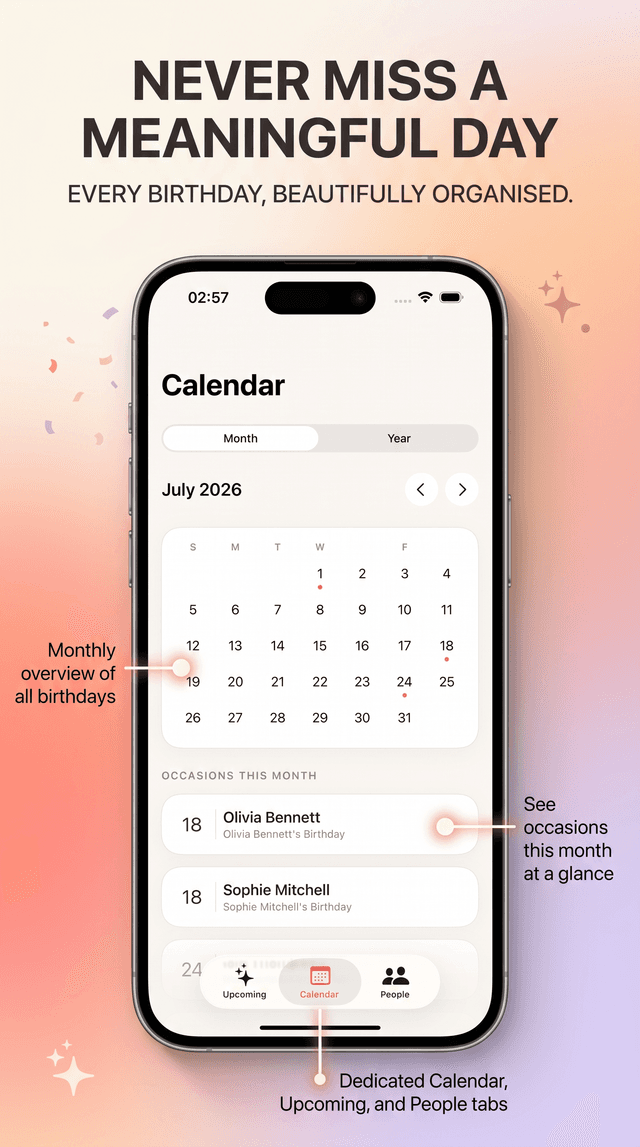
Birthday Reminder keeps countdowns, configurable reminders, notes, and Home and Lock Screen widgets in one focused iPhone app. It works without an account, and its current privacy policy says information added to the app is stored locally on the device.
For maintenance, use it deliberately:
- Search the app before manually adding or importing someone.
- Edit the existing person when a date or note changes.
- Keep notes short and useful.
- Check an imported record separately after changing Contacts.
- Use widgets to keep the next birthdays visible between reviews.
Read the Birthday Reminder privacy details before importing contacts or storing personal notes.
Frequently asked questions
How often should I update a birthday list?
Update it whenever reliable information changes. Use a monthly review for upcoming plans and a quarterly check for duplicates, uncertain dates, and stale notes.
What if I cannot update the list immediately?
Put the change in one temporary queue and clear it within a day. Do not rely on memory or leave the information buried in a message thread.
Should Contacts or a birthday app be my master list?
Either can work. Choose one, make corrections there first, and check any copied record that is not documented as continuously synchronized.
Should I create a new record after someone changes their name?
No. Search for the existing person and edit that record. Add a short alias note only if it will help you find them later.
What if I know the month and day but not the birth year?
Keep the confirmed month and day if your chosen tool supports a yearless birthday. Leave the year unknown rather than guessing an age.
Why does an app still show the old date after I changed Contacts?
The app may hold a separate record created during an earlier import. Open the app, find the existing person, and correct that record instead of importing another copy.
A current birthday list depends on a small repeatable action: search, verify, edit, save, and check. Make that action easy, keep one temporary queue for exceptions, and let scheduled reviews catch the few changes that escape the routine.
Browse the other Birthday Reminder guides for help with importing, cleanup, reminders, and iPhone troubleshooting.