Boredom gambling urges can appear in ordinary gaps: a quiet evening, a commute, a break, or an unplanned weekend afternoon. A practical response has three layers: make gambling harder to reach, find the gaps where the pattern repeats, and prepare an alternative that can begin without much thought.
Boredom is one possible cue, not a diagnosis or a prediction. You may also be tired, lonely, restless, avoiding a task, or responding to an advert, sporting event, payday, or easy access to money.
Put barriers before the replacement activity
An alternative activity may help, but it should not carry the whole plan. A bet can be available in a few taps, and even a well-chosen alternative may sound unappealing during a strong urge.
NHS guidance for gambling-related harms recommends practical measures including:
- registering with GAMSTOP,
- installing gambling-blocking software such as Gamban,
- asking your bank to block gambling payments,
- paying important bills on payday,
- dealing with debt rather than ignoring it,
- talking to someone you trust.
GAMSTOP is a free self-exclusion tool for people living in the UK. It covers licensed gambling websites and apps. Its current minimum exclusion choices are six months, one year, five years, or five years with auto-renewal. The exclusion cannot be removed during the selected minimum period.
Coverage and eligibility differ outside the UK. Use the equivalent self-exclusion, device-blocking, bank-control, and debt-support services where you live. No single barrier is complete, so combine layers where possible.
If an urge is already strong, use the short sequence in how to handle a craving in the moment before trying to choose from a long activity list.
Work out what “bored” means in this moment
“Bored” can describe several different situations. These are planning prompts, not clinical categories:
- Under-stimulated: nothing nearby is holding your attention.
- Restless: movement sounds more useful than entertainment.
- Lonely: the gap feels empty because you want contact.
- Tired: every alternative appears to require too much effort.
- Avoiding: gambling offers a quick route away from an unwanted task.
- Waiting: you have a short gap with no clear next action.
Try completing one sentence: “I am bored because…”
“I am bored because I have been sitting alone for three hours” suggests a different response from “I am bored because I have ten minutes before the train.”
Gambler’s Help notes that stopping gambling can remove a familiar source of reward, thrill, or purpose. For some people, the resulting gap can increase boredom and the urge to gamble. That does not establish what every person will experience or how long it will last. It does explain why simply removing gambling may leave time that needs a new plan.
Map the empty windows
A general trigger log records urges and what happened before them. For this specific pattern, also record the empty windows themselves.
For one or two weeks, note:
- when the unstructured period started,
- how long it lasted,
- where you were and whether you were alone,
- whether your phone, money, or gambling account was already within reach,
- whether an urge appeared,
- what you did next.
This period is a practical experiment, not a clinical threshold. Include gaps that passed without an urge. They may show useful differences, such as having company, already knowing what came next, or being away from the usual device.
A note can be brief:
Thursday, 9:30pm; alone on sofa; open-ended evening; phone in hand; urge 7/10; messaged Sam and moved phone to kitchen.
Review the notes once a week. Look for a specific combination rather than declaring that all evenings are dangerous. “Thursday after 9pm, alone, phone in hand” is easier to prepare for than “I gamble whenever I am bored.”
GamCare provides free interactive worksheets, including My Gambling Diary, a Mood Diary, an Access, Time and Money worksheet, and a Me Today Planner. Paper or a private note also works. If you want a more detailed clock-time method, read how to track the hours you are most likely to gamble.
Build a replacement that fits the gap
Generic advice such as “find a hobby” skips the decision that matters: what can you realistically start here, with this much time and energy?
Create a short menu:
| Gap | Possible first action |
|---|---|
| Under two minutes | Stand up, put the phone out of reach, step outside, or send a prepared message |
| Five to fifteen minutes | Walk a familiar route, wash up, make food, call someone, or tidy one defined area |
| Thirty to sixty minutes | Cook, exercise, practise a skill, read a chapter, or complete one project step |
| An evening or afternoon | Arrange company, attend something scheduled, visit someone, or plan an activity away from gambling access |
These are options to test, not guaranteed urge-stoppers. Choose actions that fit your mobility, responsibilities, location, money, and energy.
Gambler’s Help suggests active and engaging alternatives, daily structure, and activities involving novelty or a new challenge. It also cautions that passive scrolling or television may not provide enough engagement for this purpose. Treat that as a prompt to compare options in your own record, not a rule that passive rest is always ineffective.
Prepare the first step before the difficult window:
- place walking shoes by the door,
- keep the book on the chair where the gap begins,
- download audio in advance,
- decide whom you will contact,
- buy ingredients before the evening,
- move the gambling app away from immediate access.
The activity does not need to be exciting or transformative. Its first job may simply be to carry you into a different location or the next deliberate decision.
Use a two-step script when the gap begins
Keep the response short enough to remember:
- Interrupt access. Close the app, move the phone, leave the room, or hand control of money or a device to someone you trust if that is part of your plan.
- Start the prepared action. Use the option already chosen for this type of gap.
A script might read:
When the match ends and I am alone, I will put my phone on charge in the kitchen and walk to the end of the street before deciding what to do next.
The point is not to promise that the urge will disappear by the time you return. It is to replace one fast decision with a safer sequence.
Review the plan without grading yourself
Once a week, ask:
- Which empty window repeated?
- Which alternative did I actually start?
- Which option required more time, money, or energy than I had?
- What was different when boredom did not lead to gambling?
- Did an access or payment barrier fail?
Change one weak point. Move the alternative closer, replace an unused option, strengthen a block, or arrange contact before the recurring window.
If gambling occurred, keep the entry. Responding to a slip without erasing your progress explains how to use the sequence as information without minimising its consequences.
Where a private log fits
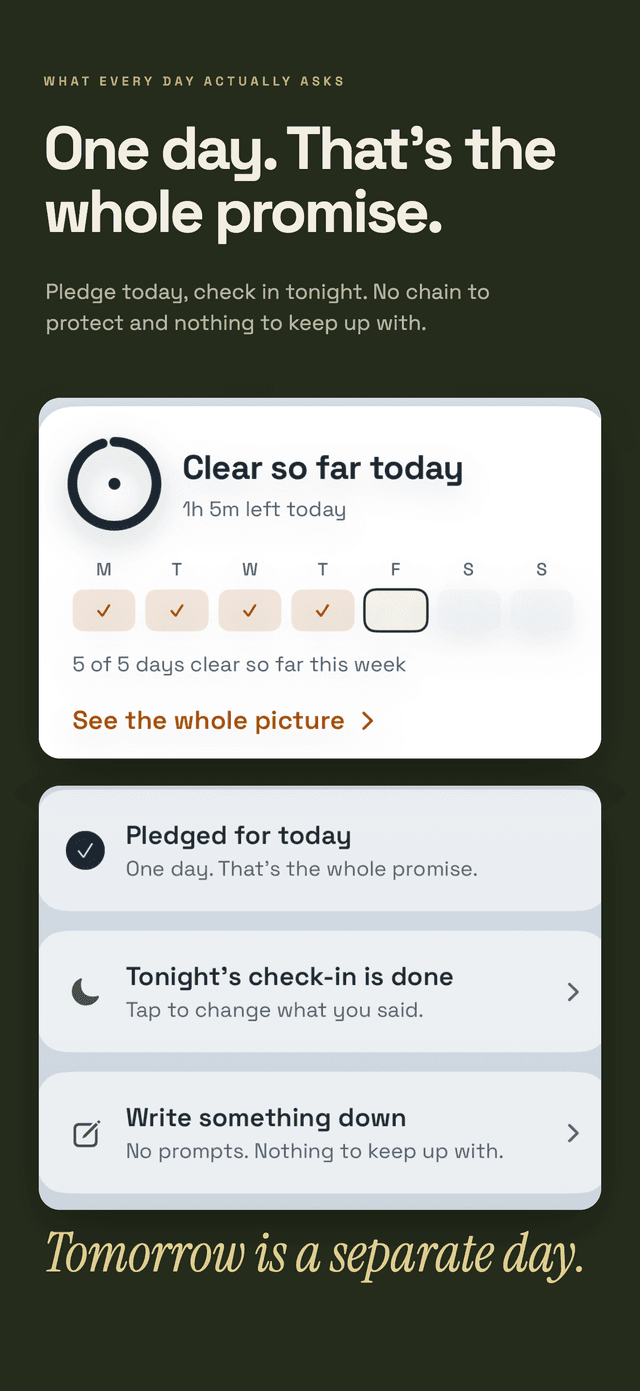
Hard Bit is an optional iPhone craving tracker. It is not a gambling blocker, treatment service, or financial safeguard.
It can keep gambling in its own record, with separate logs, a counter, a personal reason for changing, and a difficult-hour pattern. Logging, the journal, counter, hard-moment flow, milestones, help links, export, and deletion are free. A subscription adds the on-device forecast and warning, patterns and calendar, widgets, and short reads.
The forecast makes no prediction below five entries and relies more fully on your history at around twenty. Treat it as a summary of repeated entries, not a prediction of your next decision. There is no account, social feed, advertising, or server copy of your entries.
The Hard Bit overview documents the workflow. If another person uses your phone, read the private gambling tracking guide before deciding where to keep sensitive notes. A notebook can support the same exercise.
Know when boredom is not the main problem
Act promptly if gambling is causing rising spending, chasing losses, borrowing, missed bills, relationship conflict, severe distress, or repeated failure of protective barriers.
The NHS publishes a nine-question self-check. It says a score of 8 or more means gambling-related harms are likely for you or those close to you. A score from 1 to 7 may still indicate a negative effect. This is a prompt to seek support, not a diagnosis.
In Great Britain, the National Gambling Helpline is free on 0808 8020 133, 24 hours a day, seven days a week. The NHS also lists specialist gambling clinics in England that accept self-referrals and points to National Debtline for debt support. Elsewhere, contact a local gambling-support, debt-advice, or health service.
If gambling is seriously affecting your mental health, seek urgent help. In the UK, GamCare directs people to Samaritans on 116 123 when urgent support is needed and GamCare cannot be reached. Call 999 in an emergency. Elsewhere, use the crisis or emergency service where you are.
Our editorial policy explains how health guidance and product information are reviewed.
Frequently asked questions
Is boredom a genuine gambling trigger?
It can be. Gambling-support guidance recognises boredom as one possible trigger, particularly when gambling has become a familiar source of stimulation or reward. It is not the only explanation, so also record access, money, adverts, sporting events, mood, company, and what happened immediately beforehand.
What can I do during a gap that lasts only two minutes?
Do not try to begin a major activity. Interrupt the route to gambling instead: stand up, move the phone, change rooms, step outside, or send a prepared message. Then decide what fits the next part of the day.
Will a new hobby stop gambling urges?
It may provide structure and a more engaging use of time, but it cannot guarantee that urges will stop. Keep self-exclusion, device blocking, bank controls, and support in the plan rather than relying on one activity.
Should I avoid being alone?
Not necessarily. If your record shows that particular solitary windows carry more risk, arranging company during those times may be useful. The longer-term plan can also include making time alone safer through barriers, prepared activities, and support.
Is tracking enough on its own?
No. A log can reveal repeated times, contexts, and access points. It cannot block an account, protect bill money, assess mental-health risk, or provide treatment. Use it alongside practical barriers and qualified support. More planning guides are available in the Hard Bit guide library.