Boredom gaming urges are easier to plan for when you stop treating every empty hour as the same problem. Ask whether you need more stimulation, less effort, or something that feels worthwhile. Then start one alternative chosen earlier for that state.
These are working labels, not diagnoses or proven treatment categories. Their value is practical: they help you test a more suitable response than opening a launcher automatically.
Why gaming becomes the quick answer to boredom
Games can be available within seconds and offer familiar goals, feedback, social contact, or relief from an unappealing task.
A 2025 study asked 581 adult players to imagine one of four boring situations. Seventy-four percent said they would be likely to switch to a digital game. Across the scenarios, respondents generally preferred games expected to provide fun, psychological detachment, and relaxation over more effortful or reflective experiences.
That result does not show what people actually do during a real evening. Participants imagined scenarios, selected desired game experiences rather than concrete games, and were not observed over time. The study also found fewer differences between boredom profiles than its model predicted.
The useful conclusion is modest: gaming can look like an easy and appealing switch when a situation feels boring. A replacement therefore needs to compete on availability and fit, not merely sound healthier or more productive.
Use three questions to name the moment
The study drew on the Meaning and Attentional Components model. That model considers whether an activity's demands fit a person's available mental resources and whether the activity feels aligned with their goals.
For an everyday plan, simplify that into three questions:
- Do I need more stimulation? You have energy, but the current option asks too little of you.
- Do I need less effort? You are tired, overloaded, or unable to concentrate, so every alternative feels demanding.
- Do I need something that matters? You have time, but the available choices feel disconnected from people or priorities you value.
The labels can overlap. Do not spend ten minutes finding the perfect one. Choose the closest description, try the matching alternative, and record whether it helped.
A systematic review of 28 studies distinguishes temporary state boredom from trait boredom, a tendency to experience boredom frequently across situations. Nearly all its included studies were cross-sectional and based on self-report, and its included-study categories were not gaming-specific. It cannot establish that boredom causes problematic gaming. Use your own repeated entries as clues to prepare for, not proof of a disorder or a fixed personality trait.
Record the ten minutes before play
A session log tells you how long you played. A cue log tells you where another action might fit.
For one or two weeks, note:
- the time and day,
- what ended immediately before the urge,
- whether you felt alert, tired, restless, hungry, or flat,
- which of the three questions fitted best,
- what you did next.
Include evenings when boredom appeared but you did not play. Those entries may reveal useful conditions, such as being away from the setup, eating earlier, having company, or already knowing what came next.
Keep the entry short. “Wednesday, 8:40pm; finished dinner; tired; needed less effort; opened game” is enough. The broader method in how to identify craving triggers and difficult times can help if you need a template.
Build one alternative for each state
Choose activities you would genuinely begin at the relevant hour. This is a personal experiment, not a prescription.
| Working label | Alternative to prepare |
|---|---|
| Need more stimulation | Brisk walk with saved audio, one difficult recipe step, instrument ready to play, or a clearly defined project task |
| Need less effort | Shower, simple food, familiar book, one album while folding laundry, or ten quiet minutes away from the setup |
| Need something that matters | Call one person, prepare something for tomorrow, complete a useful errand, or improve one shared space |
| Too restless to choose | Put on shoes, leave the room, move for five minutes, and decide again afterward |
Make the first step possible in under a minute. “Go for a walk” begins with shoes beside the door. “Read” begins with a book on the chair. “Call someone” begins with deciding who and when before the urge arrives.
Keep the menu short. Four usable entries are better than twenty hobbies that require equipment, money, company, or more energy than you usually have.
Add friction to the automatic route
The replacement gets a head start when gaming takes one extra step:
- sign out of the game or launcher,
- disable game, party, and store notifications,
- store the controller and headset away from the usual chair,
- remove saved payment details,
- keep the phone outside the bedroom if mobile gaming is the pattern.
These changes do not guarantee that an urge will disappear. They create time to notice it and begin the prepared alternative.
If the problem is the structure of the whole evening rather than boredom alone, use the schedule-focused gaming guide. It covers start cues, session boundaries, freed time, and sleep.
Handle the evening when nothing appeals
After cutting down, an empty period may feel flat simply because the old activity occupied it reliably. There is no established timeline that says when other activities must become appealing.
Lower the job of the alternative. It can pass ten minutes, feed you, move you to another room, or connect you with someone. It does not need to become a passion.
If the urge is loud, how to handle a craving in the moment gives a short sequence for changing the cue and slowing the next decision. Urge surfing is another optional exercise, but it should not be treated as a proven gaming treatment or a promise that every urge will end within a set time.
Review the experiment once a week
Ask:
- Which label appeared most often?
- Which alternative was actually started?
- Which one required too much energy or preparation?
- What was different when boredom did not lead to gaming?
- Did one particular hour or preceding activity repeat?
Change one weak point. Replace an unused activity, move its equipment into reach, or arrange contact before the recurring hour.
Keep gaming sessions in the record. Removing them makes the pattern less accurate. If one evening did not follow the plan, use it without erasing earlier progress.
Use Hard Bit as an optional record
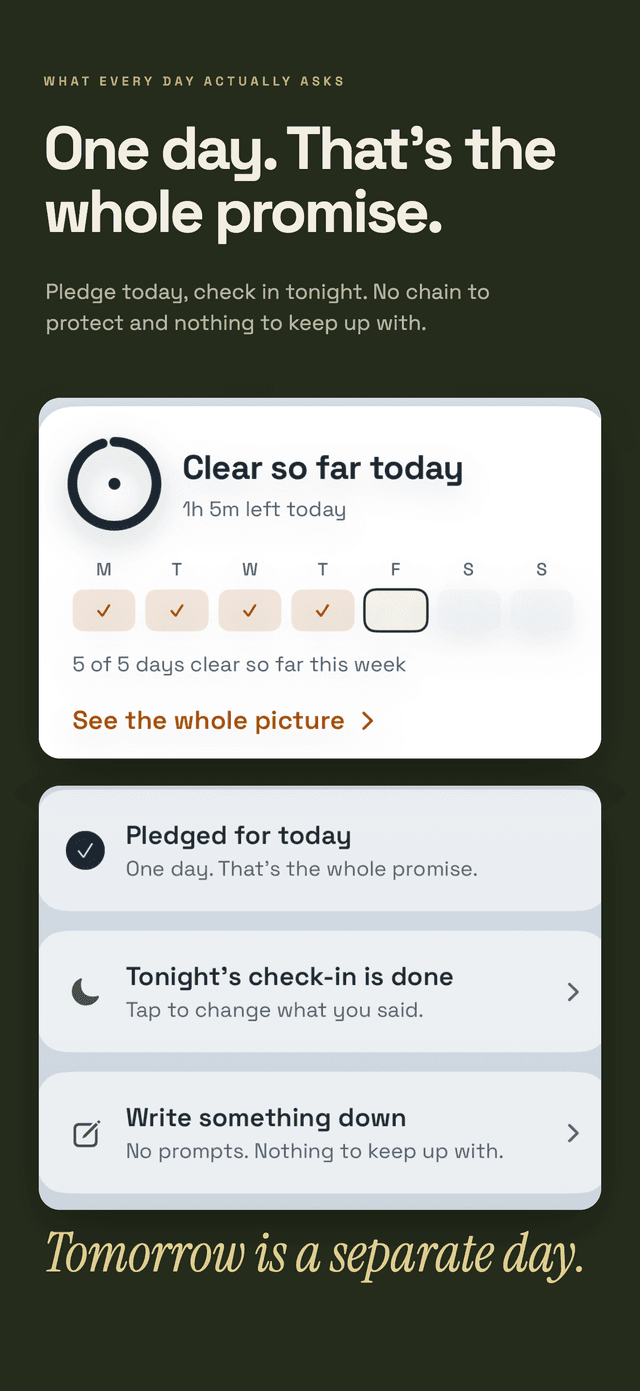
Hard Bit is an iPhone craving tracker. When you choose gaming, its prompts use hours rather than money. Each habit keeps separate logs, a counter, a reason for changing, and a difficult-hour pattern.
The counter, logging, journal, milestones, help links, hard-moment flow, and export and delete tools are free. A subscription adds the on-device forecast and warning, patterns and calendar, widgets, and short reads. The forecast makes no prediction below five entries and relies more fully on your history at around twenty. There is no account or social feed, and entered data stays on the device unless you choose to export it.
The Hard Bit overview and support page document the current feature boundaries. Paper or a private note can support the same three-question exercise. A tracker cannot diagnose gaming disorder or provide treatment.
Know when to add professional support
Playing because you are bored is not itself a disorder. WHO describes gaming disorder as impaired control over gaming, increasing priority given to gaming over other activities, and continued or escalating play despite negative consequences. The pattern must cause significant impairment and would normally have been evident for at least 12 months. WHO says it affects only a small proportion of people who game.
Seek qualified help if gaming is persistently displacing sleep, food, hygiene, essential spending, work, study, or relationships, or if attempts to change repeatedly feel unmanageable. Persistent low mood, hopelessness, or loss of interest beyond gaming also deserves a conversation with a doctor or mental health professional.
In England, the National Centre for Gaming Disorders supports people aged 13 and over who have difficulty controlling gaming. It accepts self-referrals and referrals from family members or professionals. Its CBT-based treatment focuses on greater control over gaming and increasing other activities.
The centre is not a crisis service. If you or someone else is in immediate danger, contact emergency services or an appropriate local crisis service. Outside England, begin with your usual doctor or local mental health service. Our editorial policy explains how health and product claims are reviewed.
Frequently asked questions
Is playing a game because I am bored harmful?
Not necessarily. Gaming can provide entertainment, relaxation, challenge, and social contact. The practical concern is whether it has become your only response and is repeatedly displacing needs or commitments that matter to you.
Why does every alternative seem boring?
The activity may not fit your current resources. If you are alert, a passive option may offer too little stimulation. If you are exhausted, a demanding hobby may ask too much. Change the difficulty or first step before deciding that every alternative has failed.
How long should I delay before deciding whether to play?
There is no universal number. Use a short delay to create decision space and begin one prepared action, not as a countdown that guarantees the urge will disappear.
Do I have to stop gaming completely?
No single goal suits everyone. Some people choose measurable limits; others prefer a complete break. If your chosen boundary repeatedly fails to reduce serious harm, review it with qualified support.
Can tracking the hour change the urge?
Tracking alone does not change it. A record can show which hour, body state, or preceding activity repeats. The useful step is preparing a realistic response for that specific situation. More planning articles are available in the Hard Bit guide library.