Urge surfing is a mindfulness technique for coping with a craving without acting on it. Instead of fighting the urge or giving in, you observe it the way a surfer watches a wave: you notice it rise, let it peak, and stay with it while it eases. The rest of this guide explains where the technique comes from, what the evidence does and does not show, and how to practise it step by step across different habits.
What urge surfing actually means
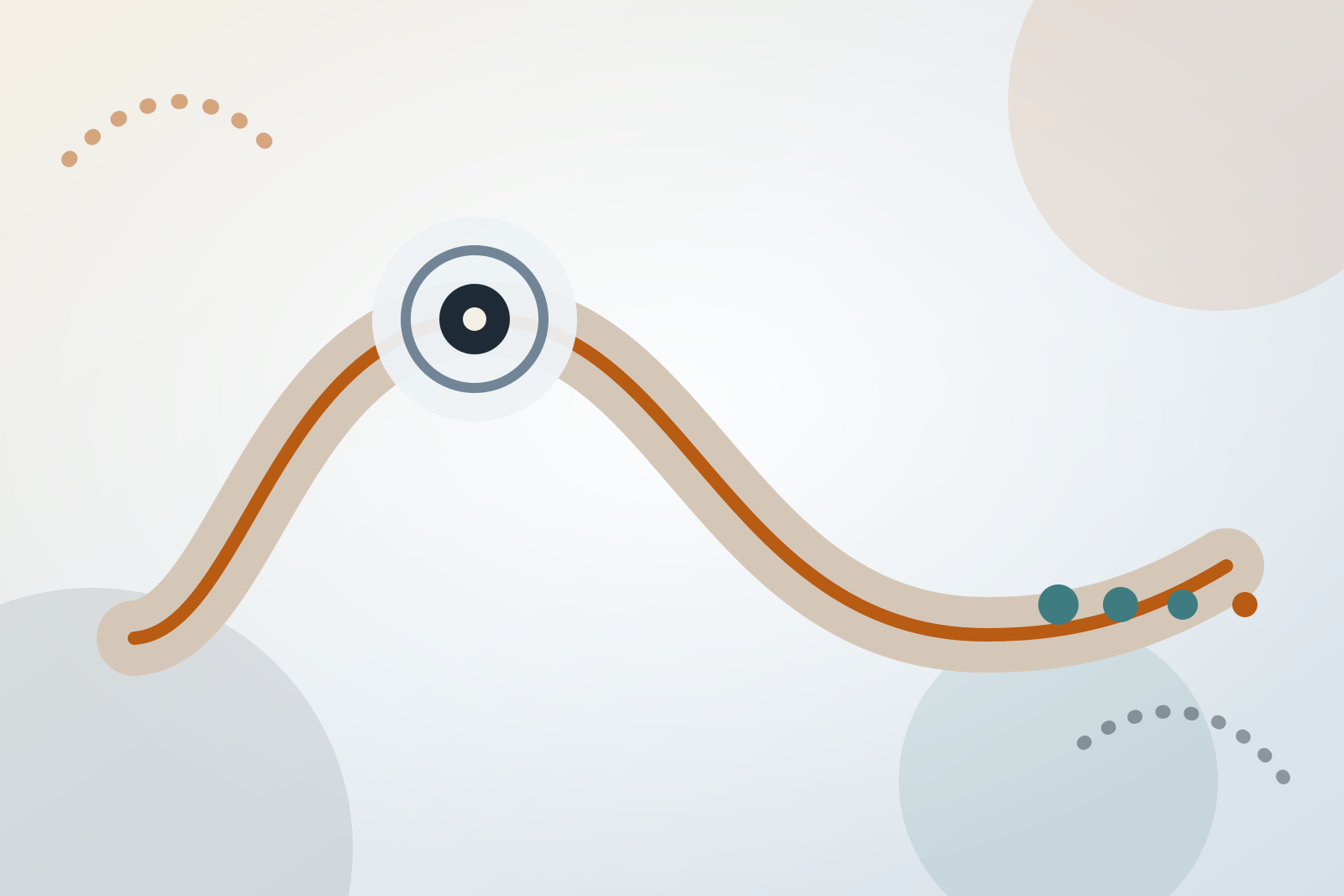
The technique was developed by the psychologist Alan Marlatt and colleagues at the University of Washington as part of Mindfulness-Based Relapse Prevention, a program for addictive behaviours. The UCI Susan Samueli Integrative Health Institute describes its core idea: an urge feels like a single solid command, but it is really a bundle of bodily sensations, thoughts, and emotions that moves through four stages.
- Trigger: something starts the craving, a place, a feeling, a routine, a notification.
- Rise: the sensation builds and your attention narrows toward the habit.
- Peak: the urge reaches its strongest point and can feel permanent.
- Fall: the intensity eases, whether or not you acted on it.
The practical claim is simple: you do not have to make an urge disappear in order to choose not to follow it. Therapist Aid's clinical handout frames urge surfing as a distress-tolerance skill used in dialectical behaviour therapy (DBT) and other approaches such as ACT and CBT, always alongside basics like managing triggers and using delay. In other words, it is one skill in a larger kit, not a standalone cure.
What the evidence says so far
It is worth being precise here, because the internet is full of confident claims about this technique.
The best-known study is a 2009 study by Sarah Bowen and Alan Marlatt, indexed on PubMed. One hundred and twenty-three undergraduate smokers were exposed to cues designed to trigger the urge to smoke. Half received brief mindfulness instructions based on urge surfing; half received no instruction. The two groups did not differ significantly in how strong their urges felt. But the mindfulness group smoked significantly fewer cigarettes over the following seven days.
That is an encouraging and genuinely interesting result. It suggests the technique may work less by weakening cravings and more by changing your response to them. It is also one preliminary study, with one habit, in a student sample. It does not prove urge surfing works for every habit or every person, and no honest guide should claim it rewires your brain or guarantees a craving will end within a fixed number of minutes.
So the fair summary is: urge surfing is widely taught by clinicians, grounded in a plausible mechanism, and supported by early research. Treat it as a coping skill worth practising, not a promise.
How to practise urge surfing step by step
Learn the sequence when you are calm. Trying it for the first time at maximum intensity is like learning to swim during a storm.
- Notice early. Catch the urge while it is still rising. Say plainly, “This is an urge to vape,” or “This is the urge to open the betting app.”
- Plant yourself. Put both feet on the floor. Let your shoulders drop. You are not preparing to fight; you are preparing to watch.
- Find the urge in your body. Is it tightness in the chest, restlessness in the hands, a dry mouth, heat in the face? Describe it to yourself in neutral words.
- Breathe and picture the wave. Let each exhale run slightly longer than each inhale. Imagine the urge as a wave you are floating on. Some versions of the practice suggest using your breath as the board.
- Watch it change. Stay curious rather than braced. Does the sensation move, sharpen, soften, spread? Keep noticing without timing it or demanding it stop.
- Note what happened afterwards. One line is enough: when it started, how high it climbed, what you did, what it felt like when it eased.
Expect the first attempts to feel awkward. Observation is a skill, and skills improve with repetition, including repetition on small urges before big ones.
For a fuller in-the-moment routine that combines this with changing your surroundings and choosing one prepared action, read how to handle a craving in the moment.
Adapt the wave to your habit
The technique is cross-habit, but the surrounding plan should not be identical for every habit.
- Smoking or vaping: surfing can carry you through a single urge, but evidence-based quit support and stop-smoking medicines improve the odds of the whole attempt. An official service such as NHS Smokefree or Smokefree.gov can explain those options.
- Drinking: if you may be physically dependent on alcohol, stopping suddenly can be dangerous. Get medical guidance on withdrawal before testing coping skills at full strength.
- Gambling: riding an urge does nothing to protect your money while the wave lasts. Pair it with practical barriers such as bank gambling blocks and self-exclusion schemes, and consider specialist support if debt is building.
- Scrolling, gaming, or porn: neutral wording helps here. If your use feels compulsive or difficult to control, surfing works best alongside changes to the environment, like charging the phone outside the bedroom, rather than as a test of pure attention.
Whatever the habit, waves arrive more predictably than they feel. Identifying your craving triggers and difficult times tells you when to expect them, which makes practising far easier.
Common mistakes that make surfing harder
Fighting the wave. Suppression (“I must not think about this”) tends to tighten your focus on the very thing you are resisting. The instruction is to observe, not to win.
Clock-watching. If you surf while silently counting down to a guaranteed end, you are bargaining, not observing. Duration varies between people, habits, and moments. Let the wave set its own timetable.
Only practising at full intensity. A first attempt during your hardest hour of the week is likely to feel like failure. Rehearse on mild urges and quiet evenings first.
Using it as the whole plan for a high-risk habit. Surfing is a way to get through minutes. It is not a withdrawal plan, a debt plan, or a substitute for professional care.
Judging the attempt. “I still wanted it, so it did not work” misunderstands the goal. Success is staying present without acting, not feeling nothing.
When urge surfing is not enough
Some situations need more than a coping technique.
If you may be dependent on alcohol or sedatives, do not stop abruptly without medical advice, and seek urgent help for symptoms such as seizures, severe confusion, or hallucinations. If gambling has created unaffordable losses or you are hiding spending, specialist services and financial blocks matter more than any mindfulness skill. If you are thinking about harming yourself or someone else, or anyone is in immediate danger, contact emergency services now.
There is no shame in any of this. Knowing when a wave is too big to ride alone is part of the skill, not a failure of it. The Daily Life Apps editorial policy explains how this site separates general coping information from guidance that belongs with a clinician.
Keep a record of the waves
Urge surfing gets easier when you know your own water. A short log of each urge, the time, the trigger, the peak intensity, what you did, turns vague struggle into a visible pattern. After a few weeks you may find that the “random” cravings mostly happen on two evenings, in one chair, after one kind of day.
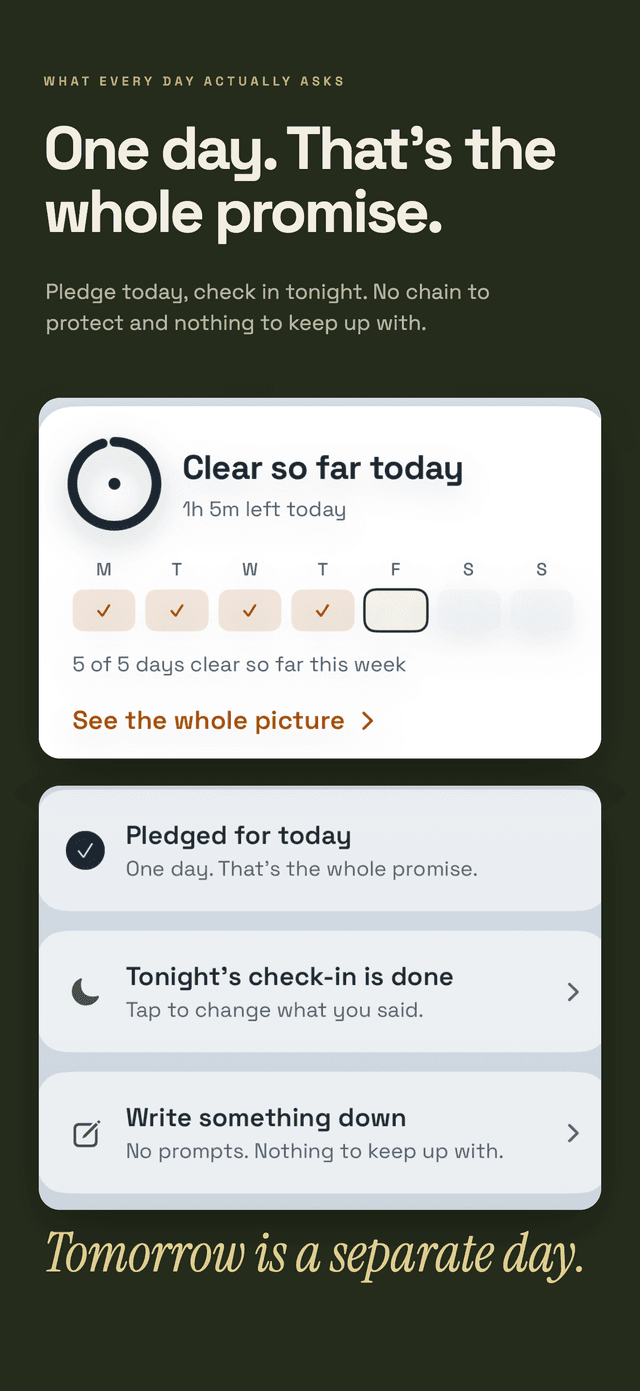
This is the workflow Hard Bit is built around. The iPhone app keeps a separate private log for each habit, brings your own written reason into the hard-moment flow, and, with Hard Bit Plus, learns your difficult weekday and hour from your logged history so it can warn you before one arrives. It makes no prediction below five entries and leans fully on your data at about twenty. Nothing leaves the phone; there is no account and no feed. The Hard Bit overview has the details, but a notebook follows the same principle.
And if a wave ends in a slip, keep the entry. What to do after a slip without erasing your progress explains why the honest record is more useful than the flattering one.
Frequently asked questions
How long does an urge last when you surf it?
There is no reliable fixed duration. Clinical handouts describe urges as rising, peaking, and fading on their own, but the timing varies by person, habit, and situation. Surf the wave without promising yourself an end time.
Does urge surfing work for any habit?
It is taught for substance use, gambling, and other unwanted behaviours, and many people apply it to scrolling, gaming, or porn use. The formal research base is still small and mostly concerns smoking and drinking, so treat it as a general coping skill rather than a proven treatment for your specific habit.
Is urge surfing the same as distraction?
No. Distraction redirects your attention away from the urge; surfing deliberately observes it. Both can be useful. Some people alternate: surf while the wave is manageable, and switch to a practical task or a change of location if it keeps climbing.
Can I practise urge surfing on my own?
For everyday urges, yes. The steps above are designed for solo practice. For habits involving withdrawal risk, serious debt, self-harm thoughts, or repeated loss of control, practise it as one part of a plan that includes a professional or a support service, not as your only line of defence.