To handle cannabis cravings after work, plan the handover between work and home before the urge arrives. Map the end of your shift, the journey or move away from your desk, the first two minutes at home, and the place where you usually settle. Then decide what the first thirty minutes will contain and what you will do if the craving is still strong.
The aim is not to force yourself into a better mood. It is to make the usual sequence less automatic.
Find the earliest point in the sequence
Work backwards from the usual session. Mark these checkpoints for one ordinary workday:
- The last work task: a difficult call, closing the laptop, handing over, or clocking out.
- The transition: driving, taking public transport, walking, or moving from a home office into another room.
- The first two minutes at home: keys down, coat off, phone checked, kettle on.
- The first place you pause: the sofa, balcony, kitchen, garden, or bedroom.
- The usual access point: a drawer, bag, shop, delivery app, or another person's supply.
A sequence might read: tense call at 5:40pm, twenty-minute drive, stop near the usual shop, keys on the table, then sofa beside the drawer containing cannabis equipment.
That description offers several possible intervention points. “I have no willpower” offers none.
Write the sequence after arriving, never while driving. Do not drive while impaired. If you already feel affected, arrange another way to travel and record the details later.
For a broader comparison across days and hours, use the separate guide to track the hours you are most likely to use cannabis.
Ask what the session is meant to provide
In a cross-sectional study of 589 Canadian workers who reported past-year cannabis use, relaxation was the most common motive at 59.3%, followed by enjoyment at 47.2% and coping at 35.1%. Almost 40% reported at least one work-related motive.
Those figures describe one Canadian worker sample recruited in 2018. They do not explain your own use. Ask instead what you are seeking at that point in the evening:
- physical release after a demanding shift,
- a clear end to work-related thinking,
- relief from boredom or loneliness,
- a reward,
- sleep,
- pain or another symptom,
- or simply the completion of a familiar routine.
Choose a response that addresses the answer. A shower or walk may fit physical tension. Changing clothes and putting work devices away may create a boundary around the job. A planned meal, call, or activity may provide a different reward.
If cannabis is prescribed, or you use it for sleep, pain, anxiety, or another health concern, discuss changes with your prescriber or GP. A transition plan should not replace medical advice or an agreed treatment plan.
Write a thirty-minute arrival plan
Build the plan for a tired workday rather than an ideal evening. One useful structure is:
| Stage | Question | Example |
|---|---|---|
| Land | What needs attention immediately? | Change clothes and prepare food |
| Release | What marks the end of work? | Shower, walk, music, or a short call |
| Start | What gives the evening direction? | Cook, feed a pet, or complete one small task |
Keep each action easy to begin. If your plan depends on travelling to a gym, finding an open shop, or making a complicated decision, write a lower-effort backup.
For example:
When I finish work, I will take the route that avoids the usual shop. At home I will put my keys down, change clothes, heat the meal I prepared, and shower before sitting on the sofa.
The plan does not need to fill the whole evening. Its job is to change the opening sequence.
Make immediate access less automatic
Change access while you are calm:
- keep cannabis and equipment secured outside the room where you usually settle,
- remove ordering shortcuts or saved shop details,
- take a different route home if a particular stop is part of the pattern,
- agree on boundaries if someone you live with uses cannabis,
- prepare food, clothing, or the next activity before work.
Do not move another person's medication or create unsafe storage around children or pets. If cannabis is prescribed, follow the storage and dosing instructions provided with it.
The purpose is not punishment. It is to put a deliberate decision between the cue and the session.
Delay the decision when the craving arrives
WithYou suggests delaying a cannabis session for five minutes while doing something else, then gradually trying ten or fifteen minutes.
Set a timer and begin one prepared action. Wash the dishes, shower, step outside without driving, or call someone. Treat the delay as space to decide, not a promise that the craving will disappear within a fixed time.
If the urge remains strong, repeat the plan, contact your support person, or move farther from the cue. The five-minute plan for the start of a craving provides a sequence you can rehearse while calm.
Prepare an exception for heavy workdays
A normal-day plan may not fit overtime, conflict, a night shift, payday, or an unexpectedly difficult commute. Add one exception line:
If work runs late or the day feels unusually heavy, I will eat before travelling, message Sam, and go straight home without stopping.
Choose the person, meal, route, and first activity in advance. “I will decide later” leaves the decision at the point when you are most tired.
If your schedule changes each week, write separate versions for early, late, remote, and weekend shifts rather than expecting one routine to cover all of them.
Allow for cannabis withdrawal
Stopping or substantially reducing regular cannabis use can temporarily change sleep, mood, appetite, concentration, and craving intensity.
A peer-reviewed clinical review reports that symptoms commonly begin within 24 to 48 hours and often peak between days two and six. Symptoms can continue for three weeks or longer in some people with heavy use. Possible symptoms include irritability, anxiety, disturbed sleep or vivid dreams, low mood, reduced appetite, restlessness, and cravings. Individual experiences vary.
If you mix cannabis with tobacco and reduce both, nicotine withdrawal may overlap. Consider keeping nicotine in a separate record so the two patterns do not become confused.
Mark the date your use changed. Seek professional advice if symptoms are severe, worsening, difficult to manage, or occurring alongside significant physical or mental health problems. Measuring cannabis progress beyond a perfect streak offers measures that remain useful during an unsettled period.
Review seven comparable workdays
Keep the evening record short:
- when work ended,
- what happened during the transition,
- what the first thirty minutes contained,
- when the strongest urge appeared,
- whether you used and the rough amount.
After seven comparable workdays, ask:
- Which checkpoint appeared before the strongest urges?
- Which part of the arrival plan actually happened?
- What was different on evenings when use was delayed or did not happen?
- Which single part should change next week?
Seven days provide an initial test, not proof of a permanent pattern. Keep missing or unusual days visible. Use neutral wording, especially after an unplanned session. Tracking cannabis without turning it into shame explains how to keep the record factual.
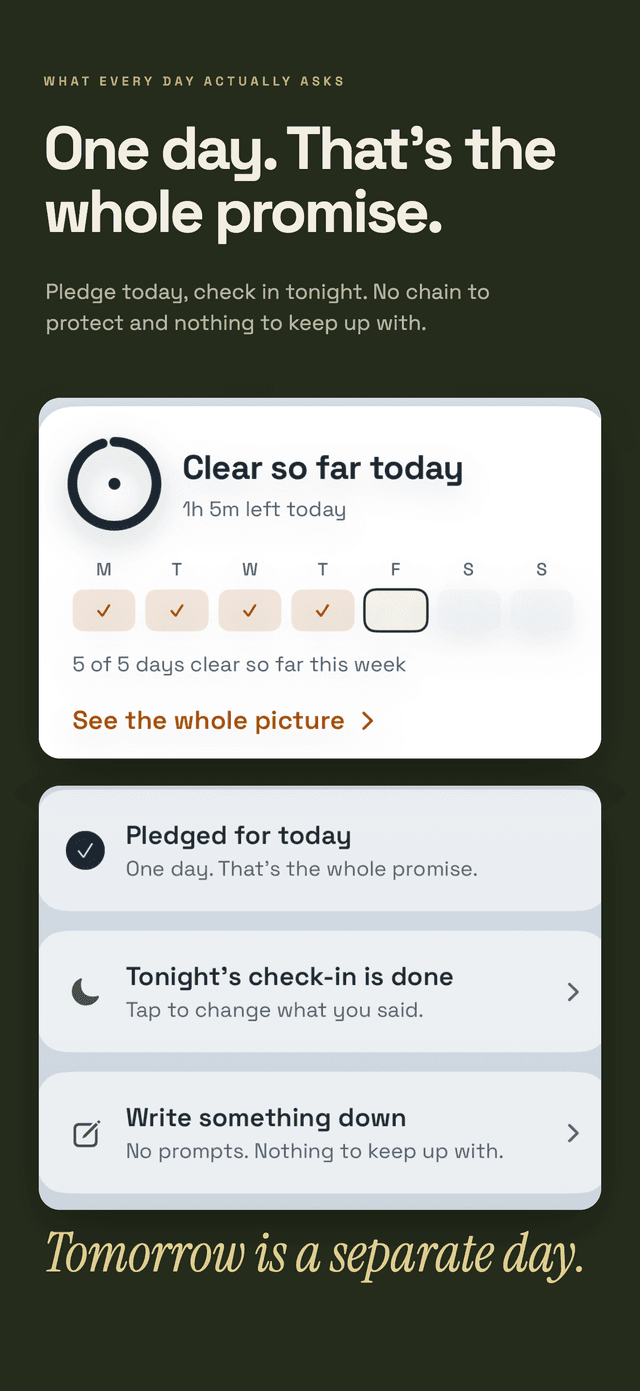
Paper or a notes app is enough. Hard Bit is an optional iPhone companion that keeps each habit in a separate private record and supports goals of stopping or cutting down. Its counter, logging, journal, hard-moment flow, personal sentence, milestones, help links, export, and deletion tools are free. A paid subscription adds the on-device difficult-hour forecast and warning, patterns and calendar, widgets, and short reads.
The forecast makes no prediction below five entries and relies fully on your history at around twenty. It describes a previously difficult hour rather than predicting what you will do. The app has no account, advertising, social feed, third-party analytics, or server copy of your entries. The Hard Bit overview explains the workflow, while the support page documents its privacy and subscription boundaries.
Know when a routine is not enough
Speak to a GP, prescriber, or drug service if cannabis is affecting your mental health, work, finances, relationships, or ability to follow limits you intended to keep.
The NHS says a GP can discuss a drug problem and usually refer you to a local drug service. You can also approach a service directly. In the UK, the FRANK drugs helpline on 0300 123 6600 can explain available options. Outside the UK, contact an appropriate local health or drug service.
Seek urgent local help for severe confusion, hallucinations, intense paranoia, thoughts of harming yourself or someone else, or any immediate danger. A transition plan or private log cannot assess those situations.
Our editorial policy explains how health and product claims are reviewed. More practical articles are available in the Hard Bit guide library.
Frequently asked questions
Why do I crave cannabis as soon as work ends?
The end of work may bring several repeated cues together, including a particular time, route, place, feeling, or first activity at home. Mapping the sequence can reveal an earlier planning point. It cannot diagnose the reason for the craving.
Should I delay the session or skip it?
Either may fit your goal. A short delay can interrupt the automatic sequence whether you are cutting down or stopping. It is decision space, not a required compromise or a guarantee that the urge will end.
What if I work from home?
Create a visible handover between work and the evening. Close work apps, put equipment away, change rooms or clothes, and begin a prepared activity before sitting in the usual place.
What if I use cannabis to sleep after a late shift?
Discuss persistent sleep problems and changes to prescribed or self-managed cannabis use with a GP or prescriber. Withdrawal can temporarily disturb sleep, particularly after regular use, so a clinician can help assess the wider situation.
What if the plan works on some days but not others?
Keep both kinds of evening in the record. Compare workload, shift, route, company, food, access, and withdrawal symptoms. Change one condition at a time rather than treating one difficult evening as proof that the entire plan failed.