To track cannabis without shame, record observable facts: when use happened, the product and rough amount, where you were, what happened beforehand, and how you felt afterward. Keep use-free days in the same history, mark days you did not observe, and review the record once a week rather than every time regret appears.
The aim is not to produce a perfect score. It is to create an honest record that helps you notice one changeable part of the pattern.
Understand what the evidence says about shame
Shame does not have one simple or predictable relationship with substance use.
A systematic review of 42 studies found no overall association between shame and substance use itself. It found a small association between shame and substance-use-related problems, while results over shorter periods were more complicated. The review covered different substances and populations, so it cannot tell you exactly how shame affects your cannabis use.
Cannabis-specific research does show that stigma is relevant. In a 2025 study of 684 German adults who used cannabis at least monthly, 30.6% agreed that others would think badly of them if their use became known, and 22.1% reported shame when others found out. The survey was quota-sampled, cross-sectional, and conducted before Germany changed its cannabis law. It describes that sample, not every person who uses cannabis.
The practical conclusion is modest: a tracker should not add another source of judgement. If its wording makes you edit, avoid, or delete difficult entries, it cannot give you a complete picture.
Give the record one clear purpose
Write a sentence at the top of the log:
This record exists so I can see what happens and choose one useful next step.
Avoid making the purpose “prove that I am improving” or “punish myself when I fail.” Those goals encourage all-or-nothing readings of ordinary data.
You do not need a diagnosis, a quit date, or a firm decision between stopping and cutting down before you begin. WithYou suggests keeping a simple cannabis diary for about a week to understand current use before deciding what to change.
Use a short, factual entry template
Record enough detail to reveal a sequence without turning every entry into an essay:
- Day and time
- Product and rough amount
- Place and people present
- What happened immediately beforehand
- How you felt before and after
- One relevant outcome, such as spending, sleep, or a missed commitment
A useful entry might read:
Tuesday, 10:15pm, at home alone. Finished work late and skipped dinner. About two bowls of flower. Tense beforehand, flat afterward. Went to bed at 1am.
“Did it again, pathetic” contains no time, cue, amount, or possible next step. Describe the event instead of assigning yourself a trait.
Also distinguish three kinds of day:
- Use day: cannabis use was recorded.
- Use-free day: you observed the day and recorded no use.
- Not observed: you cannot reliably say what happened.
Do not silently count missing days as use-free. If timing seems important, use the separate method for tracking the hours you are most likely to use cannabis.
Keep different products separate
Cannabis products are difficult to combine into one meaningful personal total. Start with measures you can apply consistently:
- use days,
- separate sessions,
- joints, bowls, or inhalations,
- edible portions or the labelled dose,
- product strength when it is known,
- money spent.
A 32-day cannabis diary study used “standard joint equivalents” for flower but excluded the small number of edible and concentrate observations from its quantity analysis because equivalent amounts across product types were not established. That was a choice in one study, not a universal conversion rule.
For a personal log, keep flower, edibles, and concentrates in separate fields. Label estimates as estimates. “About two bowls” is more honest than an invented gram figure.
If cannabis is prescribed, follow the agreed treatment plan and discuss dose or schedule changes with the prescriber. A personal chart should inform that conversation, not replace it.
Keep the full history after a use day
A single streak can make one entry look as though it erased everything before it. Keep a wider measure beside any current streak.
For example, “22 of the last 28 observed days were use-free” retains both the six use days and the other twenty-two. It does not minimize the use or discard the surrounding information.
The guide to measuring cannabis progress beyond a perfect streak offers additional measures such as sessions, real-life outcomes, and return-to-plan time. If an unplanned session happened, review it without erasing earlier progress.
Protect the privacy of the record
Privacy is not only about whether a developer receives your data. Consider who can access the device and any copies you create.
Check:
- whether notification previews reveal the habit,
- whether another person knows the device passcode,
- whether the app uses an account or server storage,
- whether exports sit in email or a shared folder,
- whether screenshots or backups create another copy,
- and whether an app lock is available.
Use a notebook, note, spreadsheet, or app that fits your situation. No method is private merely because it feels discreet.
If someone monitors your phone or changing its settings could put you at risk, do not make sudden changes that may alert them. Seek specialist support from a safer device when possible.
Review the pattern without putting yourself on trial
Choose one calm ten-minute period each week. Ask:
- Which day, hour, or setting repeated?
- What usually happened immediately before use?
- What was different on use-free days?
- What is one condition I can change this week?
That change might be eating before a repeated evening window, arranging a call, moving an activity to another room, or preparing an alternative before the usual session begins. Keep it small enough to test.
Do not expect recording alone to change cannabis use. A systematic review of self-monitoring across substances found mixed results. Among analyses from studies rated moderate or strong quality, 29% found a helpful effect, 63% found no effect, and 8% found a detrimental effect.
In the 32-day cannabis study of 88 women who were not seeking treatment or trying to abstain, neither the probability nor quantity of use changed significantly over time. The sample and missing data limit what can be generalized.
Tracking can provide information, but it is not treatment. If logging increases distress, compulsive checking, or shame, simplify it, pause it, or discuss another approach with a qualified professional.
Know when tracking should become a conversation
Stopping or substantially reducing regular cannabis use can involve irritability, anxiety, sleep disturbance, unusual dreams, appetite changes, restlessness, low mood, or cravings. Experiences and duration vary, so do not use a fixed timeline as a test of whether your response is normal.
Speak to a GP, prescriber, or drug service if cannabis is affecting your mental health, work or study, finances, relationships, or ability to keep limits you intended to follow. Ask for help if withdrawal symptoms are severe, worsening, or difficult to manage.
The NHS says a GP can discuss a drug problem and usually refer you to a local drug service. You can also approach a service directly. In the UK, FRANK offers confidential advice on 0300 123 6600. Outside the UK, use an appropriate local health or drug service.
Seek urgent local help for severe confusion, hallucinations, intense paranoia, thoughts of harming yourself or someone else, breathing difficulty, inability to wake, or another immediate danger. Do not drive while impaired, and make any entry after you are somewhere safe.
For immediate urges that are not emergencies, use the steps in how to handle a craving in the moment.
Where Hard Bit fits
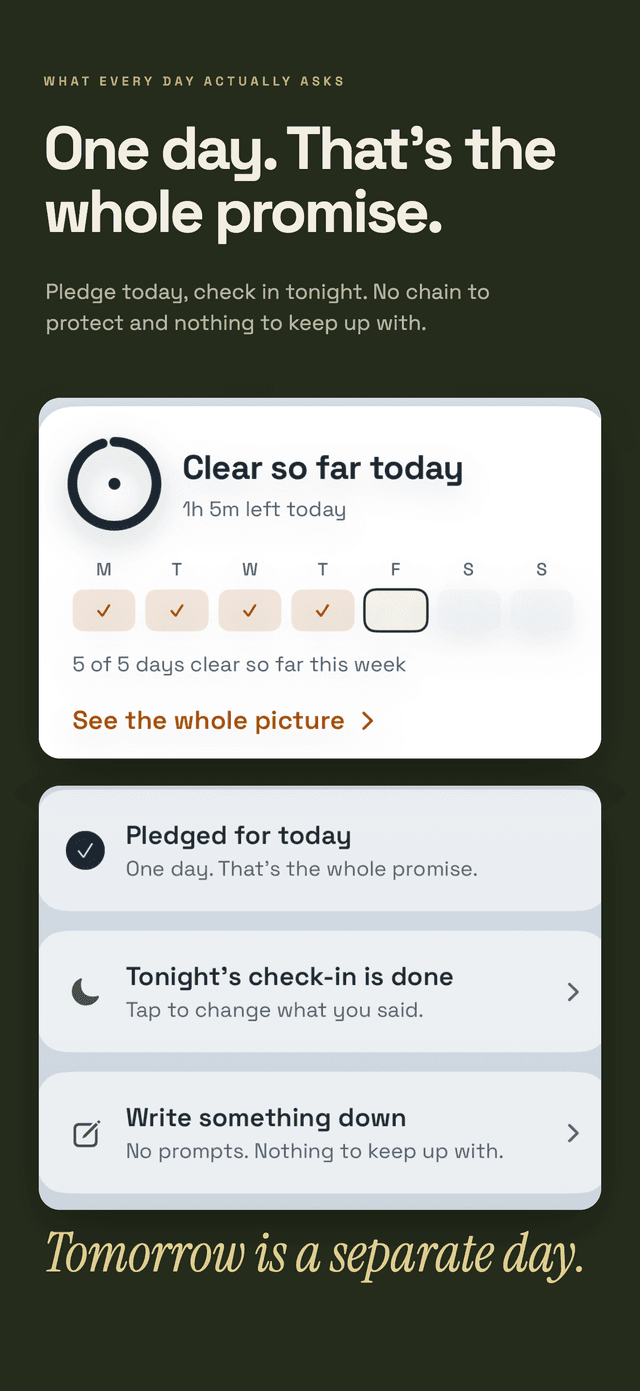
Paper or a basic note can support this method. Hard Bit is an optional iPhone companion that keeps each habit in its own on-device record. It supports stopping or cutting down, and logging a use changes the counter wording without deleting earlier use-free days.
The counter, logging, journal, milestones, hard-moment flow, personal sentence, help links, export, and deletion are free. Hard Bit Plus adds the on-device difficult-hour forecast, advance warning, patterns and calendar, widgets, and short reads. The forecast makes no prediction below five entries and relies fully on your history at around twenty.
Hard Bit has no account, advertising, social feed, third-party analytics, or server copy of your entries. Its optional app lock uses iOS authentication. An export becomes a separate file under your control, so store or delete it deliberately.
The Hard Bit overview explains the workflow, and the support page documents its privacy and subscription boundaries. Our editorial policy explains how health and product claims are reviewed.
Frequently asked questions
Does keeping a cannabis log mean I have a problem?
No. A log records a pattern; it does not diagnose cannabis use disorder. If the pattern worries you or is causing harm, discuss it with a qualified professional rather than trying to diagnose yourself from the entries.
Should I log every session or once a day?
Choose the smallest routine you can maintain honestly. Session-level entries provide more timing detail. A daily summary may be more practical. If logging in the moment is unsafe or distracting, record it later.
How should I log edibles and concentrates?
Record the product, time consumed, labelled dose or rough portion, and context in separate fields. Do not convert unlike products into one supposedly precise number.
Can tracking reduce my cannabis use?
It may help you notice patterns, but research does not show that self-monitoring reliably reduces use by itself. Use the record to guide a practical change or a conversation with a clinician or drug service.
Do I need an app?
No. A notebook or private note can work. An app may make logging, separate habit records, export, and deletion easier, but it cannot assess medical risk or replace treatment.