To measure cannabis progress without streaks, keep four indicators side by side: use days in a fixed period, sessions or another consistent amount measure, a few real-life outcomes, and the time it took to return to your plan after an unplanned session.
A streak can remain on the page if it motivates you. It simply should not be the only evidence you keep.
Why a streak gives an incomplete answer
A streak answers one question: how long has it been since the most recent use? It does not show whether use fell from six days a week to two, sessions became less frequent, spending changed, or you resumed your plan sooner after a difficult day.
A prospective study followed 193 US adults who used cannabis frequently and intended to change on their own. Participants moved repeatedly between usual use, intentional reduction, and abstinence. Most made a reduction attempt, and nearly half made a quit attempt. The sample was self-selected, so its percentages do not predict what any individual will do. It does show why progress rarely fits one uninterrupted line.
If a session happened, keep it in the record. Reviewing a slip without erasing earlier progress can help you decide what to change next.
Start now instead of waiting for a perfect baseline
Do not postpone a change you want to make merely to collect four weeks of baseline data.
If you already have a reliable calendar, diary, purchase history, or app record for the previous 28 days, use it. Otherwise, begin today and label the first seven or fourteen days as your starting period. Compare it with another period of the same length.
WithYou suggests a simple cannabis diary recording the day and time, place, people present, amount, and feelings before and after use. Keep the entry short enough to complete consistently.
Record missing days as not observed, not as use-free. If several days are missing, describe the result as incomplete rather than calculating a precise change.
Make use days your main measure
Count how many observed days included cannabis use. A 28-day window is practical because it includes four examples of each weekday, but it is not a clinical standard.
| Window | Days observed | Use days | Use-day rate |
|---|---|---|---|
| Starting 28 days | 28 | 25 | 89% |
| Next 28 days | 28 | 18 | 64% |
| Latest 28 days | 28 | 11 | 39% |
The latest rate is about 56% lower than the starting rate. That describes one measured change; it does not prove that health or functioning improved by the same percentage.
Use one day boundary throughout. For example, you might count a 1am session as part of the previous evening. The exact rule matters less than applying it consistently.
A methodological review found that cannabis use days were associated with functioning across several studies, while evidence for quantity measures was less consistent. Frequency is also easier to estimate than grams across shared cannabis, edibles, concentrates, and products with different strengths.
If time matters more than the day total, use the separate guide to track the hours you are most likely to use cannabis.
Keep an amount measure, but label it as approximate
Frequency can improve while use on each use day stays the same or increases. Add one amount measure that fits what you can record reliably:
- number of separate sessions,
- number of joints or inhalations,
- portions of an edible,
- labelled dose or strength when available,
- money spent, if product amounts vary too much to compare.
Define a session before you start. Some treatment studies counted occasions separated by at least an hour, but that is a research definition rather than a universal personal rule.
Report sessions per use day as well as total sessions. This prevents a fall in use days from hiding heavier use on the remaining days.
Do not combine unlike products into a falsely exact grams figure. If cannabis is prescribed, discuss dose or schedule changes with your prescriber rather than adjusting treatment from a personal chart.
Track two or three outcomes that matter in daily life
Lower consumption is not the only possible goal. Before reviewing the numbers, choose a few observable outcomes so you do not move the goalposts afterward.
Examples include:
- nights when sleep felt disrupted,
- money spent,
- missed work, study, or household commitments,
- arguments or plans affected by use,
- mornings when memory or concentration felt impaired,
- activities completed that cannabis had been displacing.
Record a count or a short factual note. “Missed one morning class” is more useful than “bad week.”
An exploratory analysis of 920 participants from seven US cannabis-use-disorder treatment trials found that lower frequency and amount were associated with fewer cannabis-related problems, better clinician ratings, and improved sleep scores, but not with the quality-of-life measure used. Because this was a secondary analysis of treatment samples, it cannot show that reduction caused each improvement or predict an individual result.
Sleep also needs context. Withdrawal after stopping or substantially reducing regular cannabis use can involve disturbed sleep, unusual dreams, irritability, anxiety, low mood, appetite changes, restlessness, and cravings. Experiences and duration vary. Mark the date your pattern changed and seek advice if symptoms are severe, worsening, or hard to manage.
Add a measure for returning to your plan
A useful process measure is the time between an unplanned session and the next action consistent with your goal. That action might be recording the event, removing immediate access, contacting someone, or following the next planned use-free period.
Also count supportive actions:
- telling someone what you are changing,
- preparing for a repeated trigger,
- moving supplies out of immediate reach,
- contacting a clinician or drug service,
- using a planned response to an urge.
In the study of adults changing on their own, using at least one coping action during a quit attempt was associated with longer attempts. Telling someone was one of the actions associated with duration. The study was observational, so it does not establish that any one action caused the difference.
For a repeated cue, use the trigger-identification guide. For an urge happening now, follow the safer steps in how to handle a craving in the moment.
Review the dashboard once a week
Use a short weekly summary:
4 use days out of 7 observed; 1.5 sessions per use day; £30 spent; no missed shifts; returned to the plan the following morning.
Then ask:
- Which measure changed?
- Which stayed the same or worsened?
- What was different on the use-free days?
- What is one adjustment for the next repeated situation?
- Do I need more support?
Do not turn one unusual week into a permanent conclusion. Travel, illness, work changes, and missing entries belong beside the numbers.
If you track cannabis alongside nicotine or another habit, keep each habit in its own record.
Do not turn trial percentages into personal targets
The aggregated treatment-trial analysis produced exploratory cutoffs of about 47% fewer use days and 74% less amount for classifying improvement on one clinician-rated measure. Those models performed less well for several other outcomes, and the authors called for further research.
These figures are not recommended personal targets. They came from participants in cannabis-use-disorder treatment trials, included self-reported use, and had limited generalizability. A smaller realistic step agreed with a qualified professional may be more appropriate for you.
The purpose of a personal dashboard is to make change visible, not to decide whether you have passed a clinical test.
Know when tracking is not enough
Speak to a GP, prescriber, or drug service if cannabis is affecting your mental health, work or study, finances, or relationships, or if you cannot keep to limits you intended to follow.
The NHS says a GP can discuss a drug problem and will usually refer you to a local drug service. You can also approach a service directly. In the UK, the FRANK drugs helpline on 0300 123 6600 can talk through the options. Outside the UK, use an appropriate local health or drug service.
Seek urgent local help for severe confusion, hallucinations, intense paranoia, thoughts of harming yourself or someone else, or any immediate danger. Do not drive while impaired or make tracking entries while driving.
Where Hard Bit fits
Paper, a spreadsheet, or a notes app can hold every measure in this guide. Hard Bit is an optional iPhone companion for keeping each habit in a separate, on-device record.
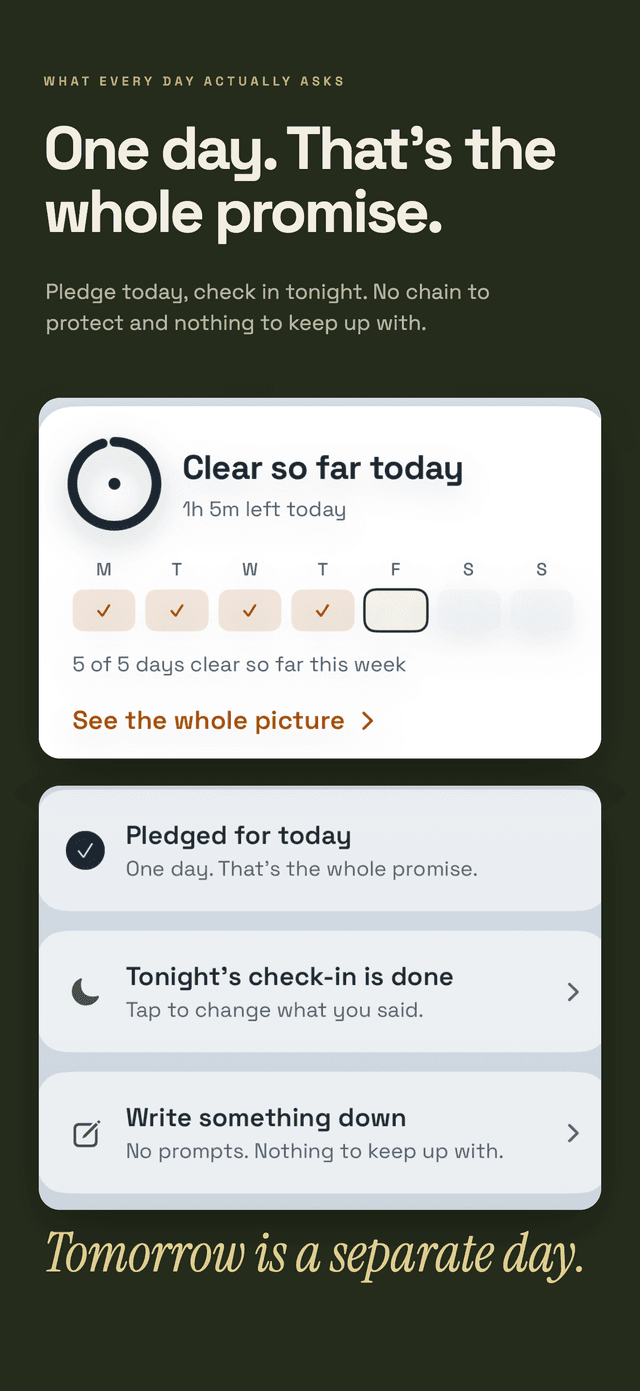
You can choose stopping or cutting down. Logging a use changes the wording rather than resetting the full count, so an earlier clear day remains part of the history.
The counter, logging, journal, milestones, hard-moment flow, personal sentence, help links, and export and deletion tools are free. Hard Bit Plus adds the on-device difficult-hour forecast, advance warning, patterns and calendar, widgets, and short reads. The forecast makes no prediction below five entries and relies fully on your history at around twenty.
There is no account, advertising, social feed, third-party analytics, or server copy of your entries. The Hard Bit overview explains the workflow, and the support page documents the free and subscription features.
Our editorial policy explains how health and product claims are reviewed.
Frequently asked questions
Is a streak still worth keeping?
Yes, if it helps you. Keep it beside use-day frequency, real-life outcomes, and return-to-plan time rather than treating it as the complete record.
What should count as progress?
Progress depends on your goal. It might include fewer use days, fewer sessions, less disruption, following prescribed use more consistently, preparing for triggers, or seeking suitable support. A tracker cannot determine clinical improvement.
What if my use days fall but I feel worse?
Record both facts. Withdrawal, another health condition, or unrelated circumstances may affect sleep and mood. Contact a clinician or drug service if symptoms persist, worsen, or feel difficult to manage.
How should I measure occasional weekend use?
Compare longer, equal periods, such as two complete 28-day windows. Sessions per use day and real-life outcomes may show change even when the number of use days is unchanged.
Do I need an app?
No. A paper table works. An app may make regular logging, separate habit records, export, and deletion easier, but it does not replace professional assessment or treatment.