If you want to stop drinking while cooking, do not treat the whole meal as one long test of resolve. Find the precise step that usually leads to the pour, change what happens immediately before it, and prepare one response that works in a busy kitchen.
That might mean taking an alcohol-free drink from the fridge before the ingredients, choosing a recipe that does not require opening wine, or leaving the kitchen while the oven heats. The useful change is the one that interrupts your own sequence.
Check withdrawal safety before changing your drinking
A kitchen plan is appropriate for a learned cue. It is not a safe substitute for medical advice when physical dependence may be involved.
The NHS states that suddenly stopping can be very dangerous if your body is dependent on alcohol. Withdrawal can begin within 6 to 12 hours of the last drink and usually lasts 3 to 7 days, although some symptoms can continue longer. Possible symptoms include anxiety, trouble sleeping, nausea or vomiting, a racing heartbeat, sweating, shaking, hallucinations, confusion and seizures.
Seek medical help before stopping or reducing if you experience withdrawal symptoms, particularly if they appear when you delay or miss a drink. A GP or alcohol service can assess what support you need.
Visible shaking, severe agitation or distress, confusion, hallucinations or a seizure after stopping are emergencies. In the UK, call 999 or go to A&E without driving yourself. Elsewhere, call your local emergency number or use an emergency department.
The steps below are not a detox plan. They can be used when self-directed change is medically appropriate or alongside advice from your care team.
Map the cooking sequence, not just the hour
NIAAA describes external triggers as people, places, things or times that provide an opportunity to drink or remind someone of drinking. Cooking can combine several of them: the same room, the same time, visible bottles, familiar glassware and repeated pauses between tasks.
For 7 to 14 cooking sessions, record:
- when you started preparing food,
- when you first noticed an urge,
- when the first pour happened, if it did,
- what you were doing immediately beforehand,
- whether anyone else was present,
- what you had eaten and how tired you felt.
Seven days can provide an initial comparison. Fourteen days gives you two examples of each weekday, but neither period proves a permanent pattern. Extend the record if the entries are sparse or the period was unusual.
Keep the notes factual. “Opened the fridge at 6:15; wine was beside the vegetables; urge 7/10” is more useful than “I failed again.”
For a fuller timing method, use the guide to tracking the hours you are most likely to drink.
Find the earliest changeable cue
Read the entries back and identify the first repeated step that you can realistically alter. Common possibilities include:
- opening the fridge and seeing a bottle,
- taking out a wine glass automatically,
- opening wine because a recipe calls for it,
- waiting while the oven heats,
- beginning a repetitive task such as chopping,
- finishing the active preparation and standing at the counter.
Choose the cue shown by your record rather than assuming every example applies.
An earlier change is usually more practical than waiting until a filled glass is in your hand. If opening the fridge is the cue, decide what you will see and take first. If waiting is the cue, decide where you will go or what short task you will start.
If the urge has already become intense, use the in-the-moment craving guide rather than trying to redesign the kitchen during it.
Write one if-then response
Link the cue to one clear action:
- If I open the fridge to start dinner, then I will take out my prepared alternative first.
- If I reach for a wine glass, then I will put it away and use the glass I set beside the chopping board.
- If the oven is heating, then I will leave the kitchen and lay the table.
- If a recipe requires opening wine, then I will choose the alcohol-free recipe I saved instead.
- If my partner pours a drink, then I will ask them to keep it outside the kitchen.
Keep the response brief enough to remember while your hands are occupied.
A systematic review of 16 studies found that implementation intentions, or if-then plans, produced a small average reduction in weekly alcohol consumption. It did not detect a reduction in heavy episodic drinking, and the effects diminished over time. That makes an if-then plan a modest planning tool, not treatment or a guarantee. Review and rewrite it when the situation changes.
Redesign the kitchen before cooking starts
Changing access and routine reduces the number of decisions required during the difficult window. Depending on your goal and medical advice, useful changes may include:
- keep alcohol out of the kitchen or keep little or none at home,
- remove open bottles from the counter and fridge door,
- store alcohol glassware and opening tools away from the preparation area,
- choose recipes that do not require opening alcohol,
- set out your alternative drink before collecting ingredients,
- prepare part of the meal earlier or use a shorter meal on difficult nights,
- eat something before cooking if your entries repeatedly show that hunger matters,
- arrange a call or ask someone to join you during the usual pour point.
NIAAA recommends keeping little or no alcohol at home while changing your drinking. Alcohol Change UK also recommends identifying drinks taken from habit, planning ahead, swapping something in rather than only removing something, and recruiting a trusted ally.
The replacement does not need to resemble wine, beer or spirits. Choose something you will actually use. If an alcohol-free version of your usual drink strengthens the association for you, use an unrelated drink instead. Treat your response as information, not a universal rule.
For a waiting period that needs one simple default, see how to choose one action for a difficult twenty minutes.
Compare cooking sessions and revise one thing
After each session, add four short notes:
- Did the usual pour happen?
- When was the urge strongest?
- Which prepared action did you use?
- What would make the next session easier?
Use any urge scale only to compare your own entries. It is not a medical measurement.
After a week, compare sessions with similar meals and start times. Look for practical differences. Perhaps the plan worked when the alternative was already visible but not when it was still in the cupboard. Perhaps the urge moved from the fridge-opening moment to the period after the food went into the oven.
Change one condition for the next comparison. Replacing everything at once makes it difficult to tell what helped.
If you drank, keep the entry. The guide to responding after a slip explains how to update a plan without erasing earlier progress.
Where Hard Bit fits
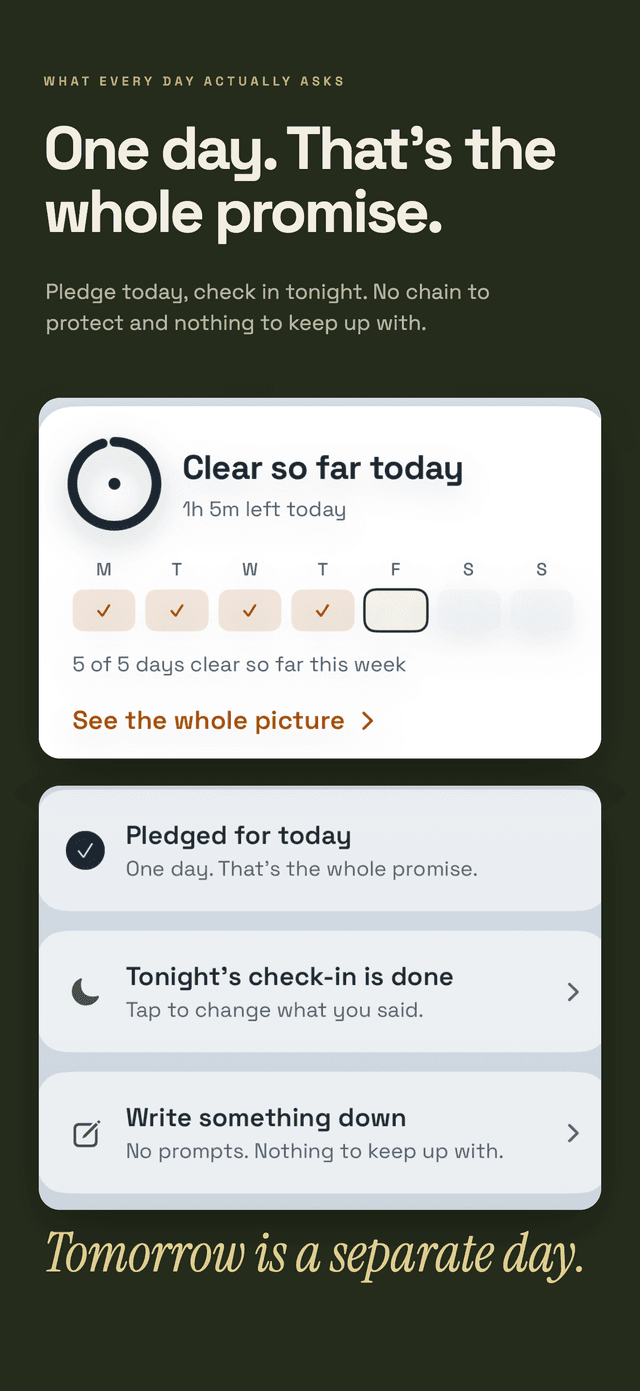
Paper or a notes app is enough for this exercise. Hard Bit is an optional iPhone companion that keeps the cooking window in your private drinking record.
The counter, logging, journal, hard-moment flow, personal sentence, help links, and export and deletion tools are free. A subscription adds the difficult-hour forecast, advance warning, patterns, calendar, widgets and short reads.
The forecast makes no prediction below five entries and relies fully on your history at around twenty. It describes a time that has been difficult in your record; it does not predict that you will drink. The app stores the record on your device and does not require an account.
The Hard Bit overview explains the workflow, while the support page documents the feature and subscription boundaries.
Know when a cue plan is not enough
Contact a GP, clinician or alcohol service if urges remain difficult to manage, you repeatedly drink more than intended, alcohol is harming your health or daily life, or you are worried about dependence.
Treatment can include medical support for withdrawal, talking therapies and medicines that help reduce cravings or support abstinence. A clinician can explain which options are appropriate. A tracker cannot assess withdrawal risk, diagnose alcohol-use disorder or replace treatment.
Seek emergency help for severe withdrawal or any immediate danger. The Daily Life Apps editorial policy explains how health information and product descriptions are reviewed separately.
Frequently asked questions
How long will the urge last while I cook?
There is no reliable fixed duration. An urge may rise and ease, remain present, or return later. NIAAA lists distraction, leaving the situation and riding out an urge among possible responses. Plan for the next safe action rather than relying on a countdown.
Should I stop cooking for a while?
You do not have to prove that you can complete a long cooking session immediately. A prepared meal, a short recipe, batch cooking or occasional takeaway can reduce exposure to the cue while you establish another routine. Choose an option that fits your budget, health needs and responsibilities.
Can I still cook with wine?
Base the decision on your goal and observed cue. If opening the bottle reliably leads to drinking, choose a recipe written without it rather than testing yourself. If your goal requires avoiding alcohol entirely, remember that recipe substitutions and retained alcohol vary by dish, so use an alcohol-free recipe.
What if my partner drinks while I cook?
Make one specific request. You could ask them to keep their drink outside the kitchen, avoid offering you one, pour your alternative first or handle dinner on a particularly difficult night. A concrete request is easier to act on than a general request for support.