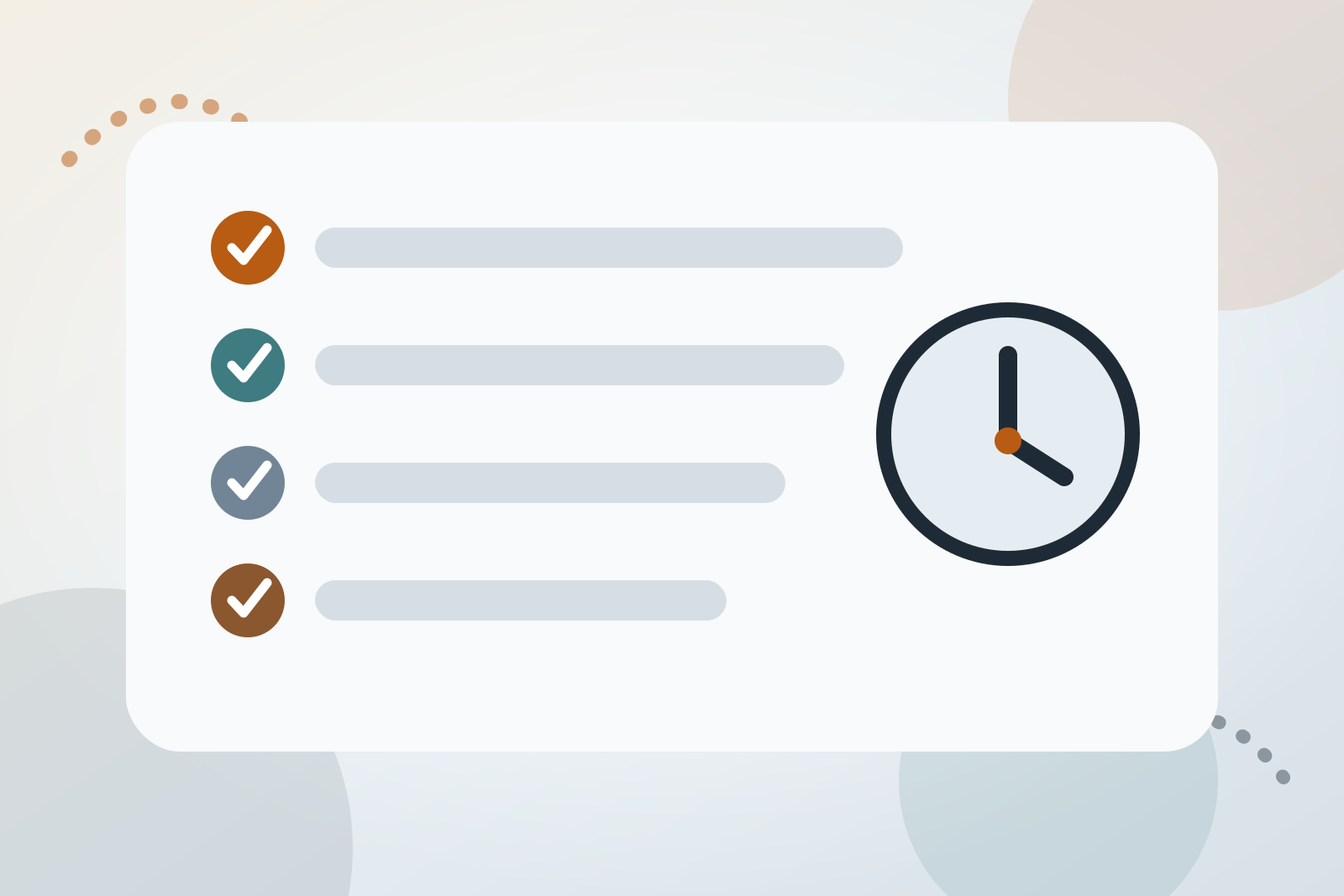
A useful twenty minute craving activity is not necessarily the most impressive option. It is one that fits where you are, what you can safely access, who is nearby, and how much attention you have.
Ask four questions: Can I leave? Is the habit still within reach? Do I need another person? How much of the next twenty minutes is actually mine? Choose one action you can begin now and give it a clear endpoint.
Twenty minutes is a planning block, not a promise that the urge will disappear when the time is up.
If withdrawal, thoughts of self-harm, or immediate danger may be involved, go to the safety section rather than relying on an activity.
Why twenty minutes is a planning unit
Claims that every craving lasts twenty minutes are not well supported. Cravings vary by person, habit, withdrawal state, and situation. They may ease, return, or remain strong beyond any timer.
The Australian alcohol and drug service Counselling Online describes a craving as a wave that builds, peaks, and breaks. It says peak intensity rarely lasts beyond a few minutes, but that does not establish one duration for every craving. NIAAA describes alcohol urges as short-lived while offering several coping methods rather than a fixed countdown. Mayo Clinic suggests a ten-minute distraction for nicotine cravings, again as a coping step rather than a guarantee.
Twenty minutes is useful because it makes the decision smaller. You are choosing what to do next, not making an irreversible promise about the rest of your life.
If you need a sequence for the first moments, use the five-minute plan for the start of a craving. This guide addresses the next question: which activity should fill the remaining time?
Choose by constraints, not ambition
Long lists become another decision problem. Narrow the choice with these questions:
- Can I leave this place safely? If not, remove walks, errands, and anything requiring another room.
- What access remains? Notice the bottle, vape, card, account, device, or route connected to the urge. Do not remove alcohol or medication abruptly if withdrawal may be a concern.
- Who is nearby? Another person may provide company or practical help, but privacy and personal safety come first.
- How much energy do I have? A late-night plan should not depend on concentration or motivation you do not have.
- How much time is genuinely available? Work, driving, and caring responsibilities may leave only a few safe minutes.
Choose the action that survives those questions. Emptying the dishwasher may be more useful than planning a run that you cannot begin.
NIAAA recommends preparing short, mid-range, and longer alternatives for different situations. The principle is not that one activity is universally best. It is that your options should fit the moment.
Pick from four practical types of action
Sort possible activities by what they do rather than keeping one unstructured list.
Change location. Walk to the end of the street, sit in a shared room, take a shower, visit a public place, or use a route that avoids the usual cue. Choose somewhere safe where the habit is harder to continue.
Use your body. Walk indoors or outside, stretch, carry laundry, or complete a short physical task. A meta-analysis found that short bouts of physical activity reduced cigarette craving among temporarily abstinent smokers who were not using cessation medicines. That evidence concerns cigarette craving, not every habit, and it does not mean exercise replaces treatment.
Occupy your hands or attention. Wash dishes, prepare tomorrow's lunch, clear one shelf, make tea, or listen to one saved audio track. Give the task a visible endpoint. “Clear the kitchen counter” is easier to finish than “tidy the house.”
Bring in another person. Call someone, send a prewritten message, or sit near a trusted person. NIAAA recommends talking an alcohol urge through with someone you trust and arranging support in advance.
Pick one type first. Combining several elaborate activities can make it harder to start any of them.
Pair distraction with a practical barrier
An activity changes what you are doing. A barrier changes what is immediately possible. When access is central to the urge, using both may be more useful than distraction alone.
Depending on the habit and your safety needs, that could mean:
- putting a phone on charge outside the room,
- signing out of an account,
- removing a saved shortcut,
- leaving a usual route,
- asking a trusted person to hold a payment card with your agreement,
- starting an official gambling self-exclusion process,
- moving to a place where smoking or vaping is not permitted.
Do not discard alcohol or alter a prescribed sedative medicine as a craving exercise if physical dependence may be possible. A clinician should help you plan a safe change.
Barriers are not guarantees. Their advantage is that some remain in place after the activity ends.
Match the choice to the habit and situation
The selection method can be used across habits, but the details should change.
- Alcohol: If withdrawal is not a concern, distance from the usual shop, route, or drinking setting may help. If you may be dependent, contact a clinician or alcohol service before changing use abruptly.
- Smoking or vaping: Mayo Clinic suggests options such as sugarless gum, raw carrots, nuts, sunflower seeds, water, or a short walk. An official quit service can also discuss counseling and cessation medicines.
- Cannabis: If the urge appears during a repeated transition, such as arriving home, choose an action that changes that particular sequence. Do not assume every cannabis craving has the same trigger.
- Gambling: Pair the activity with protection for money and access. Self-exclusion and specialist support may matter more than finding a more absorbing distraction.
- Pornography or private device use: Moving the device or spending time in a shared, safe space may change the conditions around the urge.
- Scrolling or gaming: Choose an alternative with a clear stopping point. Another screen activity may still be useful, but check whether it leads straight back to the original app or game.
For a broader response that includes naming the urge, changing the cue, and deciding whether to seek help, read how to handle a craving in the moment.
Choose an option when you cannot leave
You may be at a desk, in a waiting room, beside someone who is asleep, or somewhere else you cannot leave.
Options that need little space include:
- move the device, glass, or other cue out of immediate reach,
- change chairs or face away from the cue,
- write down the time and what happened just before the urge,
- drink water slowly,
- chew gum if it is safe for you,
- send one brief message,
- take five slow breaths if that feels comfortable,
- complete one small task already in front of you.
You can also observe the urge rather than distract yourself. Urge surfing explains that method and the limits of its evidence.
While driving, do not handle your phone or attempt anything that takes attention from the road. Wait until you arrive or pull over safely.
Keep three realistic options ready
Choose your shortlist while you are calm:
- If I can leave: for example, walk to the postbox and back.
- If I cannot leave: for example, make tea and clear the kitchen counter.
- If access is the main problem: for example, charge the phone in the hall or sign out of the account.
Write the exact first step. “Go for a walk” still requires decisions. “Put on shoes and walk to the postbox” is ready to begin.
Rehearse each option once. Replace any option that depends on unavailable money, equipment, privacy, or energy.
Record whether the action helped
Counselling Online recommends noting what works and repeating it. Keep the record short:
- time and place,
- what happened just before the urge,
- action chosen,
- urge intensity before and after on the same personal scale,
- whether you used the habit.
A few entries do not prove that an activity works or reveal what caused the craving. They can show whether an option was practical enough to use. Review after several real opportunities and replace choices that repeatedly remain untouched.
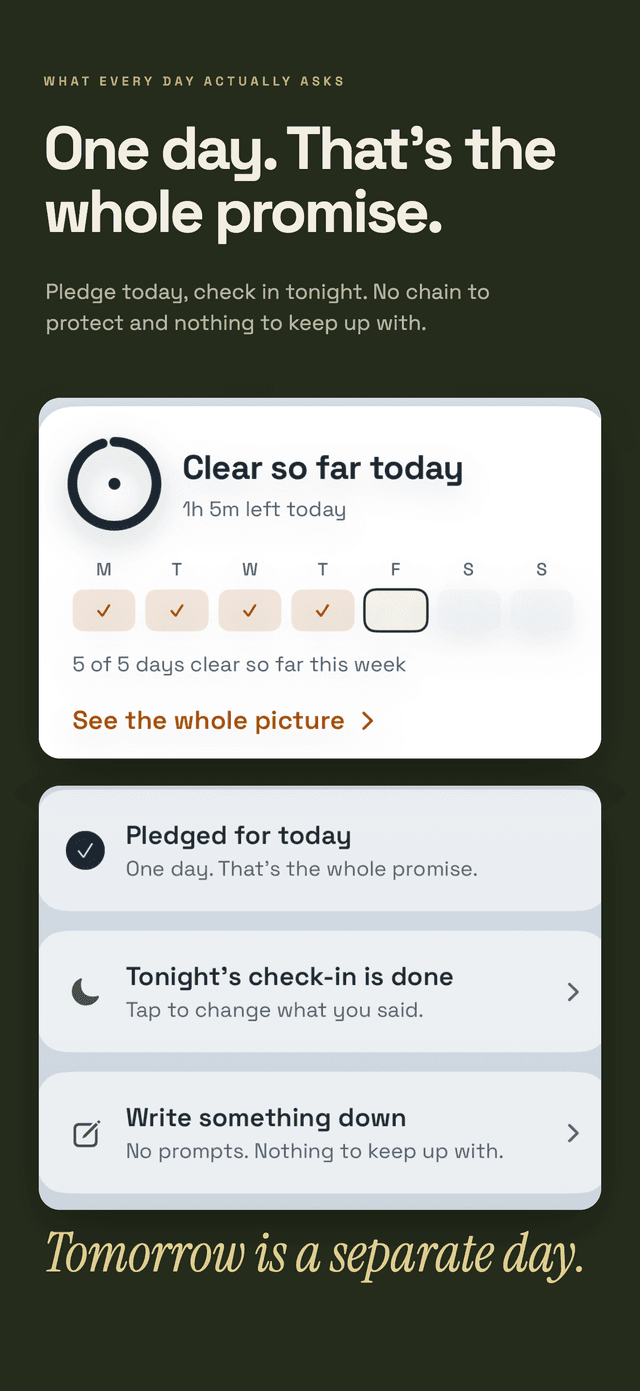
Hard Bit is a private iPhone craving tracker. Its free hard-moment flow runs for about twenty minutes and includes a breathing circle, your saved sentence, and a final question. Logging, the journal, export, and deletion also remain free. Hard Bit Plus adds the on-device forecast, advance warnings, pattern views, calendar, widgets, and short reads. The app makes no forecast below five entries and relies more fully on personal history at around twenty entries.
Those entry thresholds are product rules, not clinical standards. How many logs you need before a pattern means anything explains the distinction. The Hard Bit overview describes the app, while a notebook can support the same simple review.
When an activity is not enough
A twenty-minute activity is for an urge you can manage safely. It is not a withdrawal plan, emergency response, or substitute for treatment.
If you may be physically dependent on alcohol, the NHS warns that stopping overnight can be harmful. Seek medical advice before stopping completely. Call local emergency services for severe withdrawal symptoms such as hallucinations, severe tremors, or seizures. In the UK, call 999.
The FDA also warns that abruptly stopping or rapidly reducing benzodiazepines can cause serious withdrawal reactions. Speak to the prescriber or another qualified clinician before changing the dose.
Seek immediate or specialist help for:
- thoughts of harming yourself or someone else,
- overdose risk, loss of consciousness, or breathing difficulty,
- unsafe driving, violence, or another immediate danger,
- gambling losses or debt you cannot manage safely,
- urges that repeatedly feel unmanageable with self-help alone.
If the activity ends with you using the habit, keep the event in context. What to do after a slip without erasing your progress explains how to check safety and change one condition without deleting earlier progress. The editorial policy explains how Daily Life Apps reviews health and product claims.
Frequently asked questions
Do cravings really last twenty minutes?
Not reliably. Duration varies, and cravings may return in waves. Use twenty minutes as a manageable planning block, not a biological rule or promised endpoint.
What if the urge remains after twenty minutes?
Reassess safety first. You can choose another prepared activity, change the environment, or contact someone. Persistent or dangerous urges deserve professional support rather than repeated timers.
Should the activity be enjoyable?
It can be, but enjoyment is not required. A plain task with a clear endpoint may be easier to begin. The important test is whether it fits the situation and helps you reach the next deliberate decision.
Does it matter which action I choose?
The choice matters most when safety or access is involved. If money, a device, a route, or another cue makes the habit immediately available, pair the activity with an appropriate barrier.
Do I need an app?
No. A written card, notebook, and support contact are enough. Hard Bit can hold your saved reason, guide the hard moment, and keep a private on-device record, but it cannot assess medical risk or replace professional care. Product details are available on the Hard Bit support page.