When the same slip happens again, don't just repeat the old plan with more determination. Put the repeats side by side and find what they share. Then work out which part of the plan failed: the warning, the barrier, the action you planned, the support, or the goal itself. Change that one part and move it earlier in the sequence. Then watch what happens the next time the situation comes round.
A slip that happens once can be a surprise. A repeated slip that follows the same route three times is information you can use to change the plan.
Check whether the repeats are escalating
Before you analyse anything, ask whether the pattern is becoming more dangerous. More money each time, larger amounts, driving afterwards, withdrawal symptoms, hiding things from people you live with, or thoughts of harming yourself all change what kind of plan you need.
If you may be physically dependent on alcohol or sedatives, don't respond to repeated slips by stopping suddenly on your own. Get medical advice first. Severe confusion, seizures, hallucinations, or breathing problems need urgent help.
If gambling slips are creating debt or urgent money problems, put practical barriers in place now. The NHS gambling guidance lists self-exclusion, blocking software, and asking your bank to block gambling payments.
If you're in immediate danger, contact emergency services. The rest of this guide can wait.
Put two or three repeats side by side
Reading one slip at a time tends to produce one story at a time: "I was stressed," "it was a bad week." Reading the repeats together shows what they have in common.
Write a short line for each, with the same headings:
| Slip 1 | Slip 2 | Slip 3 | |
|---|---|---|---|
| Day and time | |||
| Where I was | |||
| What happened first | |||
| What I told myself | |||
| What made it easy | |||
| What my plan said to do | |||
| What I actually did |
Then circle anything that appears in every column. One example: a Thursday, after a late shift, walking home past the same shop, with the thought "I've earned one."
If you only have two repeats, treat the overlap as a lead to check, not a verdict. How to Separate a Pattern From a Coincidence explains how to avoid building a plan around a one-off.
Public-health guidance already asks people to learn from a slip. MedlinePlus suggests working out why it happened and planning what you will do the next time you are in the same situation. Comparing several slips makes that question sharper. You aren't asking what went wrong once. You're asking what keeps going wrong in the same place.
Find the layer of the plan that failed
One useful way to read a plan is as five layers, even if you never wrote them down. A repeated slip often means one of them isn't working.
- Warning. Did you see the situation coming? If every slip felt sudden, the warning layer is missing.
- Barrier. Was the substance, app, money, or device within easy reach? If you noticed the urge but access took seconds, the barrier layer is too thin.
- Action. Did you have something specific to do instead, and could you actually do it at that hour? A plan to go to the gym fails at 11pm.
- Support. Was there a person or service you could reach in that moment? If your support only exists during office hours and your slips happen at night, there's a gap.
- Goal. Is the goal itself realistic and safe for your situation right now? Repeated slips on a cut-down limit can mean the limit is unclear, or that stopping completely would be easier to hold. The opposite can also be true.
Look at the "what my plan said to do" row. If the plan said nothing, the warning layer failed. If it said something you didn't do, ask why. Was the action unavailable, too vague, or blocked by a thought like "today doesn't count anyway"?
That last thought matters. Marlatt's relapse-prevention model proposes that guilt and self-blame after a lapse can make a fuller relapse more likely, and calls this the abstinence violation effect. So it's practical to plan for "I've already blown it" as a predictable thought rather than a fact.
Change one layer, not the whole plan
After a run of slips, it's tempting to overhaul everything at once: new rules, new apps, new routines, a new start date. Big overhauls can be hard to keep up, and when they fail you can't tell which part didn't work.
Change the layer you identified, and only that one:
- Weak warning: set one reminder for the hour before the difficult hour, or ask someone to message you then.
- Thin barrier: add friction that works at the point of access. For example, don't carry a card on that route, take the app off the phone, keep the drink out of the house, or remove the saved payment method.
- Unrealistic action: replace it with something you can start in under a minute at that hour and in that place. How to Choose One Action for a Difficult Twenty Minutes can help you pick one that fits.
- Missing support: find someone or something you can actually reach at that time, such as a quitline, a friend on a later schedule, or a recovery worker who knows about the pattern.
- Mismatched goal: reconsider the goal with professional input, especially if alcohol, sedatives, or other drugs are involved.
Smokefree.gov makes a similar point about setbacks: look at what helped and what led back to smoking, and use what you learn next time rather than simply repeating the same attempt.
Move the change earlier in the sequence
Repeated slips often happen because the plan steps in at the last possible moment: at the shop counter, with the betting app already open, with the vape in your hand. By then the urge is often at its strongest and the action is easiest.
Look back along your comparison table for the first point that appears in every repeat. That's usually where a change costs the least effort.
Some examples of moving a plan earlier:
- A Friday drinking slip that always starts on the walk home might change at the station, not at the fridge.
- A late-night scrolling slip that always follows taking the phone to bed changes at the charger in the kitchen, not at the 40th video.
- A Saturday betting slip that always follows a pre-match odds notification changes when notifications are turned off on Friday, not when the bet slip is filled in.
- A morning vaping slip that always follows the first coffee changes where the coffee is drunk, not when the craving peaks.
Write the new plan as a single if-then line tied to that earlier point: "If I'm on the train home on Thursday, I'll text my sister before my stop." Keep it short enough to fit on a short craving emergency card.
Test the change on the next occurrence
Treat the new plan as a test, not a vow. Decide in advance what you'll check after the situation next comes round:
- Did the warning arrive in time?
- Did you use the changed layer?
- If the slip happened anyway, did it happen at the same point or a later one?
- Was the slip smaller, shorter, or cheaper than before?
A slip that happens later in the sequence, or with less harm, is useful evidence even though it's still a slip. It suggests the change reached the right part of the pattern and may need strengthening rather than replacing. How to Notice Reduced Frequency as Real Progress covers how to read that kind of change honestly.
If the new layer didn't fire at all, go back to the five layers and check whether you picked the wrong one.
Keep the record honest so the comparison works
This whole method depends on an accurate history. If you delete the slips or reset everything to zero after each one, you lose the record that lets you compare repeats.
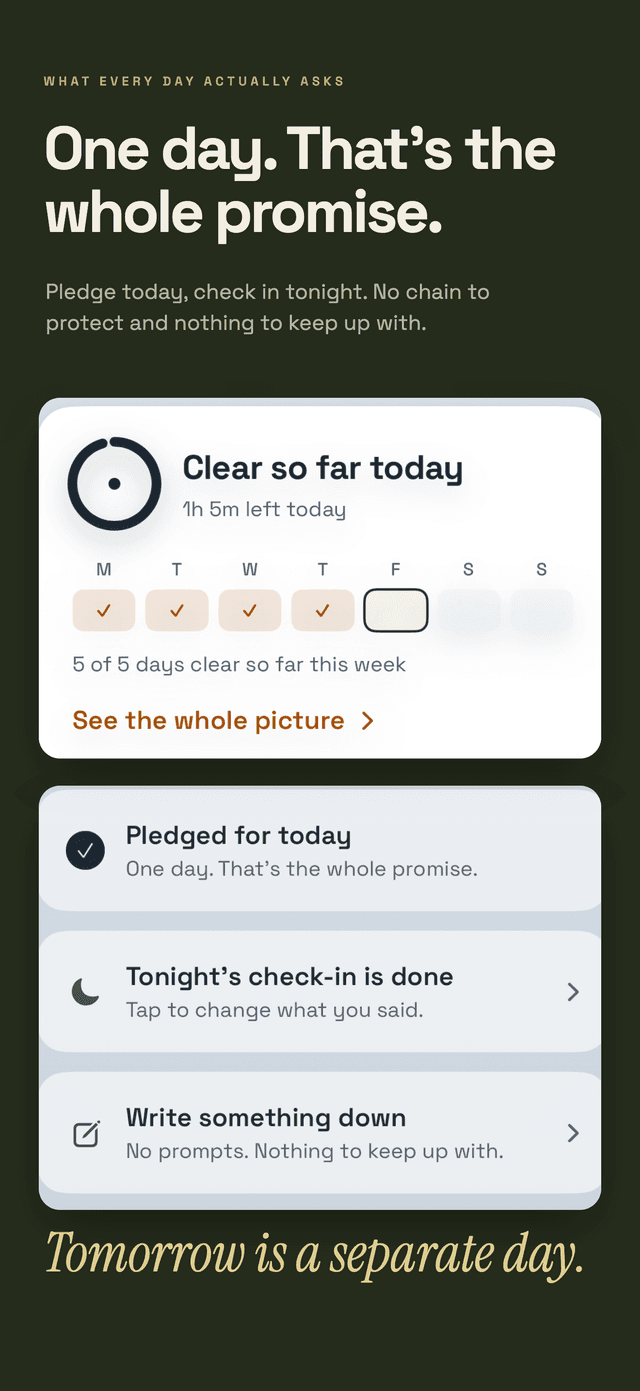
If you use Hard Bit, logging a use keeps that day in the habit's history without resetting the counter. Each habit keeps its own logs and difficult hour, so a Thursday drinking pattern doesn't blur into a late-night scrolling pattern. With Hard Bit Plus, the patterns and calendar views can help you spot repeats by weekday and hour, and the forecast can warn you before a difficult hour. The forecast is calculated on your phone from your own entries, and it makes no prediction until you have at least five. The Hard Bit overview explains how this works. Paper works too. What matters is keeping the slips and the clear days in one timeline.
A weekly look-back makes repeats easier to catch early. How to Review a Week of Craving Logs gives a simple structure.
Know when repetition means you need more support
Some patterns don't give way to better planning alone. Consider professional support if:
- the same slip has continued through several honest plan changes,
- the slips are becoming more frequent or more harmful,
- you notice withdrawal symptoms,
- debt, relationships, work, or safety are getting worse,
- you're keeping the pattern from everyone.
WithYou treats a lapse as a chance to learn, and suggests telling your recovery worker or the people supporting you so they can help. For smoking and vaping, MedlinePlus notes that medicines and nicotine replacement can help. A quit service or doctor can explain options that self-management can't replace. For gambling, specialist services and practical barriers such as self-exclusion can matter more than any coping technique.
A tracker or a written plan can help you describe the pattern clearly to someone qualified. It can't assess medical risk or decide what level of care you need. Our editorial policy explains how we separate general information from medical advice.
If you've just had another slip and need to steady things first, start with What to Do After a Slip Without Erasing Your Progress, then come back to this comparison when you're calmer.
Frequently asked questions
How many repeats do I need before changing the plan?
There's no fixed number. If the same situation has led to a slip twice, it's reasonable to compare the two and test one change. Treat the overlap as a working guess and keep checking it against later entries.
Should I switch from cutting down to stopping completely?
Sometimes repeated slips mean a cut-down limit is too vague or too easy to renegotiate. Sometimes a stop goal isn't safe or realistic right now. For alcohol, sedatives, or other drugs, talk to a clinician before changing the goal, because stopping suddenly can carry withdrawal risks.
What if I can't find anything the slips have in common?
Widen what you record. Add sleep, food, money, people present, and the thought right before the slip. Also look at the clear days: what was different when the situation didn't lead to a slip? If nothing repeats after several weeks, the slips may be driven by something better explored with a professional.
Does a repeated slip mean the plan is useless?
No. It usually means one part of the plan doesn't fit the situation it meets. Keep what works, change the layer that keeps failing, and add support when changing the plan alone isn't enough.