Reduced habit frequency is progress when it holds up under a fair comparison. Write down how often the habit happened in a baseline window. Count the same thing over a later window of the same length. Check that each occasion has not become bigger, more expensive, or more harmful. If the later window shows fewer days with use and longer gaps between them, something real has changed, even if you have not stopped completely.
This kind of change is easy to miss. A streak only resets, so a month that went from daily use to twice a week can look the same as a month where nothing changed.
Why fewer times can count as real change
People often discount a reduction because it is not the end goal. "I still did it on Saturday" can erase four weeks of real change.
There is some research support for taking reduction seriously. A pooled analysis of seven treatment trials for cocaine use disorder, published in Drug and Alcohol Dependence, sorted people into three levels: no use, 1–4 days a month, and 5 or more days a month. People who dropped at least one level by the end of treatment used less and had better functioning on several measures for up to a year than people who did not.
Treat that as specific evidence, not a universal rule. It comes from one substance, in a treatment setting, with researchers measuring outcomes. It does not prove that fewer gaming sessions or fewer scrolling episodes bring the same benefits. What it does show is that some clinical researchers count a drop in frequency as a meaningful outcome, not just a failed attempt to stop completely.
Public guidance on cutting down points the same way. NHS alcohol advice suggests having several drink-free days each week. Drinkaware notes that keeping track of how much you drink and how you are progressing can help people who are cutting down.
Set a baseline you can compare fairly
You cannot notice reduced frequency without something to compare it with. Memory tends to be unreliable here: it can exaggerate a bad stretch or play down a habit that felt normal.
Build a baseline from the most honest source you have:
- logs you kept before changing anything,
- bank or betting statements,
- screen-time reports or console play history,
- receipts or purchase records,
- a calendar you rebuild from those records, with uncertain days marked as uncertain.
Then pick one window length and keep it. Seven days gives quick feedback; twenty-eight days smooths out weekday and weekend differences. Neither is a clinical standard. The guide to measuring clear days without worshipping a streak covers window choice and unlogged days in more detail.
Write the baseline as one plain sentence, for example: "Weeks 1–4: vaped on 24 of 28 days." That sentence is what every later window gets compared with.
Count frequency three ways
"How often" can mean several things, and each one shows something different.
- Days with use. How many days in the window included the habit at all? This is the easiest number to keep accurately.
- Episodes. How many separate times did it happen? Three short gambling sessions on one evening is a different pattern from a single session.
- Gaps between uses. What was the longest stretch without the habit, and what was the typical one? Gaps that keep getting longer can show progress that a day count misses, especially early on.
Here is an invented example for one person cutting down on evening gaming:
Baseline (weeks 1–4): played on 26 of 28 days, about 34 sessions, longest gap 1 day. Current (weeks 9–12): played on 15 of 28 days, about 17 sessions, longest gap 4 days.
None of those numbers is perfect, but together they describe a change that a single streak would not show.
Check that the habit has not just changed shape
Fewer occasions only count as progress if the rest of the picture is not getting worse. Before you call it a gain, check these:
- Amount per occasion. Drinking on fewer nights but more on each one may not reduce harm.
- Money. Fewer bets with bigger stakes, or chasing losses after a gap, can mean the same or greater financial damage.
- Duration. Fewer gaming or scrolling sessions that each run much later into the night can cost more sleep than before.
- Substitution. If vaping dropped while smoking went up, or scrolling replaced gaming, the overall pattern may not have improved.
- Consequences. Missed work, arguments, debt, or health symptoms matter more than any count.
Keep a separate record for each habit so a change in one does not hide a change in another. The guide to tracking more than one habit without mixing the data explains how to set that up. For a habit-specific example, see measuring gambling progress beyond a perfect streak.
If amount or harm has risen, say so plainly. An honest record that shows a mixed result is more useful than a flattering one.
Separate a real trend from a lucky week
One quiet week can come from illness, travel, a lack of money, or a different work schedule rather than a lasting change. Before you treat a drop as a trend, look for:
- Persistence. Does the lower frequency hold across two or more windows of the same length?
- Comparable conditions. Did the later window include the situations that used to be hardest, such as payday, a holiday, or a late shift?
- Complete records. Did you log the later window as carefully as the baseline? Missing days can look like clear days.
If a week was unusual, write down why and do not count it as evidence either way. For more on telling a signal from noise, read how to separate a pattern from a coincidence.
A weekly review helps you avoid both checking constantly and forgetting entirely. The weekly craving-log review gives you a short structure for doing it.
Know when less often is not yet enough
Reduced frequency is real, but it is not always a safe stopping point. This is where established guidance matters more than personal tracking.
Smoking. A BMJ meta-analysis of 141 cohort studies, summarised by University College London, found that smoking about one cigarette a day still carries a much higher risk of heart disease and stroke than expected, and the researchers advised quitting rather than cutting down. If you smoke less, that change happened, but a stop-smoking service, pharmacist, or clinician can talk you through support and treatment options for stopping completely.
Alcohol and sedatives. If you may be physically dependent, do not reduce quickly or stop suddenly without medical guidance. The NHS explains that stopping drinking suddenly can be dangerous for someone who is dependent. The FDA warns that stopping benzodiazepines abruptly or cutting the dose too fast can cause serious withdrawal reactions, including seizures, so any reduction should be planned with the prescriber. Severe shaking, hallucinations, seizures, or confusion need urgent medical help.
Gambling. Fewer sessions do not cancel rising debt. If money is at risk, put practical barriers in place, such as bank gambling blocks or self-exclusion. The Gambling Commission describes self-exclusion for people concerned about the time or money they spend gambling. Specialist gambling support and free debt advice can help too.
Any habit. If you have thoughts of harming yourself, face immediate danger, or have repeated serious consequences, contact emergency services or a qualified service now. Do not wait for a measurement window to finish.
Describe the progress without inflating it
Once you have the numbers, put them into one accurate sentence. A useful format:
"Compared with my baseline, I [did the habit] on [X] of [Y] days instead of [A] of [B]. Amount per occasion was [similar / lower / higher]. One thing still needs attention: [issue]."
For example: "Compared with March, I gambled on 6 of 28 days instead of 19 of 28. Stakes were similar. Paydays are still my hardest days."
That sentence counts the change without claiming it is finished. It also gives you a concrete next step and something clear to tell a supporter or professional.
If a difficult day lands in the middle of a better month, keep it in the same record. Responding to a slip without erasing your progress explains how to put safety first and change one condition.
Where Hard Bit fits
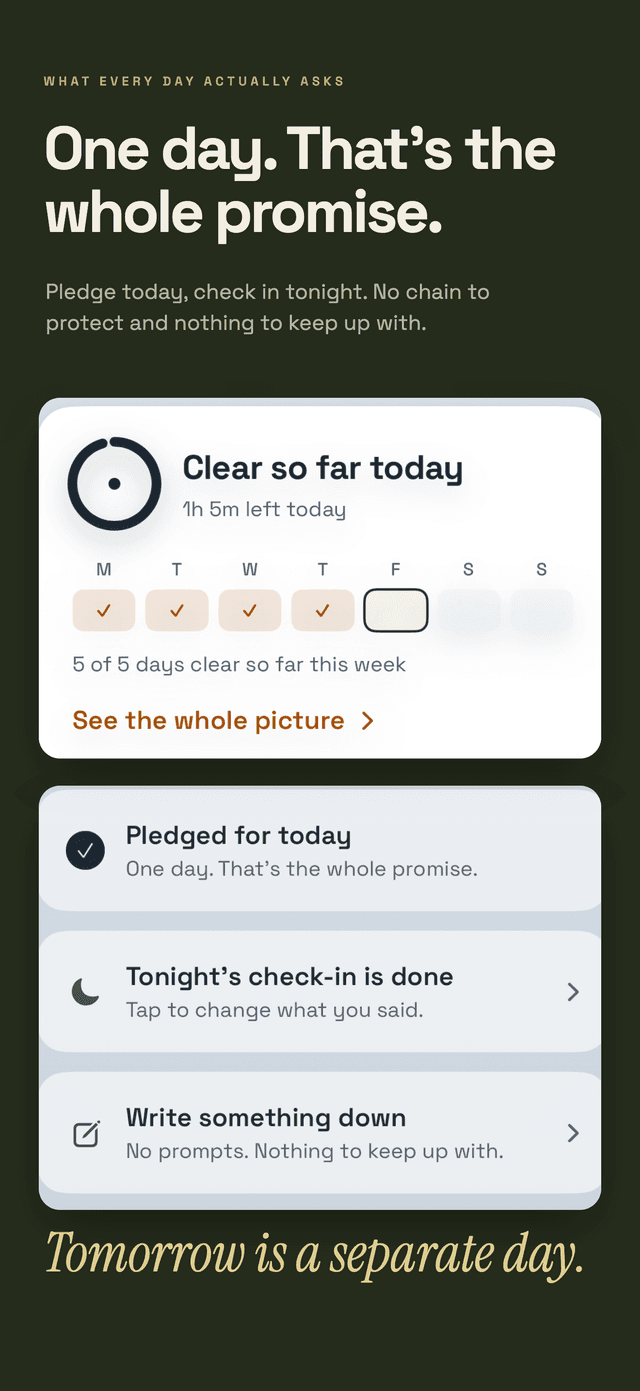
Hard Bit is an optional iPhone craving tracker, not a treatment or a clinical assessment. You choose whether to stop or cut down for each habit, and each habit keeps its own counter and logs. In cut-down mode, the app counts use-free days and lets you set your own weekly line, so a planned use does not wipe anything out.
The counter does not reset after a logged use, so earlier days stay in the history when you compare windows. Logging, the journal, and export are free, so you can export your entries and count days, episodes, and gaps yourself. Hard Bit Plus adds patterns and a calendar view.
Entries are stored on your phone, with no account, and an export goes only where you choose to send it. The Hard Bit overview describes the workflow, and the support page lists current features. An app can only describe what you record: it cannot judge whether a reduction is safe for you.
Our editorial policy explains how we review health information and keep it separate from product details.
Frequently asked questions
Does cutting down count as progress if my goal is to stop completely?
It can. Fewer occasions is a real change, and recording it accurately may help you plan the next step. Keep the final goal visible too, and get support if the reduction stalls or if the habit carries risks that cutting down does not remove.
How long should my comparison windows be?
Pick a length that covers your usual pattern and keep it the same. A week gives fast feedback; four weeks shows weekday and weekend patterns more fairly. Consistency matters more than the exact number.
What if I use less often but more each time?
Then frequency has improved while amount has got worse, and the overall result is mixed. Record both. Bigger amounts can increase harm, especially with alcohol or gambling, so talk to a qualified service if this keeps happening.
Should I track frequency if counting makes me anxious?
Simplify it. Count days with use once a week rather than checking during the day. If tracking leads to dishonest entries, compulsive checking, or harsh self-criticism, pause it or talk with a professional about another approach.
What should I do if my frequency stopped falling?
A plateau is common and is still information. Compare the windows where it stalled with earlier ones: did a new trigger, schedule, or source of money appear? Change one condition and review it again over the next window. If the plateau sits at a level that still causes harm, or the habit involves dependence, debt, or smoking, bring your record to a qualified service rather than waiting for the numbers to move on their own.