
If you want short drinking journal prompts, here is the whole method in one paragraph. Write five lines each time you drink or feel a strong urge to: the time, what you drank or wanted, where you were and who with, what happened just before, and one word for how you felt. That takes about two minutes. Once a week, read the entries back and pick one change for the next seven days.
You don't need a blank page, a morning ritual, or a page of reflection. A short entry you actually write is worth more than a long one you keep putting off.
Why a short entry is enough
The public-health tracking guidance we checked asks for details, not depth. NIAAA's Rethinking Drinking site offers printable tracker cards for marking down each drink, plus a separate card for looking at what tends to lead to drinking and what follows it. Norfolk County Council's drink-less guidance suggests writing down what you drink and when, recording every drink however small, and noting the triggers that make drinking more or less likely.
None of that needs paragraphs. The guidance asks for things you can record in a few words: type of drink, amount, time, place and trigger.
Journaling adds one thing a plain diary leaves out, which is a brief note of what was going on inside you. That line can be a single word. Our editorial view: the value comes from writing the same few details every time, not from writing at length. We haven't found strong evidence that one journaling format changes drinking by itself, so treat this as a way to notice patterns, not as a treatment.
The five-line entry
Use the same five lines every time, so you never have to decide what to write.
- When: the time, and the day if it isn't today.
- What: what you drank and roughly how much, or "urge only" if you didn't drink.
- Where and who: the room or place, and whether you were alone.
- Just before: the thing that happened in the ten minutes before the urge.
- One word: how you felt, plus anything you did instead, if you did.
Here is a finished entry:
7:40pm Thu. Two large glasses of white. Kitchen, alone. Got off a long call with my sister. Wound up.
And an urge that didn't turn into a drink:
6:15pm Mon. Urge only. Walking past the corner shop. Payday, tired. Restless, went straight home and ate.
Both entries are under thirty words. Both have enough detail to compare with next week.
If you only have the energy for one line, write the time and line four. "Just before" is the easiest detail to lose, and it's hard to piece together accurately a day later.
Short prompts for the moments that matter
The five lines cover most entries. For particular moments, swap the last line for one of these prompts. Answer in a sentence, not a page.
When an urge starts
- What do I want the drink to do for me right now?
- What is the smallest thing I can do for the next ten minutes?
- On a scale of 1 to 10, how strong is it, and what number was it five minutes ago?
WithYou describes a craving as a wave that builds up, peaks and then goes away, and suggests planning distractions for when one arrives. A rating gives you something concrete to watch while you do that. It doesn't promise the urge will be gone by any set time. Urges vary, and some come back. If the moment feels hard to manage, this plan for the difficult hour of an alcohol craving covers what to do next.
The evening after you drank
- What was the first point tonight where things could have gone differently?
- What made the drink easy to get?
- What do I need tomorrow morning: water, food, rest, or a message to someone?
On a clear evening
- What did I do at the time I usually drink?
- What helped, even a little?
- What would make tomorrow's version of tonight easier?
If you are cutting down rather than stopping
- Did I stay within the limit I set? If not, which drink took me past it?
- When did I decide on the extra drink: before I started, or during?
- What will I change about the first drink next time?
Choose two or three prompts you like and ignore the rest. Rotating through a long list is how a short journal turns back into an essay.
Facts first, feelings in one honest line
Many people stop journaling about alcohol because entries turn into self-criticism. "I'm hopeless, I did it again" takes longer to write than the facts, feels worse to read, and gives you nothing to change.
A simple rule helps: lines one to four are facts, and line five is a feeling, not a verdict. "Ashamed" is a feeling, and it's fine to write it. "I'm a failure" is a judgment, and it doesn't belong in the record.
If you drank more than you planned, write the entry anyway. A journal that only holds good days will mislead you about your pattern. For more on keeping an honest record without punishing yourself, read how to track alcohol without turning it into shame.
Some practical habits that keep entries honest and short:
- Write within an hour if you can, while "just before" is still clear.
- If you missed a day, write one line for it now. Don't skip it or invent detail.
- Use the same words for the same things, such as "kitchen" rather than "home" one day and "downstairs" the next, so patterns are easier to spot.
- Keep the journal private enough that you never need to edit it for an audience.
Read the week back in ten minutes
Short entries are raw material. They only become useful when you read them together. Pick a fixed, calm time once a week, maybe Sunday morning rather than Friday night.
Go through the entries and answer four questions:
- Which hour appears most? Circle the times. Several entries in the same hour usually tell you more than any single entry.
- Which "just before" repeats? A call, a commute, cooking, a particular person, a payday.
- What did the clear evenings have in common? These are as informative as the difficult ones.
- What one change will I try next week? Make it specific to the pattern: "On weekdays I'll eat before 6pm," not "I'll try harder."
Then write that change at the top of next week's page. Next Sunday, check whether it fitted the situation and adjust it if it didn't. For a fuller walk-through of this step, see how to review a week of craving logs.
If the same hour keeps coming up, tracking the hours you are most likely to drink goes further into planning around a specific time of day.
When a journal is not the right tool
A journal can help you see a pattern. It can't tell you whether changing your drinking is safe, and it can't help in a crisis.
The NHS advises getting medical help before cutting down or stopping if you get withdrawal symptoms. If you drink heavily every day, or you get shaky, sweaty, very anxious or unwell when you go without alcohol, speak to a GP or a local alcohol service before you change how much you drink. Stopping suddenly can be dangerous for someone who is physically dependent on alcohol.
Call 999 or your local emergency number if you or someone else has severe withdrawal symptoms, such as seizures, confusion, or seeing or hearing things that aren't there, or if anyone is in immediate danger. Don't drive yourself to hospital.
If your entries show drinking is affecting your safety, work, money or relationships, show them to a clinician or support service. A short, honest record can make that first conversation easier. Our editorial policy explains how we choose and review health information.
Using Hard Bit for the five-line habit
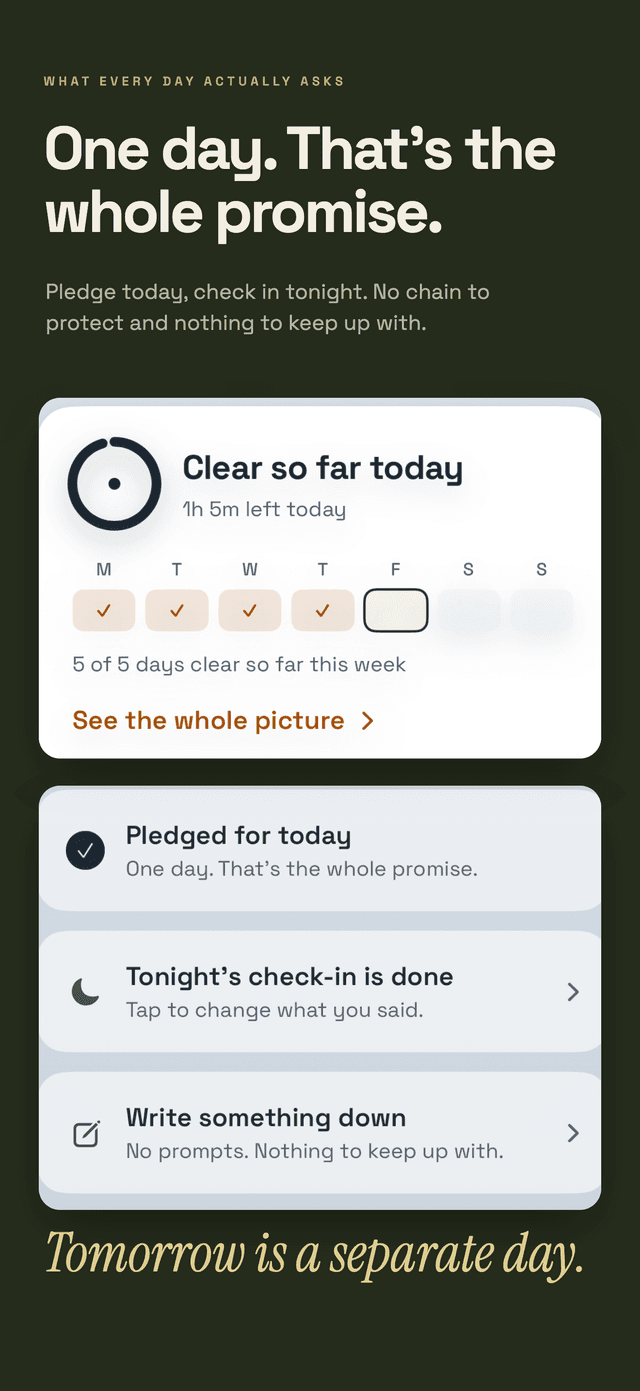
Paper, a notes app or a calendar all work for this method. If you'd rather keep the record on your iPhone, Hard Bit's free version includes logging and a private journal, and you can set a goal to stop drinking or to cut down. Your history stays on your device. There's no account, no social feed, and nobody else reading your entries.
Logging an urge or a drink records when it happened, which leaves the journal free for the short human lines. Hard Bit Plus adds a difficult-hour forecast with an advance warning, plus a patterns view and a calendar, all worked out on your phone from your logged history. It makes no prediction until you have at least five entries. The Hard Bit overview explains how these parts fit together. The app is a self-tracking tool, not medical advice or treatment.
Whatever you use, the method stays the same: five lines, written soon after, read back weekly.
You can find more practical guides on cravings, cues and tracking in the Hard Bit guides.
Frequently asked questions
How long should an alcohol journal entry be?
Long enough to record the time, what you drank or wanted, where and who with, what happened just before, and one feeling. For most people that's under thirty words. If an entry regularly takes more than a few minutes, cut it back, or you're likely to stop.
Should I journal on days I don't drink?
Yes, briefly. A one-line note on a clear evening, especially at your usual drinking time, shows what helped. Without those entries your journal only records the difficult days, which gives you a skewed picture.
What if I forget to write an entry?
Write a one-line entry when you remember, with whatever you can recall accurately. Don't fill gaps with guesses. Missing entries are information too: if you often forget on Friday nights, that tells you something about Friday nights.
Is journaling enough to cut down or stop drinking?
For some people it's a helpful part of the plan, but it isn't treatment and it can't assess risk. If you get withdrawal symptoms, drink heavily most days, or have tried several times without the change lasting, speak to a GP or a local alcohol service about support.
Can I use the same prompts if I'm cutting down rather than stopping?
Mostly, yes. Replace "Did I drink?" with "Did I stay within the limit I set?" and note when you decided to have more. That moment of deciding is often more useful to look at than the first drink.