If you want to stop playing one more match, decide when you will stop joining new matches before the session begins. Work backward from bedtime or your next commitment, allow for a long match and a short wind-down, and make the boundary independent of whether you win or lose.
When the final result appears, leave the queue or party, send a prepared message, close the game, and move to a specific activity chosen earlier. The useful decision is usually not whether to abandon a match already in progress. It is whether to start another one.
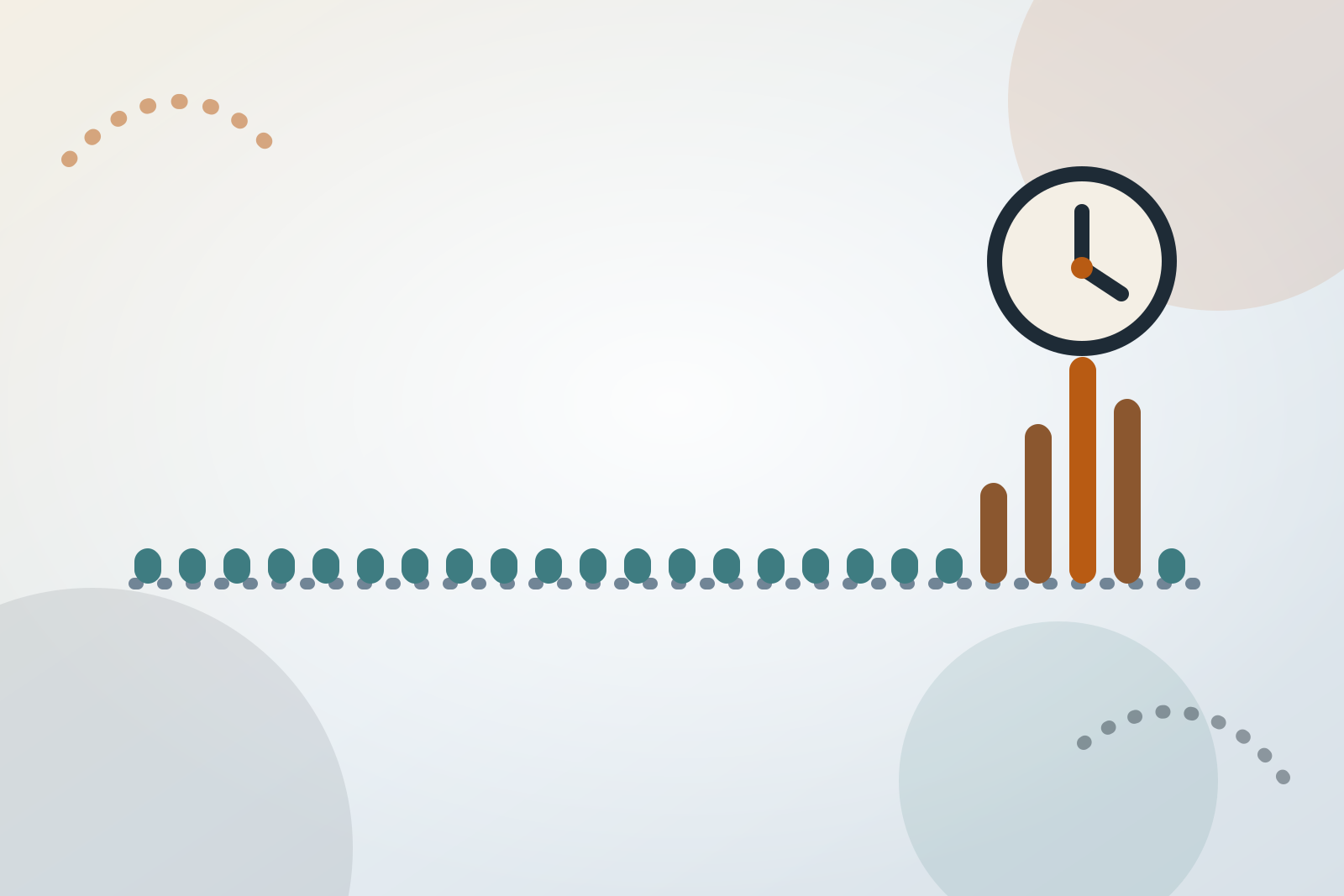
Calculate your no-new-queue cutoff
“Stop at 10:30pm” is difficult to follow if you are still in a team match at 10:30. A safer and clearer boundary is the latest time you may join a new match.
Work backward:
- Choose the time you want to be in bed or doing the next necessary task.
- Subtract the wind-down or transition time you need.
- Subtract the longest ordinary match you are willing to accommodate.
- Add a buffer for matchmaking, overtime, post-match screens, or delays.
For example, suppose you want to be in bed at 11:30pm. You want 30 minutes away from gaming first, a match may last 45 minutes, and you allow a 15-minute buffer. Your no-new-queue cutoff is 10pm.
If a match finishes at 9:55pm, your rule permits another. If it finishes at 10:06pm, the session is over. You do not need to leave an active match or decide whether its result was satisfying enough.
If your game has no reliable rounds or endpoints, use the broader guide to changing the hours around gaming.
Make the rule independent of the result
A result-based boundary can keep moving:
- stop after a win,
- stop when the losing streak ends,
- stop when the rank is restored,
- stop after one good match.
Use an observable boundary instead:
- no new queue after 10pm,
- three matches, then leave,
- two matches or 10pm, whichever comes first,
- one planned objective, with a clock cutoff as a backstop.
Write the rule as an if-then plan:
If a match ends after 10pm, then I will leave the queue before opening the scoreboard or highlights.
Implementation intentions are plans that specify when, where, and how to act in an if-then format. A 2015 review reports a meta-analysis of 94 independent studies involving more than 8,000 participants, with a medium-to-large average effect on goal attainment.
That evidence covers many laboratory and everyday goals, not late-night gaming specifically. It supports trying a precise plan, but it does not guarantee that this rule will end every session.
Prepare the gap before the first match
The interval after a result may be brief. Prepare the actions while you are not tired or responding to teammates:
- Tell the party your limit before play begins: “Three matches for me tonight.”
- Set an alarm for the no-new-queue time and place it where dismissing it requires a deliberate action.
- Disable automatic re-queue where the game offers that option.
- Write a short exit line: “That was my last one. Good games.”
- Decide whether you will close the launcher, shut down the console, or put away the controller.
- Choose the first activity after play and put anything it needs within reach.
These steps add friction to another queue and reduce the number of decisions required at the boundary. They are options to test, not proof that you lack discipline if the first version fails.
Use the same exit routine each time
When the final match ends:
- Leave or cancel the queue.
- Send your prepared exit message.
- Close the game and launcher, or shut down the console.
- Put the controller, headset, or phone in its planned place.
- Move away from the gaming setup.
- Start the first step of the next activity.
If checking the scoreboard reliably leads back into the queue, leave it until tomorrow. If social pressure is the difficult part, tell teammates at the start that you will leave without debating another round.
When the pull to re-queue feels intense, use the five-minute plan for the start of a craving. It creates decision space but does not promise that an urge will disappear within five minutes.
Give the time after gaming a job
Closing the game may leave an unplanned gap. Choose something that fits your actual energy:
- shower and prepare clothes for tomorrow,
- eat something simple and tidy the kitchen,
- read or listen to quiet audio in another room,
- take a short walk if it is safe,
- message or call someone at a planned time.
A 2014 study defined bedtime procrastination as failing to go to bed at the intended time when no external circumstances prevent it. Its survey of 177 adults found associations with lower self-regulation and reported insufficient sleep. It was cross-sectional, relied on self-report, and did not study gaming, so it cannot show that games caused sleep loss.
CDC recommends seven or more hours of sleep daily for adults aged 18 to 60. Its sleep guidance includes keeping regular bed and wake times and turning off electronic devices at least 30 minutes before bedtime. Treat that as general guidance, not a threshold that guarantees sleep.
If sleep problems occur regularly, discuss them with a healthcare provider. If the empty time after gaming is the main difficulty, see the guide to replacing boredom gaming with a realistic alternative.
Record where the boundary moved
For one or two typical weeks, record:
- your no-new-queue cutoff,
- the time the final match ended,
- whether you queued again,
- what the screen or party offered at that moment,
- what you told yourself,
- when you stopped playing and went to bed.
Include nights when you followed the rule. They may show what helped, such as warning teammates early, choosing a mode with a clean endpoint, or having a planned activity afterward.
Review combinations rather than judging yourself. “Ranked mode, full party, loss just before the cutoff” is a situation you can prepare for. The guides to identifying difficult times and deciding when a log suggests a pattern explain how to keep early observations tentative.
Paper or a private note is enough. Hard Bit is an optional iPhone craving tracker. Selecting gaming changes its prompts to hours rather than money, and each habit keeps separate logs, a counter, a reason for changing, and a difficult-hour pattern.
The counter, logging, journal, hard-moment flow, personal sentence, milestones, help links, export, and deletion are free. A subscription adds the on-device forecast and warning, patterns and calendar, widgets, and short reads. The forecast makes no prediction below five entries and relies fully on personal history at around twenty. Those are product rules, not clinical or statistical thresholds.
Current product documentation states that Hard Bit requires no account and has no social feed, advertising, or third-party analytics. Entered information stays on the device unless you choose to export it. The Hard Bit overview and support page document the current boundaries. A tracker can describe a pattern; it cannot enforce the boundary, diagnose a condition, or provide treatment.
Know when to seek more support
A late session by itself does not establish gaming disorder. WHO describes gaming disorder through impaired control over gaming, increasing priority over other activities, and continued or escalating gaming despite negative consequences. The pattern must cause significant impairment and would normally have been evident for at least 12 months. WHO says studies suggest that it affects only a small proportion of people who game.
Seek qualified support if gaming persistently displaces sleep, food, hygiene, study, work, essential spending, or relationships, or if repeated attempts to change feel unmanageable.
In England, the National Centre for Gaming Disorders supports people aged 13 and over who have difficulty controlling video game use. It accepts self-referrals and referrals from family members or professionals. Its service includes assessment and CBT-based treatment focused on greater control over gaming and increasing other activities.
The centre does not provide crisis intervention. If you or someone else is in immediate danger, contact emergency services or an appropriate local crisis service. Outside England, start with your usual doctor or local mental health service. Our editorial policy explains how health and product claims are reviewed.
Frequently asked questions
Is a time limit or match limit better?
Use the boundary that the game makes easiest to observe. A match count suits rounds with variable duration. A time cutoff suits open-ended play. If you combine them, stop at whichever boundary arrives first rather than using the second one to extend the session.
What if a match runs past my planned stop time?
Finish the active match where practical, then do not join another one. For future sessions, move the no-new-queue cutoff earlier or choose a shorter mode. If immediate safety requires you to leave, safety takes priority over a game penalty.
Why is stopping harder after a loss?
A loss can make “finish on a win” feel appealing, but that creates a boundary with no reliable endpoint. Decide before playing that the result will not change the match count or no-new-queue time.
Does deleting the game solve the problem?
Deleting it can add friction, but it does not decide what will replace the session or preserve social contact that mattered within the game. Pair any access change with a specific plan for the freed time and qualified support when gaming is causing persistent harm.
More source-reviewed planning articles are available in the Hard Bit guide library.