A reason for quitting drinking helps most when it is specific, personal, and short enough to read in a few seconds. Start by writing every reason you have. Then pick the one that still matters on an ordinary Tuesday evening, not only on the morning after a bad night. Rewrite it as one first-person sentence about something you want to keep or gain. Then test it at the hour you usually drink, and change it when it stops working.
Most people who write a reason don't write a bad one. They write it for the wrong moment.
Why a reason that felt strong can stop working
Reasons are usually written when motivation is high: after a hangover, an argument, a health check, or a night you would rather forget. In that moment, "I need to stop" feels obvious. Three weeks later, at 7 p.m. after a long day, the same words can feel like someone else's idea.
That is not a flaw in you. It's a mismatch between where the sentence was written and where it needs to work. A useful reason has to make sense to the tired, irritable, bored, or lonely version of you. The motivated version already agrees.
Health services commonly recommend writing your reasons down. HealthLinkBC's guidance on making a plan to cut back starts with knowing your reasons and suggests writing them down, because you're more likely to succeed when you know exactly why you want to change. Ireland's HSE suggests listing reasons such as health, sleep, or relationships and keeping them somewhere easy to reach, like your wallet or a note on your phone. Neither source says how to word a reason so it holds up weeks later. That part is our editorial suggestion, below.
Step 1: Write the long, messy list first
Don't edit yet. Give yourself ten minutes and write down everything, including reasons that feel small, selfish, or embarrassing. Some prompts:
- What do I want my mornings to feel like?
- What have I avoided, cancelled, or hidden because of drinking?
- Who do I want to be more present with?
- What does drinking cost me in money, time, sleep, or attention?
- What would I do with a clear Friday evening?
- What am I tired of explaining, to myself or anyone else?
If you'd like a structure, HealthLinkBC's form for identifying reasons to cut down or stop offers example reasons by area, such as health, with space to add your own. It also suggests going back to the list whenever you're struggling to remember why you started.
Research suggests reasons vary a lot from person to person. A 2024 systematic review of 21 studies found 21 different themes in why people who had received alcohol treatment chose to quit or cut down. Physical health, conflict with personal goals, family influence, and social factors came up often. The review only covered people who had been in treatment, and it noted that the way reasons were measured affected which ones people reported. So don't read it as a ranking of what should motivate you. Its useful message is simply that there is no single correct reason.
Step 2: Choose the reason that survives an ordinary evening
Look at your list and ask one question of each line: Will this still matter to me at my usual drinking time, on a day when nothing has gone wrong?
Some reasons fade quickly. "I'm so embarrassed about last night" is powerful on Sunday and faint by Thursday. "My blood test was bad" may lose force once the appointment is behind you. These reasons are real, but they're tied to a moment.
Other reasons hold up because they belong to everyday life:
- wanting slow Saturday mornings with your children,
- wanting to sleep through the night,
- wanting to keep the money for a specific plan,
- wanting to stop doing the mental maths about how much is "too much".
Circle one or two. If you're cutting down rather than stopping, the same approach works. Your reason may be about protecting certain nights or keeping a limit you chose yourself. If you're changing more than one habit, keeping separate reasons for each habit explains how to stop one general sentence from covering all of them.
Step 3: Turn it into one specific, kind sentence
Now rewrite the circled reason as a single sentence. These are our editorial suggestions for wording, based on what tends to be easier to read under pressure. They are not clinically tested rules.
Make it concrete. "Be healthier" is hard to picture. "Wake up on Sunday ready for the walk, not dreading the day" is easy to picture.
Use "I want", not "I must". A sentence about what you want to keep or gain gives you something to move towards. A sentence built on "must" or "should" can feel like an order you're tempted to push back against.
Leave out insults and threats. "Don't be pathetic again" may feel motivating when you write it, but at a hard moment it adds shame to stress. It gives you nothing to do.
Keep it short. Aim for something you can read in one glance on a lock screen, roughly ten to fifteen words.
Here are some before-and-after examples:
| Written in the moment | Rewritten to help later |
|---|---|
| I have to stop drinking. | I want my Saturday mornings back for the park with Maya. |
| Drinking is ruining my life. | I want to sleep through the night and not dread 4 a.m. |
| Never again after last night. | I want to remember every conversation at Dan's wedding. |
| I'm wasting so much money. | The £60 a week goes toward the March trip instead. |
If money is part of your reason, tracking what alcohol used to cost can turn a vague figure into a number that feels real.
Step 4: Put it where the difficult hour happens
A sentence in a notebook in a drawer can't help at 6:45 p.m. in the kitchen. Put your reason where your usual drinking moment happens:
- a note on your phone, pinned or used as a lock-screen line,
- a card in your wallet next to the card you would pay with,
- a sticky note inside the cupboard where glasses are kept,
- a message saved for a time you know is difficult.
If you have a pattern, such as evenings, Fridays, or after certain calls, plan the reminder around that time. Building a plan before evening cravings start covers how to prepare for that window. Your sentence can also go at the top of a short craving emergency card.
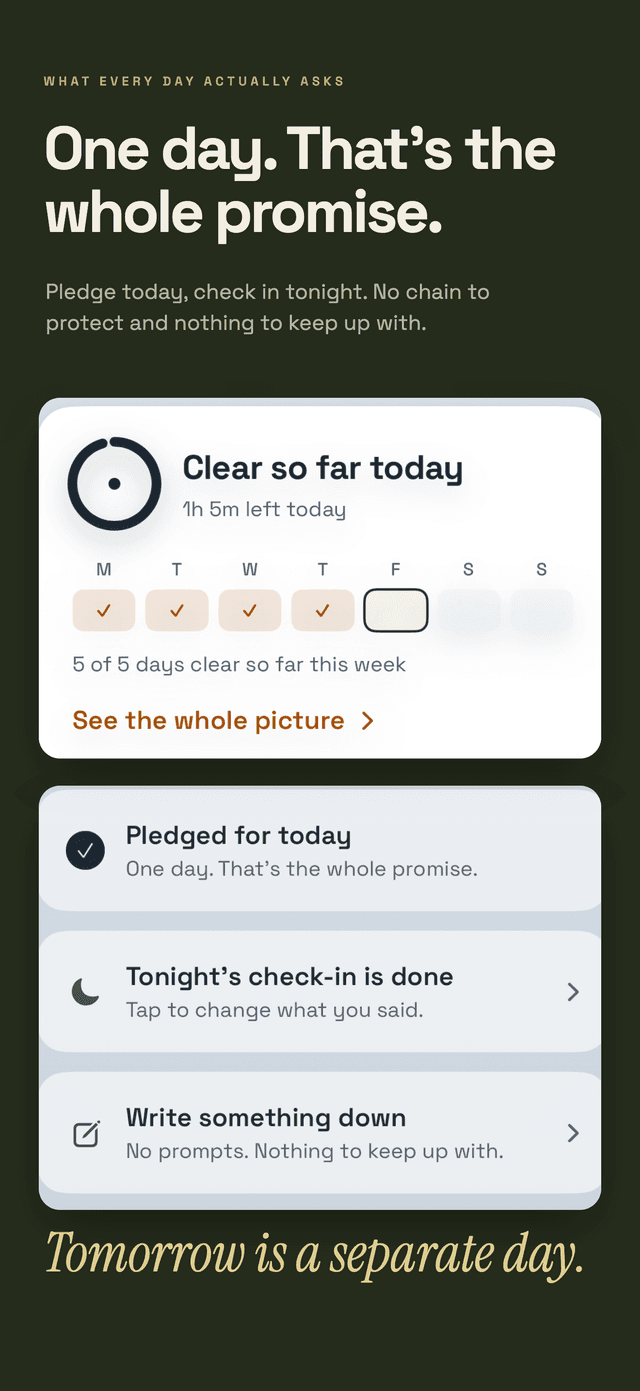
Hard Bit, an iPhone app, keeps a reason for stopping for each habit you track. It brings your sentence back in the hard-moment flow, so it's there when you open the app during a craving rather than sitting in a separate notes app. The personal sentence and the hard-moment button are free. Everything stays on your phone, with no account. The Hard Bit overview explains how this fits with private logging. Paper works too. What matters is that the sentence is close to the moment.
Step 5: Test it at the hour it was written for
For the next week or two, read your sentence at the time you would normally drink. Then write one honest line about how it landed:
- "Helped. Made me put the kettle on."
- "Felt flat. Too abstract tonight."
- "Made me feel guilty, not motivated."
That one line is enough. If writing more feels like a chore, journaling about alcohol without writing an essay suggests short formats that fit a tired evening.
A reason alone is rarely a full plan for a difficult moment. Pair it with one practical action, such as leaving the room, eating something, messaging someone, or walking. A practical plan for the difficult alcohol hour can help you choose one.
Step 6: Revise it when your life or goal changes
Your reason should change as your situation changes. Revisit it when:
- the sentence has started to feel like wallpaper,
- the original problem has eased (sleep has improved, or the debt is paid),
- you switch from cutting down to stopping, or the other way round,
- you've had a slip and the old wording now feels like an accusation.
After a slip, the most useful change is often from "never again" to something about the next evening, such as "I want tomorrow night to go differently, and I know what I'll do at 7." You don't need to start from zero. What to do after a slip without erasing your progress covers the rest of that response. Keep the old versions of your sentence. Seeing how your reasons have changed can be encouraging in itself.
One more editorial suggestion: keep a second, running list of small benefits you notice along the way, like clearer mornings, a conversation remembered, or money still in the account. When the main sentence fades, the newest benefit can become the next version.
When a reason is not enough on its own
A well-written reason is motivation. It isn't a medical plan.
The NHS warns that it can be very dangerous to stop drinking suddenly if you are dependent on alcohol. If you get withdrawal symptoms, get medical help before you try to stop. If, after stopping, you have a seizure or see, hear, or feel things that are not there, that is an emergency: call your local emergency number. If you're unsure whether any of this applies to you, ask a GP, doctor, or local alcohol service before you set a stop date.
Get support too if drinking is linked to self-harm thoughts, violence, unsafe driving, or a situation you can't manage alone. Call your local emergency number if anyone is in immediate danger. A self-tracking app can't assess these risks. Our editorial policy explains how we handle health information and sources.
More planning articles are available in the Hard Bit guides.
Frequently asked questions
What is a good reason for quitting drinking?
A good reason is one that still matters to you on an ordinary evening, not only after a bad night. Common themes include health, sleep, relationships, money, and personal goals. The most useful reason is the one that is specific to your life and easy to picture.
Should I have one reason or a whole list?
Both. Keep the full list for reflection and to remind yourself of everything that matters. For the difficult moment itself, one short sentence is easier to read and act on than a page.
What if my reason stops motivating me?
That's common and doesn't mean your goal was wrong. Rewrite the sentence around what matters now, make it more concrete, or swap in a recent benefit you've noticed. Revising your reason is part of the process, not starting over.
Does the same approach work if I'm cutting down rather than stopping?
Yes. Your reason might be about protecting certain nights, keeping a weekly limit, or staying clear-headed for particular events. Make it just as specific, and check it against your actual drinking times.
Can writing a reason replace professional help?
No. Writing a reason can support motivation, but it can't assess withdrawal risk or provide treatment. If you may be dependent on alcohol, get medical advice before stopping. Contact a qualified service if drinking is causing serious harm.