A private craving tracker should store only the details that reveal your pattern, and it should keep them where only you can read them. In practice that is a short list: the habit you are tracking, the date and time of each urge or use, what happened just before, how strong the urge felt, what you did next, and your own reason for stopping. Everything else is optional, and some details should never be collected at all.
This guide separates what a tracker needs from what it can skip, then covers the checks worth running on storage, export, and deletion before you trust an app with a sensitive record.
Store the facts that reveal a pattern
The core of a useful craving record is small. Cornell Health's urge tracking log, a worksheet from its substance-use self-help resources, asks for the day and time, the situation, thoughts, and physical sensations. That structure works across habits. Whether the urge involves alcohol, nicotine, gambling, pornography, gaming, or scrolling, the record that helps you later captures context, not confession.
A practical entry needs five fields:
- When: the day of the week and rough time.
- Where and doing what: "kitchen after dinner", "in bed with the phone", "walking past the shop after the late shift".
- What happened just before: an argument, a match notification, payday, a long meeting.
- How strong: a simple rating, such as 1 to 10, using the same scale each time.
- What you did next: rode it out, called someone, or used the habit, recorded honestly either way.
One entry might read: "Thursday, 9:40 pm, sofa after the match, restless, 7/10, made tea and texted my brother." Another: "Weekday, 7:30 am, kettle on, automatic reach for the vape, 6/10, used it." Neither entry judges you. Both are usable evidence.
You do not need to log in the moment if that is unsafe or impractical. A note later the same day keeps most of the value. For turning these entries into a trigger picture, see How to Identify Your Craving Triggers and Difficult Times.
Keep your reason and plan in the same place
A tracker earns its place in a hard moment, not just in a calm one. Two extras are worth storing beside the log:
- Your reason for stopping or cutting down, written by you while calm. One specific sentence beats a paragraph: "I want tomorrow morning to belong to me" travels better into a difficult evening than a lecture.
- One prepared action for the next difficult hour, small enough to actually do.
WithYou, a UK drug and alcohol support charity, describes cravings as a normal part of cutting down or stopping, and recommends planning for them rather than treating each one as a surprise or a failure. A stored reason and a stored action are that plan in its smallest form.
If your tracker has a journal, treat it as the most sensitive part of the record. Write for a tired future version of yourself: factual, kind, and free of verdicts.
Know what a private tracker does not need
Data minimisation is the quiet test of a privacy claim: the less an app holds, the less can leak, be sold, or be handed over. A craving tracker does not need:
- your contact list or social graph,
- precise location history,
- your real name, date of birth, or a photo of ID,
- payment card numbers stored by the app itself,
- the names of other people inside your entries,
- access to your microphone, camera roll, or health records.
If an entry involves someone else, describe the situation without identifying them. "Row at home" does the same analytical work as a name, with none of the exposure if a device is lost, repaired, or borrowed.
Also question permissions. Notifications for a craving tracker can be scheduled locally on the device. If an app asks for contacts, location, or tracking permission, ask yourself what tracking cravings has to do with that data. Often the honest answer is nothing.
Ask where the data actually lives
"Private" in a store listing is a claim, not an architecture. Two findings are worth knowing before you take it on trust.
The US Federal Trade Commission warns that health apps can collect some of your most sensitive personal information, that some share or even sell it, and that many are not covered by health privacy laws such as HIPAA. Its advice is plain: compare privacy protections between similar apps and look for a privacy notice that explains, in simple terms, what is collected and how it is used and shared.
There is also peer-reviewed evidence behind the caution. A JAMA Network Open study examined 36 top-ranked depression and smoking-cessation apps and found that 29 transmitted data to services provided by Facebook or Google, while only 12 accurately disclosed this in their privacy policy. That was a snapshot of the app market at the time, not a verdict on every app today, but it shows why a policy alone is weak evidence.
Practical checks you can run in a few minutes:
- Does the app require an account? No account means no server-side profile tied to your identity.
- Is the privacy policy written in plain language, and does it name advertising or analytics partners?
- Does the App Store privacy label match the marketing?
- Does the core tracking work with the internet off?
For a fuller walkthrough of these checks, read How to Track a Habit Privately Without an Account.
Check that you can export and delete everything
Storage is only half the question. The other half is exit. Before a tracker holds months of history, confirm two controls exist and work:
- Export in a format you can actually read, so the record stays yours if you change phones or apps. How to Export a Habit Log for Your Own Records covers how to check the file before relying on it.
- Deletion that removes individual entries and the whole record, not just the app's icon. How to Delete a Craving Log You No Longer Want walks through the details.
If data is stored only on your device, deleting the app removes it. If an account is involved, ask what remains on the company's servers afterwards, because uninstalling the app does not answer that question.
Remember what a tracker cannot tell you
A craving record shows patterns in your own behaviour. It cannot assess medical risk, diagnose anything, or replace professional care.
- If you may be physically dependent on alcohol or sedatives, stopping suddenly can be dangerous. Seek medical advice before an abrupt stop, and get urgent help for severe confusion, seizures, hallucinations, or any immediate danger.
- For smoking or vaping, a log supports your own awareness, but evidence-based cessation support and medicines come from official quit services and clinicians.
- For gambling, if money or debt is involved, practical barriers such as self-exclusion and bank controls, plus specialist support, matter more than any tracking feature.
- For pornography, gaming, or scrolling, prefer neutral wording such as "compulsive" or "difficult to control" rather than diagnosing yourself.
Our editorial policy explains how this site separates general information from product claims and reviews health-related sources.
How Hard Bit answers the storage question
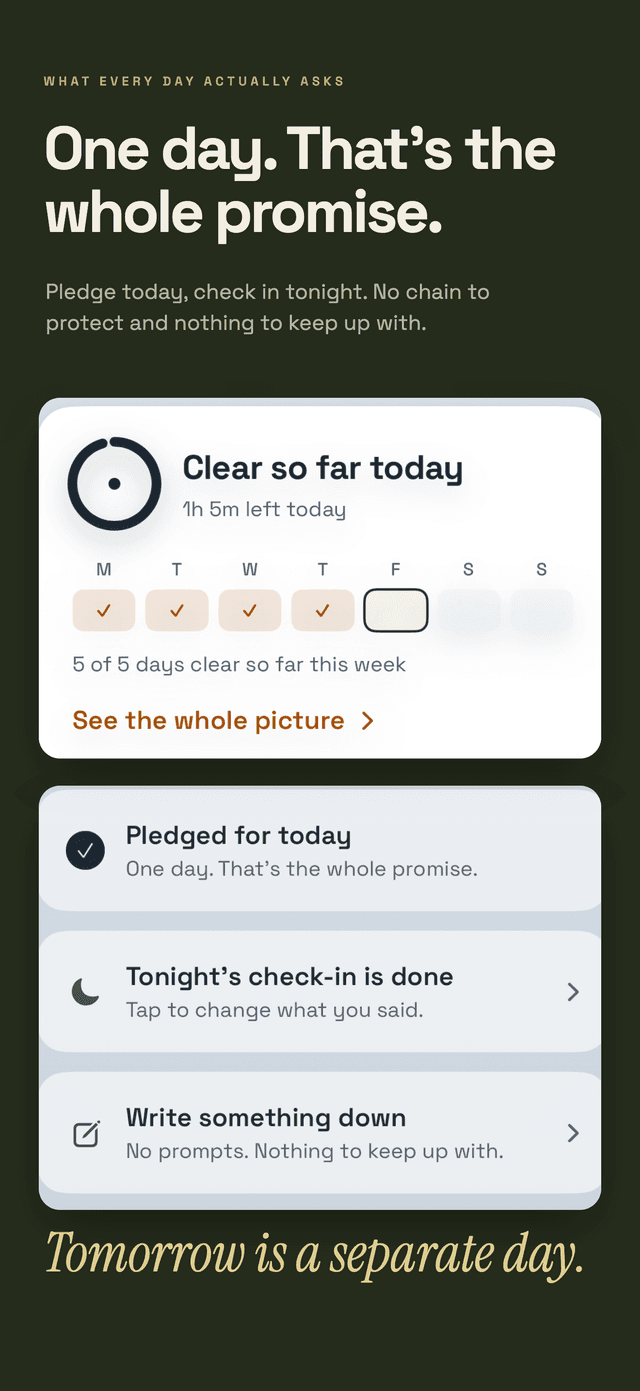
Hard Bit is built around the short list above. Each habit you track, whether drinking, smoking, vaping, cannabis, betting, porn, scrolling, gaming, or a custom habit, keeps its own counter, logs, difficult hour, reason for stopping, and relevant units. Your personal sentence sits inside the hard-moment flow, next to the log it belongs to.
Everything is stored on your iPhone. There is no account, no social feed, no advertising, no third-party analytics, and no server-side history. The learned forecast is calculated on-device from your own entries: below five entries it makes no prediction at all, and it leans fully on your data at around twenty. Export and deletion are free and stay free, and the Hard Bit overview explains how the pieces fit together.
A tracker cannot decide what level of support you need, and Hard Bit does not try to. What it can do is hold an honest record, in the fewest fields that work, somewhere only you can read it.
Frequently asked questions
Is it safe to keep a craving log on my phone?
It can be, if the entries stay on the device, the app needs no account, and your phone itself is locked. On-device storage removes the server as a point of exposure, and a device passcode or app lock covers the person who picks up your phone. The remaining risk is one you already manage for messages and photos.
Should I log slips as well as clear days?
Yes. A record that only contains good days cannot show you the hour, place, or sequence where things actually go wrong. Logging a use honestly keeps the pattern accurate and keeps earlier clear days in the picture instead of wiping them out.
What if a craving tracker requires an account?
Ask what the account is for. Cloud sync is a legitimate reason; advertising identifiers are not. Read the privacy policy, check what data the account ties to your identity, and decide whether the convenience is worth a server-side copy of a sensitive record. If you cannot find a clear answer, that is an answer.
Can I show my log to a doctor or support service?
Yes, and an honest record can make that conversation easier. Export the entries, review the file first, and share only what you choose to share. The log helps a professional understand your pattern; it does not replace their assessment.