
A daily reward gaming trigger is a login bonus, daily quest, or streak that gives you a reason to return at a predictable time. If it keeps pulling you into sessions you did not intend to play, make the next decision while the game is closed.
Let the reward lapse when claiming it repeatedly starts unwanted play. If you still want to keep it, use a bounded login plan based on what has actually happened before, not on how quickly you hope the claim will be.
Why a daily reward can feel difficult to skip
A daily reward combines a cue with a deadline. The notification, reset hour, expiring quest, or streak counter prompts you to act, while missing it is presented as losing something.
A 2022 mixed-methods study surveyed 178 participants about engagement rewards such as daily logins, repeatable challenges, and seasonal rewards. Participants described benefits such as motivation, but also fear of missing out, obligation, and the feeling that rewards had become a chore. Quantitative findings supported this mixed experience.
The study records how one sample described these systems. It does not show that daily rewards cause gaming problems or that everyone experiences them negatively.
The practical point is narrower: if the mechanic supplies a predictable cue, you can make a plan before that cue arrives.
Measure what the claim actually costs
A reward that takes ten seconds and ends there presents a different problem from one that regularly becomes an hour-long session.
For several typical opportunities, record:
- when the reset or reminder occurred,
- how many minutes you planned to spend,
- how many minutes you actually spent,
- what extended the visit,
- whether you wanted the resulting session.
One entry might read: “Thursday, planned five minutes, actual 70, joined a party after collecting the quest reward.” Another might say: “Sunday, planned five minutes, actual four, signed out.”
Include occasions when you skipped the reward. Those entries show what happened to the same hour without the login.
Treat a few observations as clues, not proof of a permanent pattern. The guide to deciding when a log suggests a pattern explains why quiet opportunities and repeated days matter.
If the claim itself ends quickly but the next match does not, use a no-new-queue cutoff for that separate boundary.
Choose between letting it lapse and a bounded login
Make one written decision for each game rather than treating every reward alike.
Let it lapse when the claim routinely leads to unwanted play, disrupts sleep or responsibilities, feels like a chore, or conflicts with a goal to stop playing that game.
Use a bounded login when you are cutting down rather than stopping, the reward genuinely matters to you, and previous entries show that you can usually close the game near the planned time.
Keep a planned social session when the important part is time with friends rather than the daily item. Schedule that session on its own terms instead of using a reward notification as the invitation.
A bounded login is not the safer choice merely because it sounds moderate. If it repeatedly turns into a full session, the record is telling you that opening the game is the boundary that needs changing.
Write the decision as an if-then plan
Implementation intentions specify when, where, and how you will act: “If situation Y occurs, then I will do Z.”
A peer-reviewed review reports a meta-analysis of 94 independent studies involving more than 8,000 participants. Across varied goals, implementation intentions had a medium-to-large average effect on goal attainment compared with goal intentions alone. This was not a trial of gaming limits, so it supports trying a specific plan, not expecting a guaranteed result.
For a reward you are dropping:
If I see a daily reset notification, I will dismiss it, leave the game closed, and make tea.
For a bounded login:
At 6:15pm, I will start a five-minute timer, open the game, collect the named login item, sign out, and leave the phone in the kitchen.
Start the timer before opening the game. Do not set a new alarm at the reset hour if that alarm would simply become another prompt to log in.
Smokefree.gov recommends changing activity, reviewing your reasons, and contacting someone during nicotine cravings. That guidance is for smoking, not gaming, but it supports preparing a concrete switch instead of improvising while an urge is strong. For a broader sequence, use how to handle a craving in the moment.
Remove the prompts that start the sequence
Reduce reminders in one pass:
- turn off game, launcher, store, and companion-app notifications,
- mute guild or group channels that announce resets,
- disable launcher auto-start,
- remove the game from the phone dock or first home screen,
- sign out after a permitted session,
- store the controller or headset away from the usual seat.
These changes do not guarantee that you will stop thinking about the reward. They make the login less automatic and give your earlier decision a chance to operate.
If gaming starts through several cues across the evening, the guide to changing the hours around gaming covers the wider schedule.
Plan the first streak you let lapse
If you are dropping a reward, choose the first date you will not claim it. Before that date, write:
- what will expire or reset,
- whether it has value outside the game,
- what you will do during the usual login window,
- who you can contact if the pull feels difficult.
You may feel irritated, restless, disappointed, relieved, or little at all. There is no established timeline for when the pull should become easier.
Do not reopen the game merely to check what happened to the streak. Review your written list instead. If the empty time becomes the main problem, prepare a low-effort alternative with the guide to replacing boredom gaming with a better default.
Separate rewards from spending
Some reset prompts lead directly to a store, timed banner, pass tier, or paid currency offer. If spending is part of the sequence:
- remove stored payment methods where practical,
- require authentication for purchases,
- avoid opening the store to collect a nominal free item,
- review platform and bank records away from the game,
- involve someone you trust if spending is hidden or affecting essential costs.
A timer or tracker cannot protect money. Use platform controls, financial barriers, and qualified support when personal limits are not holding.
Use a private record if it helps
A notebook is enough to compare planned and actual minutes.
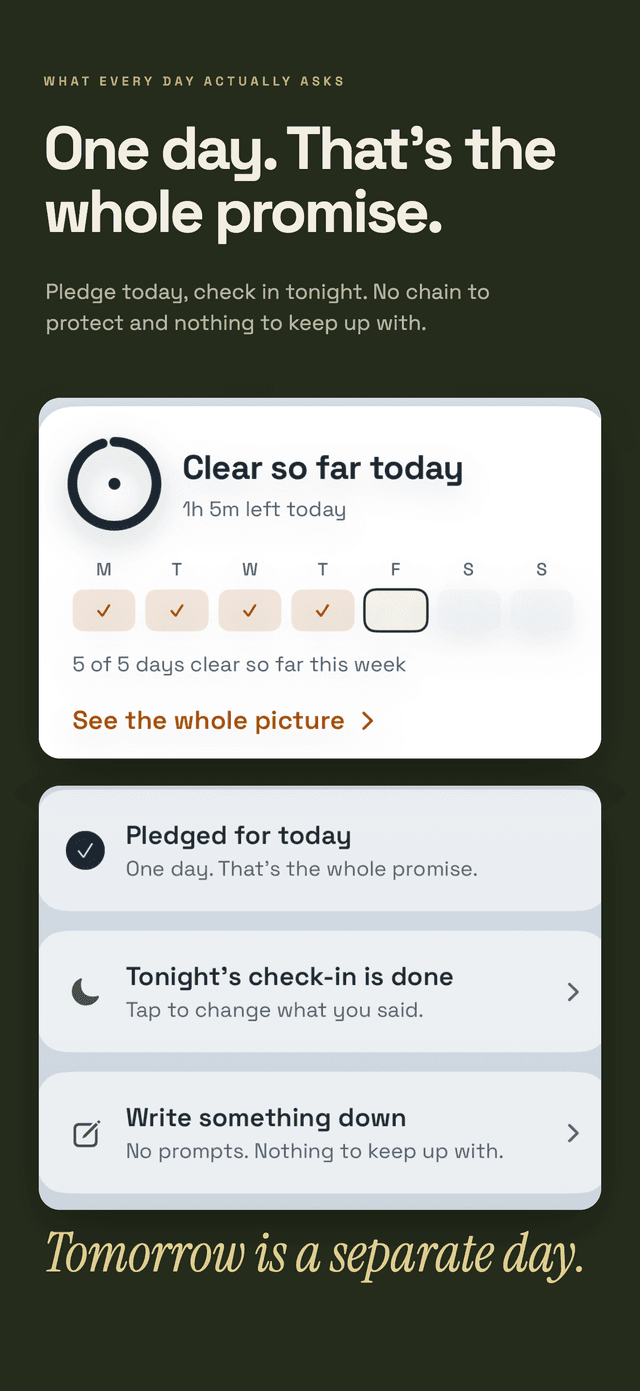
Hard Bit is an optional iPhone craving tracker. Entries are manual; it does not import playtime or block games. Choosing gaming changes its prompts to hours rather than money, and each habit keeps separate logs, a counter, a reason for changing, and a difficult-hour pattern.
The counter, logging, journal, hard-moment flow, personal sentence, milestones, help links, export, and deletion are free. Hard Bit Plus adds the on-device forecast and warning, patterns and calendar, widgets, and short reads. The forecast makes no prediction below five entries and relies more fully on personal history at around twenty. Those are product rules, not clinical thresholds.
Hard Bit requires no account and has no social feed, advertising, or third-party analytics. Entered information and the forecast stay on the device unless you choose to export a file. The Hard Bit overview and support page document the current boundaries.
Know when to involve professional support
Logging in for a reward does not establish a disorder.
WHO defines gaming disorder through impaired control over gaming, increasing priority given to gaming over other activities, and continuation or escalation despite negative consequences. The pattern must cause significant impairment and would normally have been evident for at least 12 months. WHO also says studies suggest that gaming disorder affects only a small proportion of people who game.
Seek qualified support if gaming persistently displaces sleep, food, hygiene, essential spending, study, work, or relationships, or if repeated attempts to change feel unmanageable.
In England, the National Centre for Gaming Disorders supports people aged 13 and over who have difficulty controlling video game use. It accepts self-referrals as well as referrals from family members and professionals. It does not provide crisis intervention.
If you or someone else is in immediate danger, contact emergency services or an appropriate local crisis service. Outside England, start with a doctor or local mental health service. Our editorial policy explains how health and product claims are reviewed.
Frequently asked questions
Is it wasteful to abandon a long reward streak?
Ending the streak means giving up the next reward, but it does not erase enjoyment or items already received. Compare the next reward with the time and effect of continuing, rather than treating the streak's age as an instruction.
What if friends rely on me to complete daily quests?
Separate the social commitment from the reward. Agree on planned sessions or tell the group which quests you are leaving. If social pressure keeps overriding necessary limits, discuss a firmer boundary with the group or seek outside support.
Should I uninstall the game?
Uninstalling can add useful friction when every login becomes unwanted play. Signing out, muting notifications, or moving the device may be enough for other people. Pair removal with a plan for the freed time and social contact.
How long should I test the plan?
There is no universal duration. Review after several real opportunities, including skipped and claimed rewards. If bounded logins repeatedly become long sessions, change the boundary rather than repeating the same test.
More source-reviewed planning articles are available in the Hard Bit guide library.