Stress doomscrolling can begin with a reasonable impulse: something difficult happens, you open a news or social feed to feel informed, and the scan continues after it has stopped answering a useful question.
Interrupt the sequence by noticing the first body signal, naming the stressor in one sentence, and choosing one of three routes: take a small action now, schedule the action for a specific time, or support yourself while you wait. Put the phone out of reach and start that route before deciding whether to return to the feed.
This guide addresses stress outside the feed that starts a negative-news scan. If alerts or breaking news are the main trigger, use the separate guide to stopping doomscrolling without avoiding the news.
Notice the signal before arguing with the scroll
The NHS describes stress as the body's response to feeling threatened or under pressure. It lists signs including irritability, worry, racing thoughts, difficulty making decisions, headaches, and muscle pain. Stress can also change habits and contribute to avoidance.
Choose two early signs that you can recognize without opening an app. They might be:
- a tight jaw or raised shoulders,
- holding your breath,
- repeatedly checking the same message,
- standing up without knowing what to do next,
- or reaching for the phone immediately after difficult news.
For example, Priya finishes a call about a rent increase. Her shoulders tighten, and her thumb moves toward a news feed. The useful moment is not forty minutes later when she notices the time. It is the first reach, while another next step remains available.
If you notice only after the feed is open, continue anyway. Late recognition is still recognition.
Name the stressor in one sentence
Use a sentence with a concrete subject:
I am stressed about the rent letter.
I am waiting for my brother's test results.
I am worried about tomorrow's review.
Avoid forcing the situation into “everything is awful.” That may describe the intensity honestly, but it does not identify what kind of response is possible.
NIMH distinguishes stress, which generally responds to an external cause, from anxiety, which can remain present without an immediate threat. That distinction is general information, not a way to label yourself. If you cannot identify one cause, write what you do know: “My body feels on alert, and I do not know why.”
A trigger log can help you compare that moment with earlier ones. How to identify your craving triggers and difficult times explains how to look for repeated combinations without assuming one event caused every scroll.
Choose one of three routes
Match the next action to the stressor rather than choosing from a generic list.
Act on one small step
Use this route when a safe, useful step is available now and takes only a few minutes.
You might find a phone number, write down one question, check the deadline on a letter, or draft a message without sending it. Stop after the first defined step. The aim is not to solve an entire housing, work, health, or relationship problem while distressed.
Schedule the next step
Use this route when action is possible but not useful right now.
Write down what you will do, when, and where:
Thursday at 10am, at my desk: call the letting agent and ask about the review process.
A scheduled step does not promise that worry will disappear. It gives you a concrete place to return to the problem instead of repeatedly searching a feed for unrelated certainty.
Support yourself while you wait
Use this route when the outcome is not currently under your control. Test one action that does not require more information:
- send an honest message to a trusted person,
- shower or make a drink,
- take a short walk if it is safe,
- write down what you are waiting for,
- eat a regular meal,
- or return to the next ordinary task.
NIMH includes journaling, exercise, regular meals and sleep, and reaching out to supportive people among its general coping suggestions. Choose something available in your actual setting rather than the option that sounds most impressive.
Exit when the feed is already open
Use this short sequence:
- Name both events: “I am stressed about the rent letter, and I am scanning bad news.”
- End the current route: close the feed and put the phone face down beyond arm's reach.
- Change position: stand up, move to another chair, or walk to another room if practical.
- Start the chosen route: act, schedule, or support yourself.
- Decide later: return to the news only if you have a specific reason and stopping point.
Harvard Health quotes experts recommending physical boundaries such as keeping the phone off the nightstand, away from the desk and dinner table, and opting out of notifications. These are expert recommendations, not evidence that one placement will work for everyone.
The purpose of the pause is to recover a choice. It does not promise that stress or the pull to scroll will vanish on a fixed schedule.
Record the stress-scroll pairing
Screen-time totals can tell you how long an app was open. They cannot tell you what happened immediately beforehand.
Keep each entry to four fields:
- time,
- stressor in a few words,
- first body signal,
- route chosen and what happened next.
For example:
Tuesday 6:40pm; rent increase letter; tight jaw and shoulders; scheduled Thursday call, walked around the block, checked one news summary after dinner.
Also record a few stressful moments that did not lead to doomscrolling. They help you avoid mistaking “stress was present” for “stress always causes this.”
Review once a week. Treat an early pattern as a question, not a conclusion. If the record becomes another checking loop or a reason to criticize yourself, simplify it or pause. The guide to tracking scrolling without turning it into shame provides a neutral review method.
Prepare for a repeated stressful hour
If the same situation and time keep appearing, write an if-then plan:
If the team call ends and my chest feels tight, then I will put the phone on the kitchen counter and write the stressor on paper before opening a feed.
Evidence for this planning style has limits. A 2021 meta-analysis examined mental contrasting with implementation intentions, a method that combines considering an obstacle with an if-then plan. It included 21 studies, 24 independent effect sizes, and 15,907 participants. The pooled effect on goal attainment was small to medium, with Hedges' $g = 0.336$.
The authors noted publication bias, so the true effect may be smaller. The studies covered several kinds of goals and did not establish an effect on doomscrolling specifically. Treat the plan as a practical experiment, not proof that a sentence will change your evening.
If your pattern occurs at the edges of the day, use the more specific guides to stopping scrolling in bed or changing the first ten minutes of the morning.
Use Hard Bit only if a private log helps
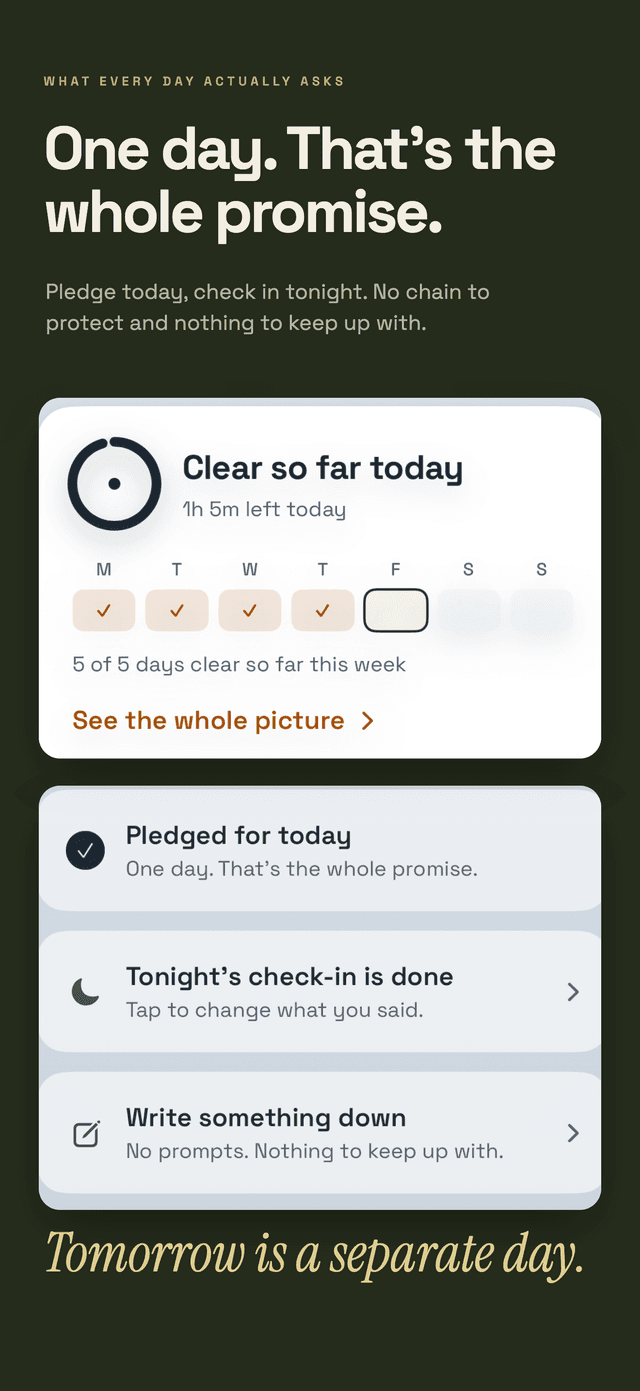
Hard Bit is an optional iPhone tool for keeping a separate record for each habit. Its free features include the counter, logging, journal, hard-moment flow, and export. Entries stay on the device, and the app has no account or social feed.
A subscription adds the on-device forecast, advance warning, patterns, and calendar. The forecast makes no prediction below five entries and relies more fully on your history at around twenty. Those are product rules, not health thresholds.
The Hard Bit overview explains the current features and privacy boundaries. A paper note works too. The useful part is a brief record that helps you prepare for a repeated situation without creating more phone checking.
Know when a phone plan is not enough
Speak with a qualified professional if stress symptoms interfere with daily life, cause you to avoid ordinary activities, remain consistently present, or feel difficult to manage. NIMH identifies those as reasons to seek more help.
The NHS advises contacting NHS 111 or a GP when stress affects daily life. In England, adults can also refer themselves to NHS talking therapies without first seeing a GP. Harvard Health advises discussing doomscrolling with a primary care doctor when it feels impossible to stop or causes extreme upset.
If distress comes with thoughts of self-harm, contact a crisis service rather than handling it alone. In the United States, call or text 988. In the UK and Ireland, call Samaritans free at any time on 116 123. Elsewhere, use an appropriate local crisis service. Call emergency services if you or someone else is in immediate danger.
Our editorial policy explains how Daily Life Apps separates research, practical suggestions, and product information.
Frequently asked questions
Does scrolling when stressed mean I have an addiction?
No conclusion follows from one urge or session. Describe the pattern instead: how often it happens, whether it is difficult to stop, and whether it disrupts sleep, work, study, or relationships. A qualified professional can help if the impact is substantial.
Should I delete the news and social apps?
That is one option, but it is not the only one. You could silence notifications, move apps away from the first Home Screen, sign out, or keep the phone outside your usual stress location. Choose a boundary that preserves any information or contact you genuinely need.
How long will the urge to scroll last?
There is no reliable universal duration. Use a short pause to make another action possible, not as a countdown by which the feeling must disappear.
Can tracking make the problem worse?
It can become unhelpful if you repeatedly check the record or use it to judge yourself. Keep entries brief, review on a schedule, and pause if tracking increases distress without helping you make a useful decision.