
The most useful personal birthday message prompts are questions about the person, not fill-in-the-blank templates. Before you write anything, spend two minutes answering three or four of these:
- What is one moment with them from the past year?
- What did they work hard at, or what changed for them?
- What one word describes them, and what did I see that proves it?
- What would I like to do with them before their next birthday?
Your clearest answer becomes the middle of the message. Add a greeting before it and a hope or a concrete offer after it, and you have a message only you could have written.
Why questions work better than templates
A template gives you someone else's words and leaves a gap for a name. A question sends you back to your own memory and gives you the raw material.
"You're amazing, have the best day" is kind, but it could go to anyone. The answer to "When did they make something easier for me?" can only go to one person.
The research below wasn't done on birthday messages, but it points the same way:
- Specific thanks lands better. UC Berkeley's Greater Good Science Center says a better thank-you names what the person did, the effort involved, and how it helped. Several questions below are designed to bring up those three things.
- Reaching out is appreciated more than people expect. Research by Peggy Liu and colleagues, reported by the American Psychological Association in 2022, found that people consistently underestimate how much others value an unexpected call, text or email. According to the study abstract, the gap was larger when the contact was more surprising and when the two people were less close.
Applying these findings to birthday cards is our editorial judgment, not a research result. Our editorial policy explains how we keep evidence and advice apart.
14 questions that surface something worth saying
Pick the three or four that give you the clearest answer and skip the rest. Some will be blank for some people, and that's useful to know too.
Questions about a shared moment
- What is one moment with them from the past year that I'd still describe to someone else?
- When did they make something easier for me, even in a small way?
- What do we laugh about that would make no sense to anyone else?
Questions about what you've noticed
- What has changed for them since their last birthday: a job, a home, a routine, a new confidence?
- What did they work hard at this year, even if it didn't turn out the way they hoped?
- What do they do that they probably don't realize I notice?
- What one word describes them, and what did I see that proves it?
Questions about the year ahead
- What are they looking forward to?
- What would I genuinely like to do with them before their next birthday?
- What do I hope gets easier for them?
Questions for someone you don't know well
- What have I seen them do, at work, in the group, or on the street, that made things better for others?
- What did they mention the last time we spoke?
Questions about where the message will land
- Do they like being celebrated loudly, quietly, or privately?
- Where will they read this: a card at dinner, a private text, a group card, a public post?
Questions 13 and 14 don't give you content. They tell you which of your other answers you can safely use.
Ask "how do I know?" after every adjective
The most common dead end is answering with a label: kind, funny, reliable, brave. Labels feel true, but they read like a greeting-card insert.
Fix this with one follow-up question: how do I know?
- "Reliable." How do I know? They were the only one who remembered to book the minibus for the reunion.
- "Brave." How do I know? They signed up for the open-mic night after saying for two years they never would.
- "Funny." How do I know? They renamed the office printer "The Disappointment" and now everyone calls it that.
The answer to the follow-up is what goes in the message. You can keep the adjective too ("That's the most reliable thing I've seen all year"), but now there's evidence behind it.
Turn each kind of answer into a sentence
Different questions produce different kinds of sentences. Once you know which kind you have, the wording is mostly arranging.
| If your best answer is… | It usually becomes… | Example opening |
|---|---|---|
| A shared moment (Q1–3) | A recalled scene | "I still think about…" |
| A change or effort (Q4–5) | Recognition | "I've watched you…" / "It was no small thing that…" |
| Something you noticed (Q6–7) | Evidence for a quality | "You probably don't know I noticed, but…" |
| A plan or hope (Q8–10) | A forward-looking close | "Before next year, let's…" / "I hope…" |
| A public kindness (Q11–12) | A short, card-safe thank-you | "Thank you for…" |
Most good messages combine one answer from the first four rows with a forward-looking close. For the full greeting-to-wish structure, use the birthday message formula. If your best answer is a memory, the guide to turning a shared memory into a birthday message covers how much of the story to tell.
Worked examples: question, answer, message
These are original examples meant to show the method. Your own details will always be stronger than borrowed ones.
A sibling. Question 5: What did they work hard at this year? Answer: studied for the nursing exam at night while working full shifts.
Happy birthday, Tom. I've watched you study at the kitchen table after twelve-hour shifts all year, and I don't think I ever told you how impressive that was. Whatever happens with the results, I'm proud of you. Celebration dinner is on me.
A friend. Question 7 plus "how do I know?": What word describes them? Answer: generous. How do I know? They gave up their festival ticket when my sister's fell through.
Happy birthday, Aisha. I still can't believe you handed over your festival ticket so my sister didn't miss out. That's exactly who you are. Next summer, we're both going.
A colleague. Question 11: What have I seen them do that made things better? Answer: always explains the new system twice without sighing.
Happy birthday, Daniel. Thank you for explaining things twice without ever making anyone feel slow. Hope you get a properly quiet day.
A friend you've drifted from. Question 12: What did they mention last time? Answer: they were about to start learning the cello.
Happy birthday, Clara. I've wondered all year how the cello is going. No need for a long reply. I just wanted you to know I was thinking of you, and I'd love to hear you play one day.
The last example draws on the APA finding: a brief, slightly unexpected message to a less-close friend is likely to be welcomed more than you'd assume. You don't need to explain the silence first.
Four questions to ask before you send
Personal shouldn't mean careless. Read your draft and ask:
- Could they read this in front of anyone who will see it? Inside jokes, health news and private struggles don't belong in a group card or public post.
- Does any line comment on age, appearance or life stage? Leave it out unless you're certain it will be welcome.
- Is the offer real? "Dinner's on me" is a promise. Make one you'll keep.
- Is it still about them? One line about what they mean to you is warm. A paragraph about your own year is not.
The guide to what not to write in a birthday card covers these risks in more depth. If you can't find a detail you're comfortable sharing, a sincere short message is still fine: "Happy birthday, Lena. I hope this year brings you more of what makes you happy."
Keep answers ready before the birthday
The hard part is usually remembering, not writing. On the day itself, you're trying to recall a moment from months ago while everything else competes for your attention.
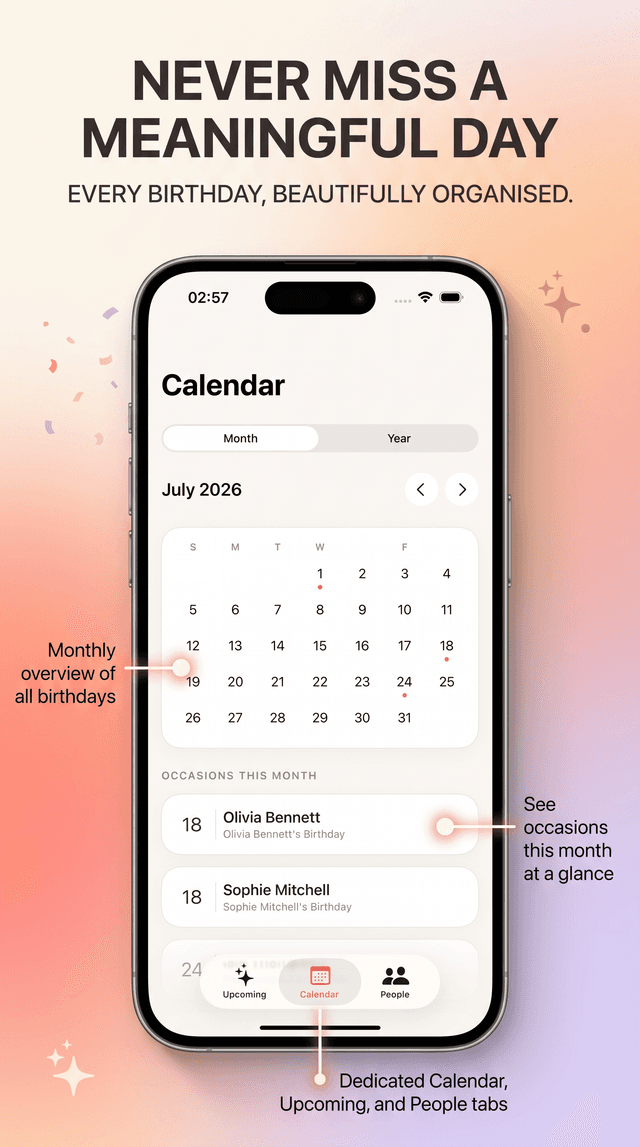
When something answers one of these questions during the year, such as a goal they mention or a moment that is typically them, write one line about it somewhere tied to that person. On iPhone, every contact has a Notes field you can edit. Birthday Reminder has a Notes field in each person's record, next to their birthday and reminders. Keep notes short and leave out anything sensitive. The guide to adding birthday notes and gift ideas on iPhone compares where to keep them.
Then give yourself time to answer the questions calmly. A preparation alert a few days early beats a rushed morning-of message. Our guide to when to set birthday reminders suggests lead times, and the simple birthday planning system shows where writing fits. For a fuller year-round routine, see how to plan birthday messages without making them generic.
If you still rely on a social network to tell you a birthday is today, start with remembering birthdays without social media.
Frequently asked questions
How many of these questions should I answer?
Three or four. You only need one strong answer for the message, so answer a few and keep the clearest one. If the first question gives you something vivid, you can stop there.
What if I can't answer any of them?
Try questions 11 and 12, which are written for people you don't know well. If those are blank too, send a short, warm, honest message. Never invent a detail to make a message look personal.
Can I ask the person directly instead?
Yes, in a normal conversation before the birthday. "What's been the best part of your year?" is a natural question, and the answer gives you something real to mention later. Avoid quizzing them in a way that gives away what you're doing.
How long should the finished message be?
Usually three to five sentences for a card or text: a greeting, your detail, and a close. A milestone or a very close relationship can take more, but only if you have more true things to say. The guide on how long a birthday message should be breaks this down by channel.
Do these prompts work for a group or work card?
Yes. Use question 11 and keep the answer public-friendly. One specific line, such as "Thank you for always saving the last biscuit for whoever's on call," stands out among a card full of "Have a great day!"
A personal birthday message doesn't need to be clever. It needs one honest answer to one good question, written down before the day arrives. Browse the other Birthday Reminder guides for help making sure the day doesn't catch you by surprise.