Breathing through cravings works best when you ask it to do one small job: slow the next minute down so you can decide on purpose. Plant your feet. Breathe in gently through your nose and let a slightly longer breath out through your mouth. Repeat that about ten times, then choose one next action. The urge may still be there afterwards. That is normal, and it does not mean you did it wrong.
Breathing is a way to create a gap, not a switch that turns the craving off. Knowing that before you start makes it easier to keep using.
What the evidence says breathing can and cannot do
Established and emerging research. A systematic review published in Addiction in 2026 pooled controlled studies of breathing techniques and heart rate variability biofeedback. The journal's press release on the review reports a small reduction in craving compared with control conditions. This held across nicotine, alcohol, opioids, stimulants and polysubstance use. Breathing methods that did not use biofeedback had their strongest evidence for relief within a single session. Effects on withdrawal symptoms were less certain, and the authors called for larger, better-designed trials. They described breathing as a low-cost addition to treatment, not a replacement for it.
An earlier randomised trial from UCL tested a single yogic breathing session with abstaining smokers. Craving measures fell straight after the session compared with a video control group. Mood and physical withdrawal symptoms did not change, and few people kept practising over the following day.
Taken together, the honest summary is this:
- breathing may take some edge off a craving in the moment,
- the effect is modest, not dramatic,
- it does not reliably treat withdrawal or remove the reason the urge keeps returning,
- it works best as one part of a wider plan.
Little research has looked at breathing for urges to gamble, watch porn, scroll or game. You can still try it as a general calming technique. Just don't assume the substance findings carry over directly.
A short breathing routine for the start of an urge
Practical editorial advice, based on public-health guidance. Smokefree.gov's craving guidance suggests breathing in through the nose and out through the mouth about ten times, or until you feel calmer. The NHS guide to breathing exercises for stress describes a similar gentle pattern, with an optional steady count. Here is a version you can use wherever you are:
- Name it once. "This is an urge to vape," or "I want to open the betting app." One plain sentence is enough.
- Plant your feet. Sit or stand with both feet on the floor. If you can, loosen anything tight around your waist or chest.
- Breathe in gently through your nose. Don't force a huge breath. A normal, comfortable breath is fine.
- Let the out-breath be a little longer. Breathe out through your mouth as if through a narrow straw. If counting helps, try in for about four and out for about five or six. If counting feels fiddly, skip it.
- Repeat about ten times. Lose count and simply start again.
- Check in without grading yourself. Ask: "Is the urge the same, smaller, or louder?" Any answer is information.
This takes a minute or two. You are not trying to reach perfect calm. You are getting through the stretch where acting automatically is most likely.
Decide what counts as success before you start
Much of the disappointment with breathing comes from expecting the wrong result. If you think ten breaths should erase the urge, a craving that is still there feels like failure. That feeling can push you back towards the habit.
Try these definitions of a useful outcome instead:
- you noticed the urge before acting on it,
- the next decision took two minutes instead of two seconds,
- you moved from the cue to a different room,
- the urge was still strong, but you chose what to do next deliberately,
- you learned that breathing alone was not enough at this hour, which is useful to know.
Rate the urge from 0 to 10 before and after if you like. A move from 8 to 6 counts. So does an 8 that stays at 8 while you stand up and put the phone in another room.
When focusing on your breath makes things worse
Practical editorial advice. Some people find that paying attention to their breathing increases anxiety, light-headedness or a sense of being trapped with the urge. If that happens, stop. You have not failed the technique. Your attention simply needs somewhere else to go.
Use an external anchor instead:
- name five things you can see and three things you can hear,
- hold something cold, or splash water on your hands,
- walk to a well-lit room or step outside,
- press your feet into the floor and describe the room aloud,
- breathe normally while doing one simple physical task.
Avoid fast, deep, forceful breathing. If you feel dizzy or tingly, return to an ordinary pace. If you have a heart or lung condition, or breathing exercises have made you feel unwell before, check with a clinician about which techniques suit you.
Pair the breath with one next step
Breathing buys a pause. The pause is most useful when you already know what goes in it. Without a plan, people often breathe, feel a little steadier, and then drift straight back to the cue.
Decide your next step before the difficult moment arrives. Make it small and physical: leave the room, make tea, start a shower without your phone, take a short walk, or send one prepared message to someone you trust. How to Choose One Action for a Difficult Twenty Minutes walks through choosing an action that fits your situation and your energy.
Breathing also pairs well with simply noticing the urge rather than fighting it. If you would like to try that, What Is Urge Surfing and How Can You Practise It? explains the approach. Like breathing, it is a coping technique, not a guarantee that the urge will fade by a certain time.
For a fuller sequence covering cues, reasons and support, see How to Handle a Craving in the Moment.
Practise when the urge is quiet
Practical editorial advice. In the UCL trial, few participants kept practising the breathing exercise over the following day. That fits common experience: a technique you have never rehearsed is hard to find when attention narrows during a craving.
Make rehearsal small and attach it to something you already do:
- ten slow breaths after brushing your teeth,
- one round while the kettle boils,
- one round before opening a familiar app,
- one round as you arrive home, if evenings are hard.
A few rehearsals make the pattern feel familiar, so the first step needs less thought when the urge arrives. If writing helps, put the routine in three lines on a short craving emergency card with your next action and one support contact.
Note what happened afterwards
Practical editorial advice. Once the intensity changes, add a short note: the time, what was happening, whether breathing helped a little, a lot or not at all, and what you did next. Over several weeks, those notes can show whether breathing suits some situations better than others. For example, it might help in the morning but rarely late at night after a drink.
You don't need a stopwatch. How to Track Craving Duration Without Watching the Clock suggests simpler ways to capture how long a hard moment felt.
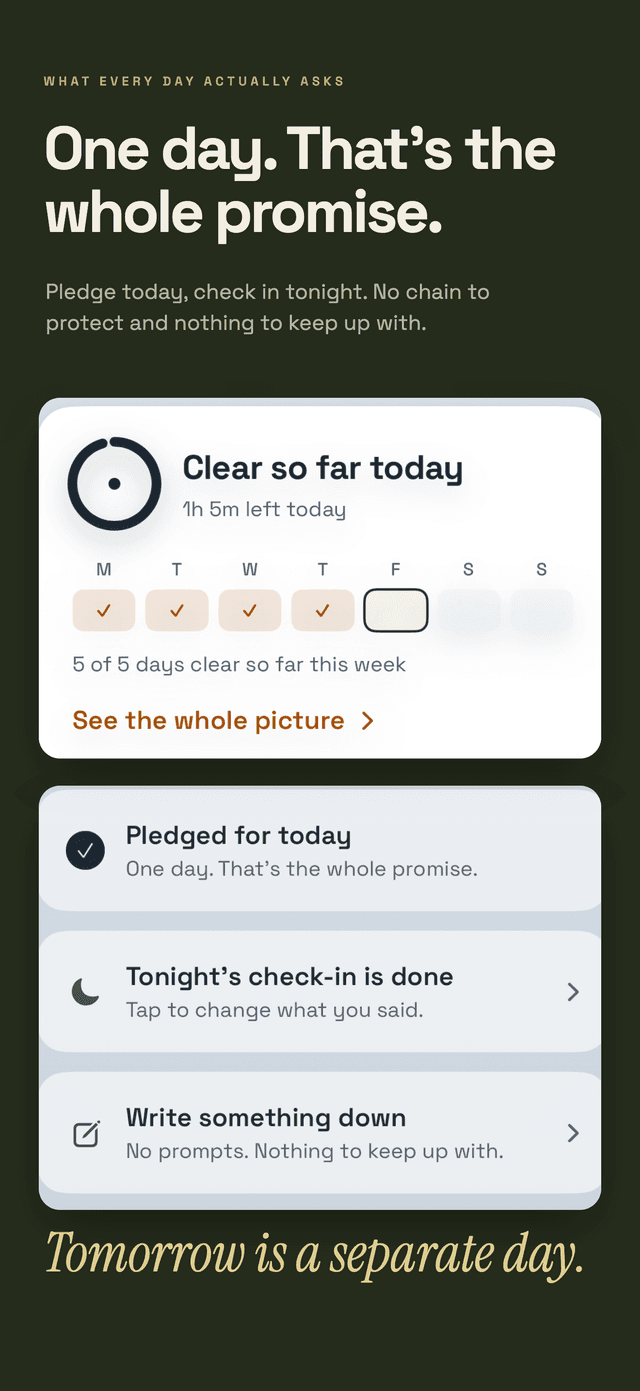
If you use Hard Bit, the free hard-moment button starts a short guided sequence that opens with a breathing circle and then brings back the personal sentence you wrote earlier. A log entry afterwards records the moment against the right habit. The Hard Bit overview explains how those logs stay on your phone and, with Hard Bit Plus, can feed a forecast of your own difficult hours. A paper note works too. What matters is a record you are honest with.
When breathing is not the right tool
Some situations need more than a self-help technique:
- Alcohol or sedatives. If you may be physically dependent, stopping suddenly can be dangerous. Get medical advice before you stop. Severe shaking, confusion, hallucinations or seizures need urgent help.
- Smoking or vaping. Breathing is a general coping idea. Official quit services can explain evidence-based support, including stop-smoking medicines, which give you a stronger foundation.
- Gambling. If money, debt or chasing losses is involved, practical barriers usually matter more than calming techniques. These include bank gambling blocks, self-exclusion and specialist support.
- Crisis. If you are in immediate danger, are having thoughts of harming yourself, or someone else is at risk, contact emergency services or a crisis line now.
Our editorial policy explains how Daily Life Apps reviews health information and keeps it separate from product content.
Frequently asked questions
Does breathing actually reduce cravings?
Current research suggests it can reduce craving a little. A 2026 review in Addiction found a small effect across several substances, and the authors called for larger trials to confirm it. They framed breathing as a low-cost add-on to treatment. Treat it as a useful pause, not a cure.
How long should I breathe for during a craving?
Smokefree.gov suggests about ten breaths, or until you feel calmer. The NHS stress exercise suggests at least five minutes when you have time. In a hard moment, start with ten breaths, then move to your next action whether or not the urge has gone.
Is there one best breathing technique for urges?
There is no single proven best pattern for everyone. The Addiction review reported similar craving effects for biofeedback and other controlled breathing methods. Choose a gentle pattern you can remember, such as a slightly longer out-breath, and adjust it if it feels uncomfortable.
What if the urge comes back after I breathe?
That is common, and it doesn't mean the technique failed. Cravings can return in waves. Repeat the breathing if it helped, change your location or remove access, and contact support if the urge keeps building or safety is a concern.