A weekend craving plan is a short checklist you write before Friday, not a promise to "be good" until Monday. It names the two or three hours most likely to be hard, adds barriers before those hours, prepares an answer for social pressure, schedules one bridge activity for each risky window, and names a person to contact. It finishes with a five-minute review on Monday. The method works for drinking, smoking, vaping, cannabis, betting, porn, scrolling, gaming or another habit you are trying to stop or cut down.
Weekends often remove the structure that quietly protects weekdays: commutes, work hours, set mealtimes and other people's expectations. In their place come free time, social events, late nights and a sense that the usual rules are off. A plan puts some of that structure back, only where it is needed.
If your weekend cravings are mainly about food or snacking, this checklist isn't designed for that. Nutrition guidance is a better place to start, and if eating often feels out of control, talking to a GP can help.
Why weekends need their own plan
A weekday plan often fails on Saturday. The cues are different, and so is the timing.
Smokefree.gov lists parties, social events, bars and being with friends who smoke among common smoking triggers. Its page on smoking and alcohol notes that for many people, drinking is a trigger for smoking too. Weekends often stack these cues together, and one habit can open the door to another.
For other habits the weekend cue may be quieter: an empty Sunday afternoon, a long sports schedule, a late night with the phone in bed, or a gaming session that started "for an hour". These are not character flaws. They are predictable situations, and predictable situations can be prepared for.
This guide covers any habit. If one habit dominates your weekend, the habit-specific guides go further: how to prepare for a cannabis-free weekend, how to plan a low-scroll weekend and how to handle the first alcohol-free Friday night.
Step 1: Find your weekend hours, not your weekend mood
"Weekends are hard" is too broad to plan for. Look back at the last two or three weekends and write down when things got difficult. Many weekends have three common windows:
- The Friday handover: the hour after work or study ends, when relief and tiredness meet.
- The open middle: long unstructured stretches on Saturday or Sunday afternoon and evening.
- The Sunday dip: Sunday evening, when the week ahead starts to feel close.
Your windows may be different. Write them down as specific times: "Friday 6–8pm, Saturday 9pm–midnight" rather than "Friday night and Saturday".
If you have been logging urges, use those entries. How to identify your craving triggers and difficult times explains a simple log you can start this weekend. Treat early patterns as provisional. A couple of weekends can suggest a question, not prove a rule. How many logs you need before a pattern means anything covers that restraint in more detail.
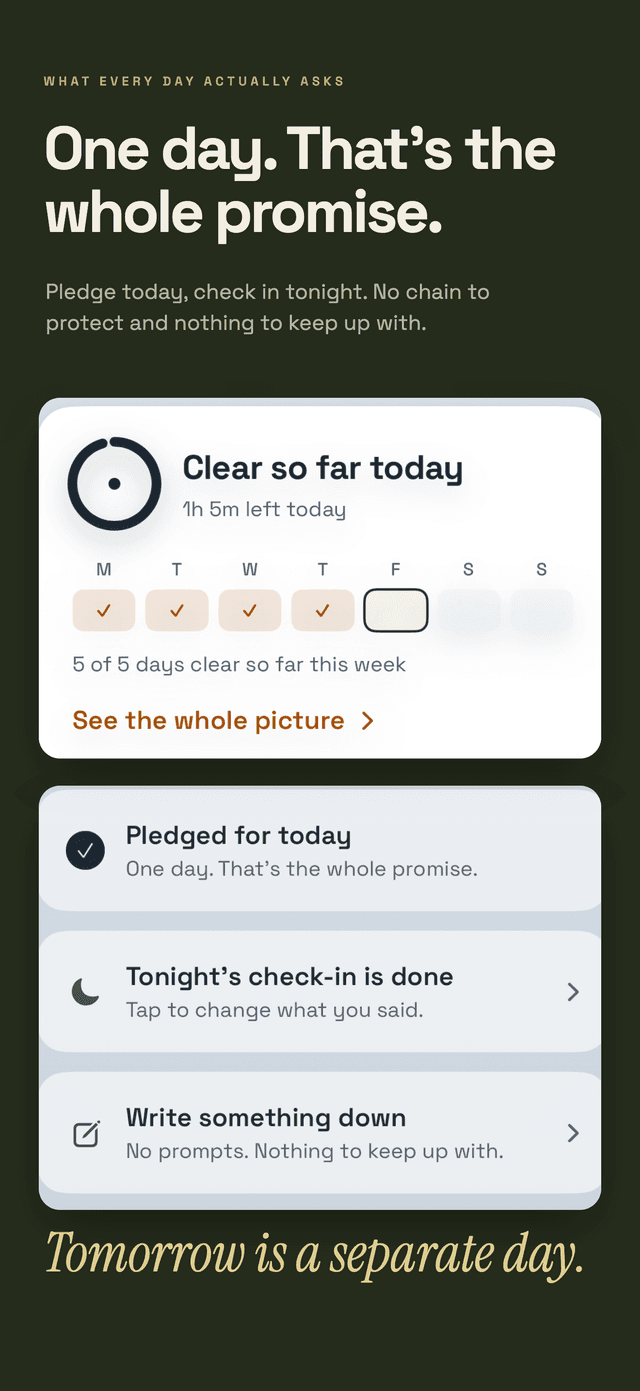
In Hard Bit, each habit keeps its own difficult hour and logs. With Hard Bit Plus, the on-device forecast learns from your own history and can warn you before a forecast hard hour. It makes no prediction until you have five entries and relies fully on your data at about twenty, so it will not invent a weekend pattern you have not logged.
Step 2: Set up barriers before Friday
A barrier you set up on Thursday asks less of you on Saturday night. Choose one or two for each habit:
- Alcohol: decide in advance which days will be drink-free, check what alcohol-free drinks a venue serves before you go, and if you do drink, go at your own pace rather than joining rounds. Drinkaware suggests these steps for long weekends. Not restocking at home adds one more barrier. If you drink heavily every day, talk to a GP before adding drink-free days, as stopping suddenly may not be safe (see Step 6).
- Smoking or vaping: leave supplies at home or don't buy them, and plan where you will stand at a party that is not the smoking area.
- Betting: consider a bank gambling block or blocking software well before the weekend. GamCare explains that bank blocks are set up card by card, and that switching one off usually involves a delay, often 48 or 72 hours depending on the bank. Check what your bank's block covers. GamCare also notes that some blocking software is free.
- Porn, scrolling or gaming: decide on Thursday where the phone or console will spend the night, log out of the app that leads to the longest sessions, or move the device out of the bedroom.
Pick barriers that fit your goal. If you are cutting down rather than stopping, the barrier might be a limit, a budget or a finish time instead of total removal.
Step 3: Prepare for the social moments
Many weekend cravings involve other people. Prepare an answer before you need it.
- Write one short line you can say without explaining: "I'm good, thanks" or "Not tonight, I've got an early start."
- Decide what you will drink, hold or do instead before you arrive.
- Tell one person at the event what you are aiming for. Smokefree.gov suggests telling friends and family you have quit so they can support you.
- Plan how you will get home, and decide in advance what time you'll leave.
The NHS encourages having several drink-free days each week, and seeing friends doesn't have to mean going for drinks. A breakfast, a coffee or a walk can keep the connection without the usual cue. One different plan on Saturday morning may also make Friday night easier.
Step 4: Fill each risky window with one bridge activity
An empty window is where an urge has the most room. For each window from Step 1, schedule one activity that fits the actual time, place, energy and budget:
| Window | Example bridge activity |
|---|---|
| Friday handover | Shower, change clothes and eat before sitting down |
| Saturday afternoon | A walk, errand or class booked with someone |
| Saturday late evening | A film or audiobook in a room without the usual cue |
| Sunday dip | Prepare Monday's lunch, then an early phone-free hour |
A bridge activity is not a test of willpower. It only needs to carry you to the next decision. If two habits tend to peak in the same window, how to handle two difficult habits at the same hour explains how to plan one response without mixing up the records.
Step 5: Put the in-the-moment steps where you can reach them
Even a good plan meets a strong urge sometimes. Decide now what you will do in the first few minutes:
- Name the urge plainly.
- Move away from the cue if it is safe to do so.
- Start the bridge activity for that window.
- Read the reason you wrote earlier for stopping or cutting down.
- Contact your support person if the plan is not enough.
How to handle a craving in the moment explains each of these steps. Keep them short enough to read at a glance. How to make a short craving emergency card shows how to fit them on one card. Hard Bit's free hard-moment flow brings back the personal sentence you saved, and the app includes help links if you need more support.
If you want a nudge before a difficult window, keep it to one. How to set a gentle reminder without creating notification fatigue explains how to time a reminder so you don't learn to ignore it.
Step 6: Know when the weekend needs more than a plan
Some weekends carry risks that a checklist cannot handle.
- If you may be physically dependent on alcohol or sedatives, do not plan a sudden stop over the weekend without medical guidance. Withdrawal can be dangerous. Contact a GP, pharmacist or local service before the weekend, and seek urgent help for severe symptoms.
- If you smoke or vape, an official stop smoking service can explain evidence-based support, including stop-smoking medicines, that can sit alongside your plan.
- If betting is causing debt or the weekend involves large sums of money, specialist gambling support and practical barriers such as blocks and self-exclusion may be more urgent than any distraction.
- If you are in immediate danger or thinking about harming yourself, contact emergency services.
A plan helps you prepare. It does not assess medical risk or replace qualified care. Our editorial policy explains how we separate general guidance from product information.
Step 7: Review the weekend on Monday
On Monday, spend five minutes with five questions:
- Which window was hardest, and did it match what I expected?
- Which barrier held, and which one did I get around?
- Did the social answer and bridge activities work?
- Was there a moment I should have contacted someone sooner?
- What one thing will I change for next weekend?
Change one thing, not everything. How to review a week of craving logs gives a fuller structure if you want one.
If the weekend included a slip, keep it in the record. In Hard Bit, logging a use doesn't reset the counter to zero, so the clear days stay visible beside the difficult one. If the same Saturday keeps going the same way, how to change the plan after the same slip happens again helps you find an earlier point to change.
The checklist to copy
Write this on Thursday evening:
- My weekend hard hours: ______
- Barrier for each habit, set up before Friday: ______
- My social answer: ______
- Bridge activity for each window: ______
- Reason I'm stopping or cutting down: ______
- Support person and when I'll contact them: ______
- Safety check: withdrawal, money or crisis risks covered?
- Monday review time: ______
You can learn more about how Hard Bit keeps each habit's hours and logs private on your phone on the Hard Bit overview.
Frequently asked questions
Should I avoid all social plans while I'm changing a habit?
Not necessarily. Avoiding high-risk events can be sensible early on, especially when they combine several cues. Many people choose a different kind of plan instead, such as breakfast, a walk or a shorter visit with a clear way home. Choose what is safe and realistic for you.
What if my hardest time is a weekday, not the weekend?
Then plan for that day using the same steps: name the hours, add barriers, schedule a bridge activity and review afterwards. The weekend is a common example, not a rule. Your own log is the better guide.
Does a weekend plan work if I'm cutting down rather than stopping?
Yes. Set a limit, budget or finish time in advance instead of total removal, and decide how you will track it. Cutting down still needs clear, measurable boundaries. If moderation keeps failing on the same night, consider changing the goal or getting support.
What if I follow the plan and still have a strong craving?
Cravings vary in strength and length, and a plan does not guarantee a quiet weekend. Use your in-the-moment steps, contact your support person, and log what happened. A strong urge you notice and record still gives you useful information for next weekend.