To reduce craving reminder notification fatigue, start with one reminder for one known difficult window. Put one action in the message, schedule it while that action is still possible, and keep its delivery quieter than an emergency alert.
Do not assume that more prompts create more support. The sources reviewed for this guide do not establish an ideal number of personal craving reminders. “Start with one” is a practical test, not a clinical threshold.
Audit the alerts already competing for attention
Before adding a reminder, check what your phone already delivers during the same hour. A carefully written prompt can still disappear among messages, news, shopping alerts, scores, games, and work notifications.
Review the relevant period and ask:
- Which alerts require action now?
- Which can wait for a summary?
- Which no longer serve a purpose?
- Which sounds or badges make you open an app automatically?
- Is the craving reminder private enough for the places where it will appear?
The Agency for Healthcare Research and Quality defines alert fatigue in clinical settings as desensitization caused by a high volume of alerts. It recommends reducing inconsequential alerts, making them more specific, and reserving interruptions for higher-severity information.
That evidence concerns health-care systems, not personal craving reminders. It does not prove that a particular phone setup will work for you. It does support a cautious design principle: remove avoidable competition before adding another interruption.
Give the reminder one job
A reminder becomes vague when it tries to motivate, warn, collect data, celebrate progress, and provide coping advice at once. Choose one job:
- Prepare: do something before a difficult window.
- Act: begin one preselected response.
- Record: add a brief note after the moment.
- Connect: contact a person or service already chosen.
If the message says “Stay strong, remember your goals, log your craving, breathe, and call someone,” it contains several decisions. Reduce it to the first useful action.
| Reminder job | Example |
|---|---|
| Prepare | “Eat before leaving work” |
| Act | “Charge the phone in the kitchen now” |
| Record | “Log the last hour in one line” |
| Connect | “Send Alex the saved message” |
Smokefree.gov recommends preparing go-to strategies for nicotine cravings and reviewing your reasons for quitting. It does not establish that notifications work for every habit. The transferable idea is preparation: choose the action while the moment is calm.
For help narrowing the choice, use the guide to choosing one action for a difficult twenty minutes.
Put it before a repeated difficult window
Timing matters only when the reminder leaves enough time to act. A message to eat before leaving work belongs before the journey home, not after you have reached the usual shop. A prompt to move a phone out of the bedroom belongs before getting into bed.
Research on just-in-time adaptive interventions defines useful support as the right type or amount at the right time. It also emphasizes providing nothing when the timing is wrong. The field is still developing, and the research does not validate one clock-time rule for personal craving reminders.
Use your own record instead:
- Identify one time or situation that has repeated.
- Choose an action that is possible shortly beforehand.
- Place the reminder before the last easy opportunity to take that action.
- Treat the timing as a hypothesis and adjust it after testing.
If you do not yet know when the difficult period occurs, first identify your craving triggers and difficult times. Do not create a dense reminder schedule from one unusual day.
Write an action, not a verdict
A gentle reminder should describe what to do without judging your character or predicting failure.
Prefer wording that is:
- specific: “Put the card in the drawer”
- short: readable without opening the app
- present-focused: about the next action
- neutral: no threats, insults, or moral score
- private: safe for the screens where it may appear
Compare these versions:
| Avoid | Use instead |
|---|---|
| “Do not ruin your progress” | “Read your reason, then make tea” |
| “Be stronger tonight” | “Take the route that avoids the shop” |
| “You always lose control after work” | “Eat before the journey home” |
| “Think carefully about your goals” | “Text Sam before the match starts” |
If naming the habit in an alert feels exposing or seems to pull attention toward it, name the next action instead. Test the wording rather than assuming one style works for everyone.
Match iPhone delivery to the reminder’s job
On iPhone, open Settings > Notifications > [app]. Apple documents controls for alert location, sounds, badges, previews, Scheduled Summary, Immediate Delivery, and Time Sensitive notifications. Available labels can vary by iOS version and app support.
For a reminder that must arrive before a specific window:
- use Immediate Delivery if the delivery choice appears,
- keep Notification Center or one other visible location enabled,
- consider turning off Sounds if a banner is enough,
- turn off Badges if the count creates unrelated pressure,
- check whether Time Sensitive Notifications are enabled.
Do not place a timing-critical reminder in Scheduled Summary. A summary delivers selected notifications in batches at scheduled times, which may be too late for the action you planned.
Scheduled Summary can suit prompts that do not depend on an exact time, such as a general weekly review. If privacy matters, alert placement and message previews need a separate check. The guide to keeping habit notifications private on iPhone covers those controls in detail.
A craving reminder is not an emergency alert. Do not rely on notification delivery for crisis help, medical monitoring, or another safety-critical instruction.
Test seven arrivals, then make one change
Use seven scheduled arrivals as a manageable review point, not as a scientific cutoff. For each arrival, note four facts:
- Did it arrive at the intended time?
- Did you notice and read it?
- Was the named action still possible?
- Did you begin that action?
Then use a simple decision:
- Keep it if the timing and action still fit.
- Move it if it arrives after the useful opportunity.
- Rewrite it if you read it but do not know what to do.
- Quiet it if the sound is unnecessary.
- Pause or delete it if you repeatedly dismiss it or no longer need it.
Change one variable at a time. If you alter the time, wording, sound, and action together, you will not know which change mattered.
A second reminder may be reasonable when it has a different job, such as one preparation prompt and one later logging prompt. Do not add a duplicate merely because the first was ignored. First ask whether its timing, wording, delivery, or purpose was wrong.
Use Hard Bit reminders without stacking them
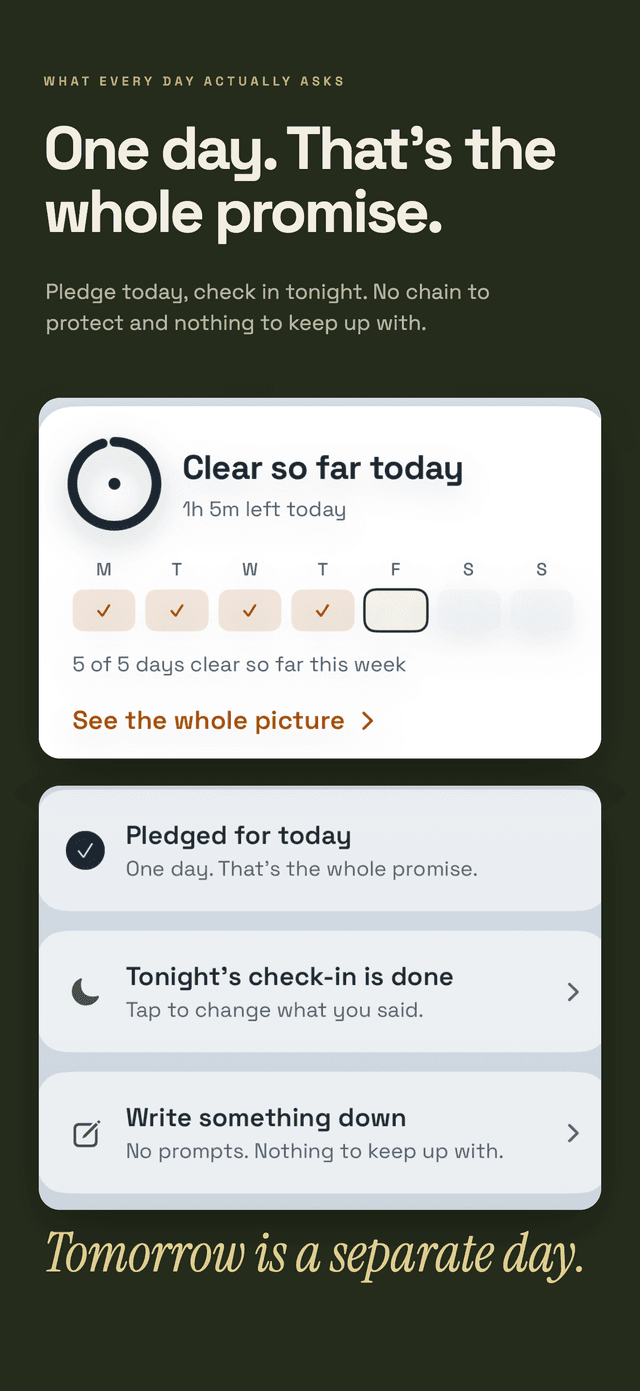
In Hard Bit, reminders are set in the You tab. First-party support documentation says they are scheduled locally on the device rather than sent from a server. Notification permission remains optional and can be changed in iOS Settings.
Start with the user-chosen reminder that has the clearest purpose. Hard Bit Plus separately adds the forecast and warning message. The forecast makes no prediction below five entries, so it should not be treated as immediate evidence about your difficult hour.
If you track several habits, each keeps separate logs, counters, difficult hours, and reasons for stopping. That does not mean each habit needs its own alert schedule. Choose the reminder that supports the habit you are actively addressing.
The Hard Bit overview explains the wider workflow, and the support notes document reminders, forecasts, subscription boundaries, export, and deletion.
Keep reminders separate from medical or urgent support
A reminder can cue a prepared action. It cannot assess withdrawal, diagnose a condition, provide treatment, or respond when someone is in immediate danger.
Alcohol withdrawal can be life-threatening for some people who stop after prolonged heavy drinking. Abrupt discontinuation or rapid reduction of a benzodiazepine can also cause serious withdrawal reactions. If either may apply, seek medical guidance rather than building a stopping plan around notifications.
Contact a clinician or relevant specialist service if cravings repeatedly feel unmanageable, the habit is causing serious harm, or self-management is not enough. Contact emergency services for immediate danger, severe withdrawal symptoms, loss of consciousness, breathing difficulty, seizures, or thoughts of harming yourself or someone else.
For a practical response during a non-emergency urge, read how to handle a craving in the moment. Our editorial policy explains how health guidance and product facts are reviewed separately.
Frequently asked questions
How many craving reminders should I set?
There is no evidence-based number that suits everyone. Start with one reminder for one repeated situation. Add a second only if it performs a genuinely different job and neither prompt is routinely ignored.
Should a craving reminder make a sound?
Not necessarily. Use sound only when the timing matters and a silent alert is easy to miss. If sound feels intrusive, test a banner or Notification Center entry instead. Keep urgent contacts and emergency alerts separate from this experiment.
Should I use Scheduled Summary?
Use it only for reminders that can wait, such as a weekly review. A prompt designed to arrive before a difficult hour should use immediate delivery because a summary may arrive after the useful moment.
What if I keep dismissing the reminder?
Do not respond by adding duplicates. Check whether the action is specific, possible, private, and timed early enough. Change one element and test again. If the reminder still adds nothing, pause or delete it and use a deliberate manual check-in instead.
Can reminders replace professional support?
No. They can cue an action or record, but they cannot assess medical risk or provide treatment, crisis response, financial help, or personalised clinical advice.
More source-reviewed planning articles are available in the Hard Bit guide library.