If you're having a difficult night quitting scrolling, don't treat it as a test of willpower. Make the night smaller. Before the hard hour, decide three things: where the phone will spend the night, what you will do for the first ten minutes when the urge arrives, and how you will fill the long middle of the evening. Then take the night one short stretch at a time and look back on it in the morning.
A difficult night is not proof that cutting down is failing. It is one of the situations you are learning to plan for.
Recognise what makes tonight different
Some evenings the phone barely pulls at you. On others the urge is loud from the moment you get home. Common reasons include:
- a stressful day you have not finished processing,
- being alone in a quiet home,
- an argument, a worrying message, or bad news,
- feeling too tired to start anything, yet not tired enough to sleep,
- feeling you have earned some time to yourself after giving the whole day to other people.
That last pattern has a name in research. A 2014 study in Frontiers in Psychology described bedtime procrastination: going to bed later than you meant to when nothing external is stopping you. In an online survey of 177 people, it predicted reports of not getting enough sleep. That was a single survey, and it shows an association, not a cause. Still, the idea is useful. Late scrolling can be less about the content and more about holding on to the evening.
Name tonight's version in one line: "I'm wired after the meeting and dreading tomorrow." You will use that line later. If the trigger is a news story, how to exit the loop after bad news covers that situation directly.
Set up the evening before the hard hour arrives
Most of your useful choices come before the urge peaks. Once you are on the sofa with the feed open, every option feels harder.
Decide where the phone sleeps. Samaritans suggests leaving your phone in a different room at bedtime if night scrolling has become a habit. Put a charger in the kitchen or hallway now, while it still feels easy. If you use the phone as an alarm, a cheap standalone alarm clock removes the main reason to keep it by the bed.
Pick a put-down time. Samaritans also suggests setting a time at night when the phone goes down for the day. On a hard night, choose it early, while you still feel calm.
Use the settings you already have. iPhone Screen Time lets you schedule Downtime, when only the apps and contacts you choose stay available. If you can dismiss a limit easily, it won't stop a determined thumb. It does add a pause, and sometimes a pause is enough.
Lay out one alternative where you will see it. Put a book on the armchair, earbuds with a saved podcast, a puzzle, or the things for a hot drink on the side. Pick it for how tired you will be at 11pm, not for how motivated you feel at 6pm.
Tell one person, if that helps. Samaritans suggests asking someone in your household to remind you to take a step back. A short message works too: "Rough night ahead. Text me at ten?"
Get through the first ten minutes of the urge
When the pull arrives, you don't need to decide anything about the whole night. Only decide about the next few minutes.
- Name it plainly. "I want to open the feed because I feel restless."
- Put distance in. Stand up and take the phone to its charging spot, or leave the room it is in.
- Start the alternative you prepared, even half-heartedly. Pour the water for tea. Open the book to any page.
- Delay, don't forbid. Tell yourself, "I'll decide about the phone after this cup of tea." That is easier to keep than "never tonight."
Some people find it helps to watch the urge rise and fall without acting on it. This is often called urge surfing. It is a coping technique, not a promise. Urges don't have a fixed length, and they can come back in waves. If another wave arrives, go through the same short sequence again.
For a slightly longer version, A Five-Minute Plan for the Start of a Craving works for scrolling as well as other habits.
Split the night into short stretches
"No scrolling all night" is too big to hold at 9pm. A few stretches, each with a clear end, are easier. This structure is our editorial suggestion, not clinical guidance:
- Until dinner is eaten and the dishes are done.
- Until one episode, one chapter, or one bath is finished. Use a screen with a natural ending, not an endless feed.
- Until the put-down time you chose earlier.
- Until bed. An early night is a fine plan. You don't have to stay up to prove anything.
At the end of each stretch, check in for a moment and start the next. You only ever have to manage the stretch you are in.
Give the long middle of the evening a job
The hardest part of a difficult night is often the empty stretch after the first urge has passed. Scrolling usually does a job: company, distraction, numbness, or a sense of keeping up. Ask which job it is doing tonight and choose something that does a similar one:
- Company: call or voice-message one person, or put on a familiar programme with a fixed end.
- Distraction: do a task with a clear finish, such as folding laundry, washing up, or one chapter.
- Settling a busy mind: NHS Every Mind Matters suggests writing down what is on your mind before bed. A few lines on paper can stand in for a long search for reassurance.
- Winding down: have a shower, stretch gently, or dim the lights in the room you are in.
If stress is clearly behind tonight's urge, What to Do When Stress Triggers Doomscrolling has a fuller way to match your response to the stressor.
Every Mind Matters also suggests avoiding phones, tablets and computers for about an hour before bed. On a hard night that may not be realistic. Any phone-free stretch before sleep is still worth having.
If you wake and reach for the phone
Some hard nights have a second hard moment in the small hours. NHS Every Mind Matters suggests that if you are still awake after about 20 minutes, you get up, sit somewhere comfortable, and do something relaxing, such as reading or listening to quiet music, then go back to bed when you feel sleepy. Keep a low lamp and the book in that chair. If the phone is charging in another room, most of this plan runs itself.
If waking up and checking the phone happens most nights, not just on hard ones, How to Stop Scrolling in Bed at Night covers the bedtime routine in more depth.
If you open the feed anyway
Sometimes the night wins a round. You open an app and look up forty minutes later. What you do next matters more than that.
Don't decide the night is ruined. That thought turns one slip into three hours. Instead:
- Close the app and put the phone back where it charges.
- Write one sentence: the time, and what was happening just before.
- Go back to the stretch you were in, or go to bed.
One honest line is more useful than a page of self-criticism. How to Track Scrolling Without Turning It Into Shame explains how to write entries that describe what happened rather than judge you.
Review the night the next morning
The next day, with some distance, spend two minutes on four questions:
- When did the urge first appear, and what was happening?
- What helped, even a little?
- Where did the plan break down, if it did?
- What one change will I make before the next night like this?
Look for the earliest point you could change. You might find the night went wrong at 8:40pm, when the phone stayed on the sofa, not at 11pm.
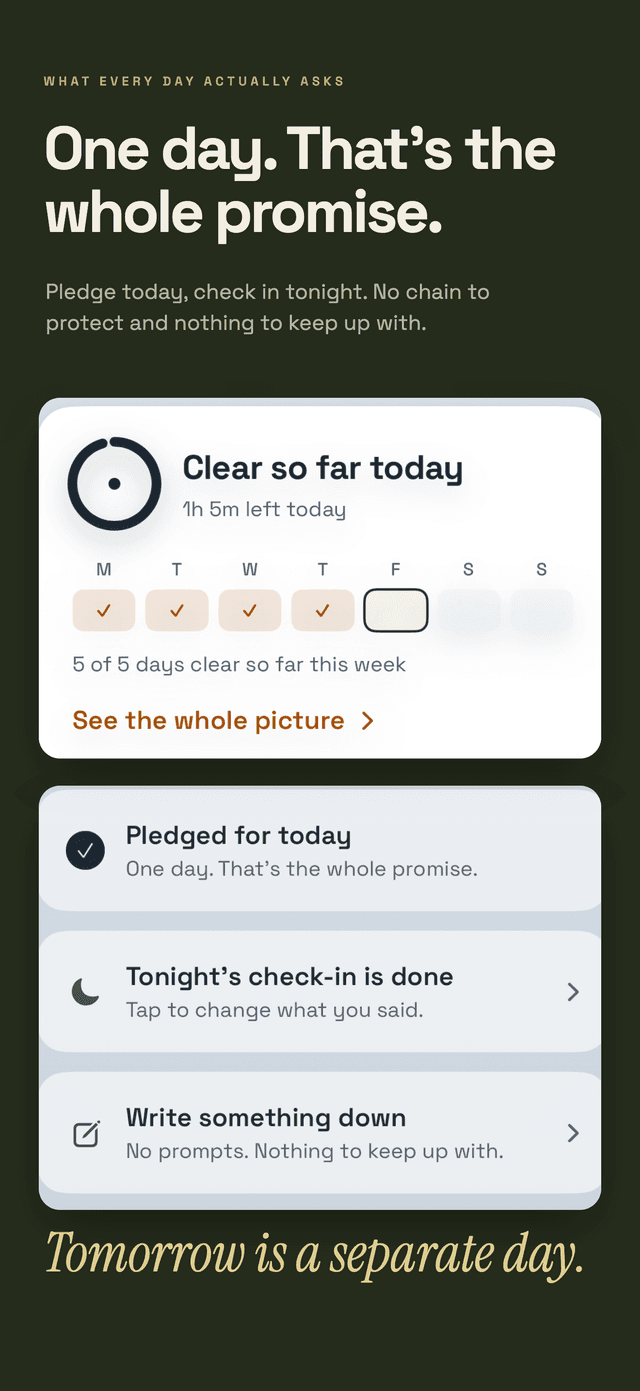
Over a few weeks, these notes may show that hard nights are not random. They might cluster on Sunday evenings, after late shifts, or on nights spent alone. That is where Hard Bit can help without taking over. You log urges and slips privately on your iPhone, and the hard-moment button and logging are free. With a subscription, the app forecasts your own difficult hours on the device and can warn you before one arrives. It makes no prediction below five entries and relies fully on your history at around 20. Logging a slip doesn't reset the counter, everything stays on your phone, and there is no account. The Hard Bit overview explains the features and privacy in more detail. A paper notebook can do the basic version.
Know when a phone plan is not enough
Most difficult scrolling nights are uncomfortable but safe. Some are not. If you are scrolling to hold off thoughts of self-harm, if you feel unsafe, or if hard nights are steadily affecting your sleep, work, or relationships, a phone plan is not enough on its own.
Samaritans can be called free, day or night, on 116 123 in the UK and Ireland. Elsewhere, contact a local crisis line. If you or someone else is in immediate danger, call emergency services. For ongoing sleep problems, NHS inform's sleep self-help guide is based on cognitive behavioural therapy (CBT) techniques. If self-help isn't enough, speak to a GP or another qualified professional, who can discuss options such as CBT for insomnia.
Our editorial policy explains how we separate health guidance from product information.
Frequently asked questions
Should I delete social apps for one difficult night?
You can, if it feels manageable and you know you can reinstall them. For many people, moving the phone to another room is simpler. Choose the barrier you will actually keep in place at 11pm.
Is it better to sit with the urge or distract myself?
Either can help. Noticing the urge without acting on it suits some people. Others do better switching to an absorbing task. On a very hard night, distraction plus distance from the phone may be the easier combination.
What if every night feels like a difficult night?
That is useful information, not a failure. For a week or two, note when the hardest stretch tends to start, then prepare for that window first. If sleep or mood is consistently affected, talk to a GP or another qualified professional.
Does scrolling on a hard night mean I've lost my progress?
No. One evening does not erase the days or nights that went differently. Record it honestly, change one thing for next time, and keep going. What to Do After a Slip Without Erasing Your Progress explains why, and more practical guides are in the Hard Bit guide library.