To quit social media without losing useful connections, do the contact work before the account work. List what each platform gives you, move every important person, group, information source, and file to another route, and test those routes before changing the account.
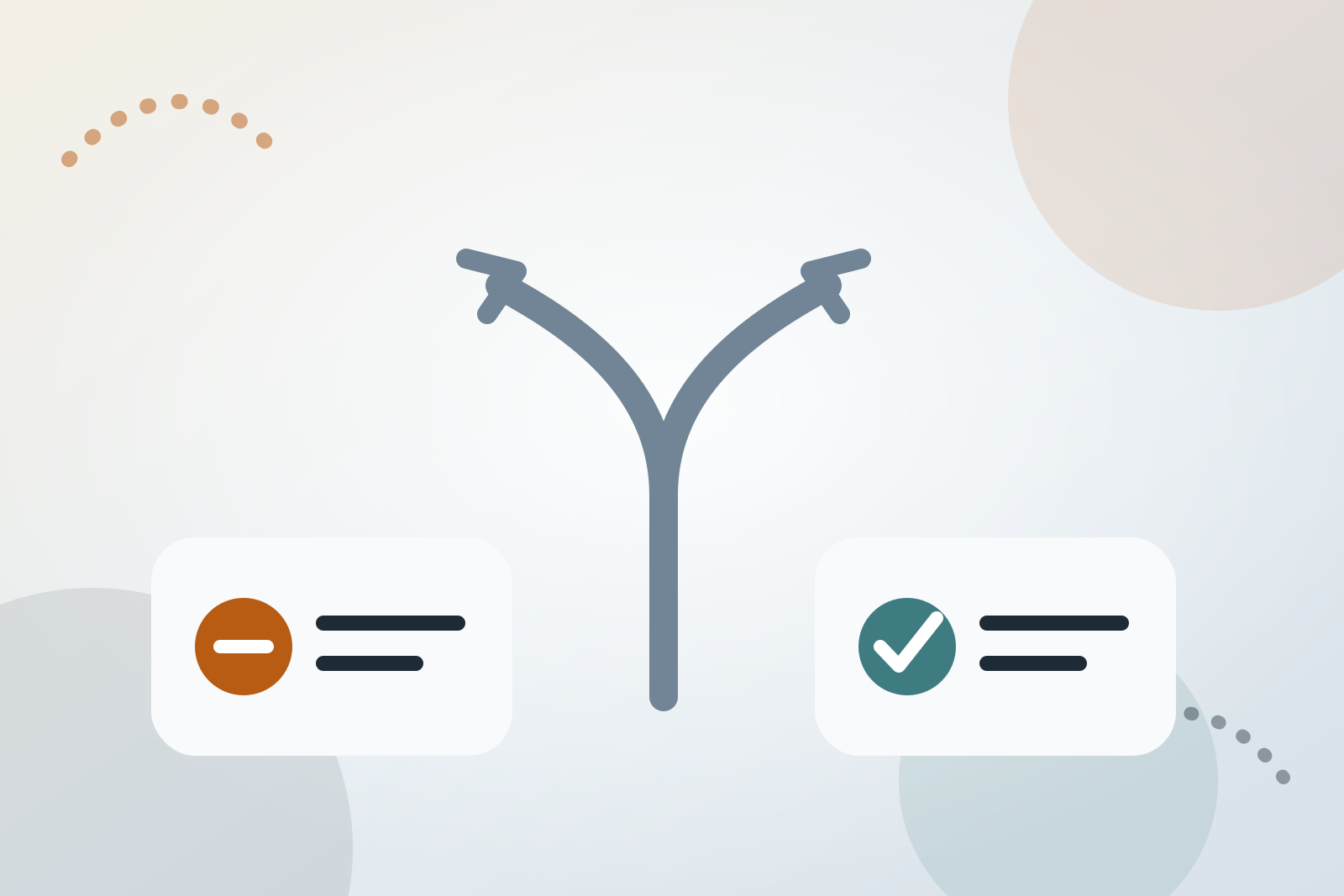
Closing a feed and becoming unreachable are not the same decision. A careful plan separates them.
Define which part you are leaving
A social platform may combine a public feed, direct messages, group organising, events, professional contacts, local information, and stored photos. Decide which functions you want to leave and which you need to replace.
Research sometimes distinguishes messaging-only apps from social media platforms. The seven-day abstinence study cited here describes messaging-only services such as WhatsApp as a separate domain. The 2025 meta-analysis also excluded a study focused only on instant messaging, while some included studies allowed messaging to continue.
That does not create a universal definition of quitting. It means you can write your own boundary clearly: for example, “No social feeds, but calls, texts, and one messaging app remain available.”
If you are unsure whether leaving is the right goal, first review the signs that social media use needs a new plan.
Make a connection inventory
Set aside about twenty minutes. Record one line for every person, group, service, or file you would genuinely miss.
| What you rely on | Current route | Replacement route | Tested? |
|---|---|---|---|
| Family member | Instagram messages | Phone number and text | Yes |
| Sports club | Facebook group | Group chat and calendar | No |
| School notices | Social page | Email list | Yes |
| Work enquiries | Profile messages | Website contact form | No |
| Saved photos | Account archive | Local or cloud copy | No |
Include less obvious dependencies:
- friends whose number or email address you do not have,
- clubs, support groups, neighbourhood groups, or parent networks,
- clients, collaborators, tradespeople, or marketplace contacts,
- school, council, transport, venue, or emergency information,
- events and birthdays stored only on the platform,
- photos, messages, documents, and account-recovery details.
Do not count followers as one task. Identify the people you would actually contact and the practical route each relationship needs.
Move each connection and test the route
Send a short message to the relevant people:
I’m leaving Instagram on Friday. You can reach me by text at this number. Could you also add me to the book-group chat?
Ask one organiser how essential updates will be shared. Subscribe to the mailing list. Add recurring events to your calendar. Send a test message through a new work contact form.
Testing matters. A saved number is not useful if it is outdated, and an email list is not a replacement if its messages go to spam.
Keep the message factual. You do not need to present leaving as a moral improvement or promise that you will never change your plan.
Export first, then choose an account action
Account controls, consequences, and timelines differ by platform. Read the current official help page for every account rather than applying one platform's rules to another.
Instagram's current documentation provides one example. It recommends exporting information before deletion because its export tool is unavailable after the profile has been deleted. It says deletion permanently removes the profile, photos, videos, comments, likes, and followers.
Instagram offers temporary deactivation if you want a break instead. Its help page says a profile and its information are permanently deleted 30 days after a deletion request, although the cancellation period varies by region. The wider deletion process can take up to 90 days, and some backup copies may remain longer for specified legal, safety, or recovery purposes. You must be able to log in to request deletion.
Your practical choices are:
- Deactivate: use a platform's temporary option while testing your replacement routes.
- Delete: export what matters, verify your contacts, and follow the current deletion process.
- Narrow: keep an account for a necessary work or group function while removing the app and avoiding its feed.
- Stagger: change one platform at a time so you can find missing dependencies.
Narrowing is not the same as fully quitting that platform, but it may fit a job, study, accessibility, or caring responsibility better.
Plan for the time you usually open the feed
Leaving the account does not automatically remove the cue. Note when you tend to reach for it and what happens immediately beforehand.
In one seven-day study, participants described habit, boredom, and coping as reasons for using social media. Notifications made abstaining harder, and some participants replaced social media with other apps. These are observations from a small study, not predictions about every reader.
Prepare for one repeated period:
- silence feed alerts while preserving calls and essential messages,
- remove the app and sign out on other devices,
- charge the phone away from the place where the session usually starts,
- choose a brief activity that suits that time and energy,
- decide who you can contact directly if you feel isolated.
Use the method for identifying triggers and difficult times. If the pull is happening now, try the sequence for handling an urge in the moment.
Replace the function, not only the minutes
The CDC describes social connection as important to mental and physical health. Supportive relationships can provide emotional help and practical help such as transport or childcare.
Replace the particular function the feed served:
- Casual contact: send one direct message or arrange a regular call.
- Group organising: use a group chat, mailing list, or shared calendar.
- Belonging: keep one recurring group activity.
- Local information: bookmark an official page or subscribe to alerts.
- Professional visibility: maintain a website, directory listing, or email address.
- Idle time: choose something with a natural ending, such as a walk, chapter, or small task.
Do not replace every weak connection with an obligation. Preserve the routes that are useful or meaningful to you.
Judge the result without promising a transformation
A 2025 preregistered meta-analysis included ten studies, 4,674 participants, and 38 effect sizes. It found no significant pooled effects of social media abstinence on positive affect, negative affect, or life satisfaction. Abstinence duration was not significantly related to those outcomes.
The authors also noted substantial differences between studies, limited statistical power, short interventions, uneven compliance, and limited generalizability. The findings do not prove that leaving has no benefit for an individual. They show that a guaranteed average wellbeing improvement is not supported by this evidence.
The earlier seven-day study reported increased mental wellbeing and social connectedness and reduced fear of missing out and smartphone use among 61 completers. However, it was an uncontrolled pre-post study using an opportunity sample, and 13 recruited participants who did not fully abstain were excluded from the final analysis.
Choose two or three personal measures, such as unplanned checks, bedtime, direct conversations, or whether the contacts in your inventory remain reachable. Our editorial policy explains how research findings are kept separate from product claims.
Preserve evidence when safety is involved
If harassment, stalking, coercive control, impersonation, or image-based abuse is involved, do not rush to erase the account or messages. Deletion may affect material you want for reporting, legal advice, or a safety plan.
Consider documenting relevant posts, messages, dates, account details, and URLs first. A specialist abuse service, lawyer, platform safety team, or police service can advise on the safest next step for your circumstances.
Seek professional support if leaving is worsening persistent anxiety, low mood, sleep, relationships, work, study, or isolation. Contact emergency services or a local crisis service if you are in immediate danger or thinking about harming yourself.
Use Hard Bit only as an optional record
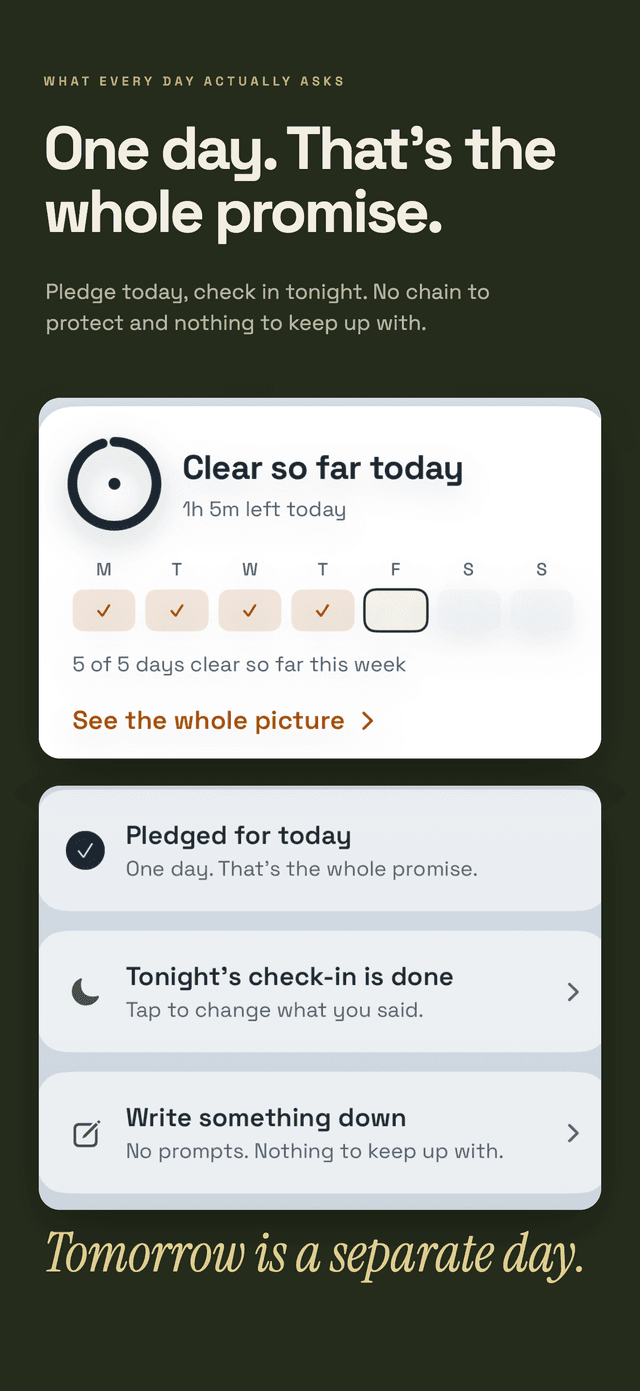
Hard Bit is an iPhone craving tracker that can keep scrolling separate from other habits. You can choose to stop or cut down, record difficult periods, and keep your entries on the device without an account or social feed.
The counter, logging, journal, hard-moment button, milestones, help links, and export and delete tools are free. Hard Bit Plus adds the on-device difficult-hour forecast, advance warning, patterns, calendar, widgets, and short reads. The forecast makes no prediction below five entries and relies fully on your history only at around twenty.
The Hard Bit overview explains the workflow, and the support page documents the current feature boundaries. A tracker can describe a pattern; it cannot diagnose or provide care.
Finish the first version today
- List the connections and information you would miss.
- Give each one a replacement route.
- Test the routes that matter most.
- Export files you want to keep.
- Choose one account action.
- Prepare for the time you usually open the feed.
The plan does not need to be permanent today. The useful contacts need to work before the old route closes.
Frequently asked questions
Should I deactivate or delete my account?
Use deactivation when a platform offers a temporary option and you want to test life without it. Use deletion when you understand that platform's consequences and have exported what you need. Check current official instructions because options and timelines differ.
How can I stay in touch after quitting social media?
Move each important relationship to a route both people can use, such as calls, texts, a messaging app, email, or a shared calendar. Send a test message before closing the original account.
Will quitting social media improve my mental health?
It may help some individuals, but a guaranteed benefit is not established. A 2025 meta-analysis found no significant pooled effects on positive affect, negative affect, or life satisfaction. Monitor your own experience and seek qualified support if your mental health is deteriorating.
What if work or study requires social media?
Define the required function narrowly. You might keep one account on a desktop browser, use it at set times, remove it from your phone, and direct personal contacts elsewhere. That is a reduction plan rather than fully quitting the platform.
Is repeatedly reaching for a removed app a sign of addiction?
No single behavior establishes a diagnosis. An automatic reach can reveal a learned cue or routine. Record when it happens, change the environment, and seek professional advice if the wider pattern is causing substantial harm or feels persistently unmanageable.