Social media addiction is commonly used to describe social media use that feels compulsive or out of control and continues despite problems. It is not a standalone diagnosis in the DSM-5-TR, and a high screen-time total cannot diagnose you.
The practical question is whether your use repeatedly affects something important or no longer feels chosen. If it does, identify the time and cue that keep appearing, protect the parts of social media you value, and change one part of that repeated situation.
Understand what the term does and does not mean
The American Psychiatric Association describes social media addiction as problematic, compulsive use that can disrupt functioning and real-world relationships. It also states that technology addictions, including social media addiction, are not currently included in the DSM-5-TR. Gambling disorder is the manual's only recognised behavioural addiction.
Researchers often use the term problematic social media use instead. That wording can help you describe a difficulty without assigning yourself a diagnosis.
Neither a website nor a tracking app can determine whether you have a mental health condition. You also do not need a diagnosis before changing a pattern that is costing you sleep, attention, money, or time with other people.
Check four kinds of signs
There is no official symptom list for social media addiction. Use these four areas as reflection prompts, not as a clinical test.
Control
Notice whether you:
- open a platform without deciding to,
- stay much longer than intended,
- repeatedly break limits you genuinely want to keep,
- feel restless or irritable when access is unavailable.
Cleveland Clinic lists difficulty controlling use and feeling antsy or irritable without access among possible signs. These experiences alone do not establish a disorder.
Consequences
Ask what the use displaces or disrupts:
- sleep,
- work or study,
- meals, movement, or other interests,
- conversations and relationships,
- money through shopping, purchases, or linked betting features.
The APA highlights continued use despite known problems. The American Academy of Pediatrics also suggests checking sleep, responsibilities, other leisure activities, relationships, and spending.
Preoccupation and concealment
Thinking about the next check constantly, experiencing a strong pull to return, or hiding how often you use can indicate that the current plan is not working. The APA includes persistent thinking, cravings, and dishonesty about frequency among behaviours that may raise concern.
The experience itself
The time may be harmful because of what happens within it. Harassment, coercion, hostile content, repeated comparison, or material that leaves you distressed long after closing the app deserves attention even when your total usage looks ordinary.
One isolated evening is not a diagnosis. A recurring loss of control, a recurring consequence, or any immediate safety problem is enough reason to change the situation or ask for help.
Do not use an hours total as the verdict
The APA says time alone might not indicate a mental health problem and gives no universal problematic threshold. AAP guidance for teenagers and young adults similarly says healthy use cannot be defined by one number of hours.
Context changes the meaning of a total. An hour spent deliberately talking with friends is different from an unplanned hour that delays sleep. Work, accessibility, community, and caring responsibilities can also involve legitimate social media use.
Use duration as one fact. Review it alongside purpose, control, timing, and consequences.
Build a short map of the pattern
For seven days, use your phone's existing Screen Time report and add a note only when use feels automatic, continues longer than intended, or has a consequence you care about. Seven days is a practical observation window, not a clinical timeline.
The AAP suggests reviewing total time, daily pickups, and the first app opened after a pickup. Add five details:
- the time and place,
- what happened immediately before,
- which app or feature you opened,
- what you intended to do,
- what happened afterwards.
A note might read:
Tuesday, 10:40pm; in bed; checked one group message; opened short videos; intended to reply only; stopped after midnight and delayed sleep.
Include deliberate use too. Otherwise, the record will make all social contact look like a problem.
Make any obvious safety change immediately. Do not log while driving or during another unsafe situation. For a wider review of feelings, places, and routines, use the guide to identify your triggers and difficult times.
Turn one repeated route into a new plan
After the week, look for a combination rather than a single dramatic explanation:
Weeknights after 10:30pm, one message leads to a video feed, and bedtime moves later.
Choose a response that matches the route:
- If a notification starts it: silence non-essential feed alerts while preserving calls or direct messages you need.
- If one app leads to another: move the feed off the home screen, sign out, or keep it browser-only.
- If the location matters: charge the phone outside the bedroom or beyond arm's reach.
- If you open it to avoid a feeling or task: prepare one small alternative, such as making tea, showering, walking, or messaging a trusted person directly.
- If the content is the harm: mute, unfollow, block, report, or leave the space rather than measuring success only in minutes.
Write the plan as four lines:
- When: weeknights after 10:30pm
- Cue: checking one group message in bed
- Change: phone charges outside the bedroom at 10:15pm
- Alternative: use a separate alarm and read until lights out
Cleveland Clinic recommends steady, manageable changes rather than assuming you must move from constant use to zero immediately. Treat this as a personal experiment, not a proven treatment. If the pull arrives despite the plan, rehearse a short response for handling the urge.
Decide what you want to preserve
Stopping every platform is one option, but it is not automatically the best option for everyone. Social media may hold community groups, direct contact, professional information, or support you value.
If you want to cut down, define boundaries you can check:
- which platforms or features,
- which purposes,
- which times and locations,
- what marks the end of a session.
“Use less” is vague. “Direct messages are available, but feeds stay closed before 9am and after 10pm” is observable.
If you want to stop using a platform, decide how important contacts will reach you first. Removal may help, but use can also move to a browser or another app if the original cue remains.
Use Hard Bit only as an optional record
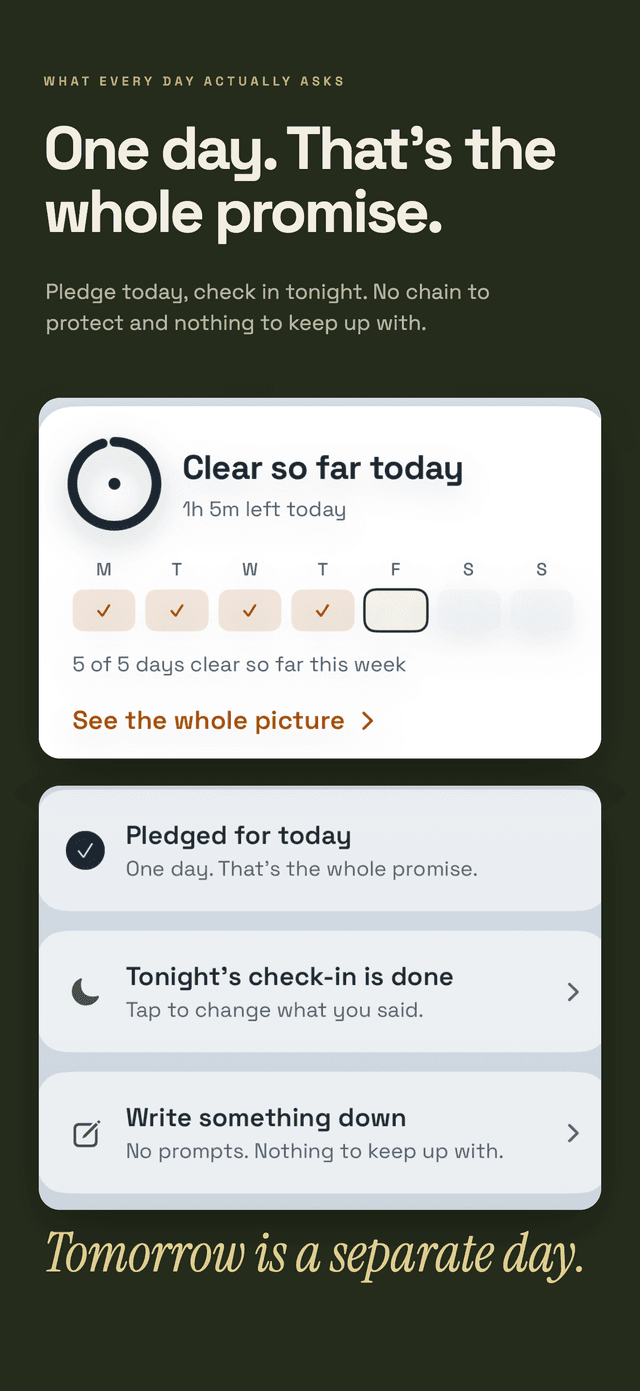
Hard Bit is an iPhone craving tracker that supports scrolling and custom habits. You can choose to stop or cut down and keep separate records for different habits.
The counter, logging, journal, hard-moment flow, help links, and export and delete tools are free. Hard Bit Plus adds the difficult-hour forecast, advance warning, patterns, calendar, widgets, and short reads. The on-device forecast makes no prediction below five entries and relies fully on your own history at around twenty.
There is no account or social feed. Entries and forecasts stay on the device unless you choose to export a file. The Hard Bit overview explains the workflow, and the support page documents feature and subscription boundaries.
A tracker can help you describe a pattern. It cannot diagnose, treat, or decide why the pattern exists. If logging becomes another checking loop or increases your distress, stop using it.
Know when self-management is not enough
The APA recommends assessment and counselling with a mental health professional as a first step when technology use is causing significant problems. It says cognitive behavioural therapy is commonly used to address contributing thoughts and behaviours.
The treatment evidence remains limited. A systematic review in the Journal of Medical Internet Research found mixed results across social-media interventions. Therapy-based approaches appeared more promising than simple limits or abstinence, but almost all included studies received weak overall quality ratings. No single approach should be presented as a guaranteed treatment.
Consider speaking with a GP, psychologist, therapist, or another qualified professional if:
- sleep, mood, anxiety, work, study, or relationships are deteriorating,
- use repeatedly feels impossible to control,
- harassment, coercion, or distressing content is involved,
- spending or linked gambling is creating financial harm,
- social media use is happening while driving or during another dangerous task,
- your attempts to change are increasing shame or isolation.
If you are thinking about harming yourself or someone else, contact emergency services or a crisis service where you live. Do not wait to finish a tracking exercise.
If a difficult session has already happened, keep it in the record without erasing the rest of your progress. More source-reviewed articles are available in the Hard Bit guide library, and our editorial policy explains how health and product claims are reviewed.
Frequently asked questions
Is social media addiction a diagnosis?
It is not a standalone DSM-5-TR diagnosis. The phrase describes a possible pattern, but it should not be used to diagnose yourself or another person.
How many hours of social media are too many?
There is no universal threshold. Review what the use is for, whether it feels controlled, when it happens, and what it displaces.
Will deleting social media fix the problem?
It may remove immediate access, but it does not always remove the cue or need that started the session. Plan how you will preserve useful contact and respond to the repeated time or trigger.
Should I track every time I open an app?
No. Let your phone count pickups and duration. Add context only when use feels automatic, continues longer than intended, or contrasts with deliberate use.