To track gaming without shame, record facts you could check later: the day, start and stop times, what happened just before, what the session was for, how strong the urge felt on your own scale, and what happened next. Leave judgments about your character out of the entry.
Include evenings that went as planned as well as difficult ones. Then review the week in one short sitting instead of treating each day as a score.
This guide concerns gaming patterns while you are considering or making a change. It is not about cataloguing an unplayed backlog.
Decide what the record is for
A gaming log can answer different questions:
- Where do my evenings go?
- Which sessions run later than planned?
- What usually happens before an unplanned session?
- Which conditions help me stop when I intended?
Write one question at the top of the notebook, note, or app. For example: “I am recording evenings so I can see which sessions run past midnight.”
That sentence limits the log’s job. It does not need to measure your worth, prove effort, or collect every available statistic.
If you are still choosing a tool, a private way to track gaming on iPhone compares library trackers, Screen Time, platform reports, and behaviour logs.
Write entries as facts rather than accusations
Compare two records of the same evening:
- “Wasted another entire evening. No self-control.”
- “Thursday, 9:10pm to 1:40am. Started after a long work call. Planned to stop at 11. Urge 7/10. Went straight to bed and felt tired the next morning.”
The first expresses a painful judgment but offers little to change. The second identifies a cue, intended boundary, outcome, and consequence.
Six fields are usually enough:
- Day and start time
- Planned and actual stop times
- What happened immediately before
- What the session was for
- Urge strength on one consistent personal scale
- What happened afterwards
If a game remained open while you ate, worked, or left the room, decide whether that idle time belongs in the session. Use the same rule each time. Consistency matters more than creating a perfect measure.
Describe the session, not the person
Research commonly distinguishes shame, a negative evaluation of oneself, from guilt, a negative evaluation of a particular behaviour.
Evidence about how these emotions affect change is limited and does not establish what will happen with gaming. One PLOS ONE study followed 110 sexual minority men with recent methamphetamine use for 15 months. Higher initial shame was associated with slower decreases in stimulant use.
That study was about substance use in a specific population, not video games. It should not be generalized into a gaming-treatment claim. It does provide a reason to avoid building attacks on your identity into a record that is supposed to help you observe behaviour.
Watch for words such as “always,” “never,” and “typical.” Replace them with the dates or events you actually observed. “I played late on three work nights” is more precise than “I always ruin the week.”
Record what the session was for
An hours total without context can invite judgment while hiding why the session mattered.
An American Psychological Association feature reports psychologists’ view that time alone is not enough to classify gaming as pathological. Context and consequences matter. The article also discusses research linking motives with outcomes: gaming for fun or social contact differs from repeatedly gaming to forget problems or escape negative feelings.
Add a short purpose note:
- wind down after work,
- spend time with specific friends,
- avoid a task I did not want to start,
- fill an empty evening,
- finish a planned objective,
- get away from a difficult mood.
This note is a description, not a diagnosis. Two four-hour sessions can have different purposes and consequences.
If the repeated issue is re-queuing after an intended endpoint, use the guide to stopping one more match from becoming the whole night.
Include evenings that went to plan
A log containing only frustrating nights gives you an incomplete comparison.
Add a short entry on ordinary days:
- “Tuesday: no gaming, bed at 11.”
- “Sunday afternoon: two hours with friends, stopped as planned.”
- “Friday: wanted to play after work, cooked first, then decided not to.”
Quiet entries provide a denominator. Four late sessions out of fourteen observed evenings describe a different pattern from four late sessions out of four.
They also show potentially protective conditions, such as eating before logging in, starting earlier, having another commitment, or playing with people who leave at a planned time.
For help interpreting a small record cautiously, read how many logs you need before a pattern means anything.
Keep difficult days instead of restarting the record
A shame-driven response can be to delete a long session, reset the count, or quietly begin again on Monday.
Deleting it removes the event most likely to show where the plan stopped fitting the situation. Keep the entry and record the sequence without adding a verdict.
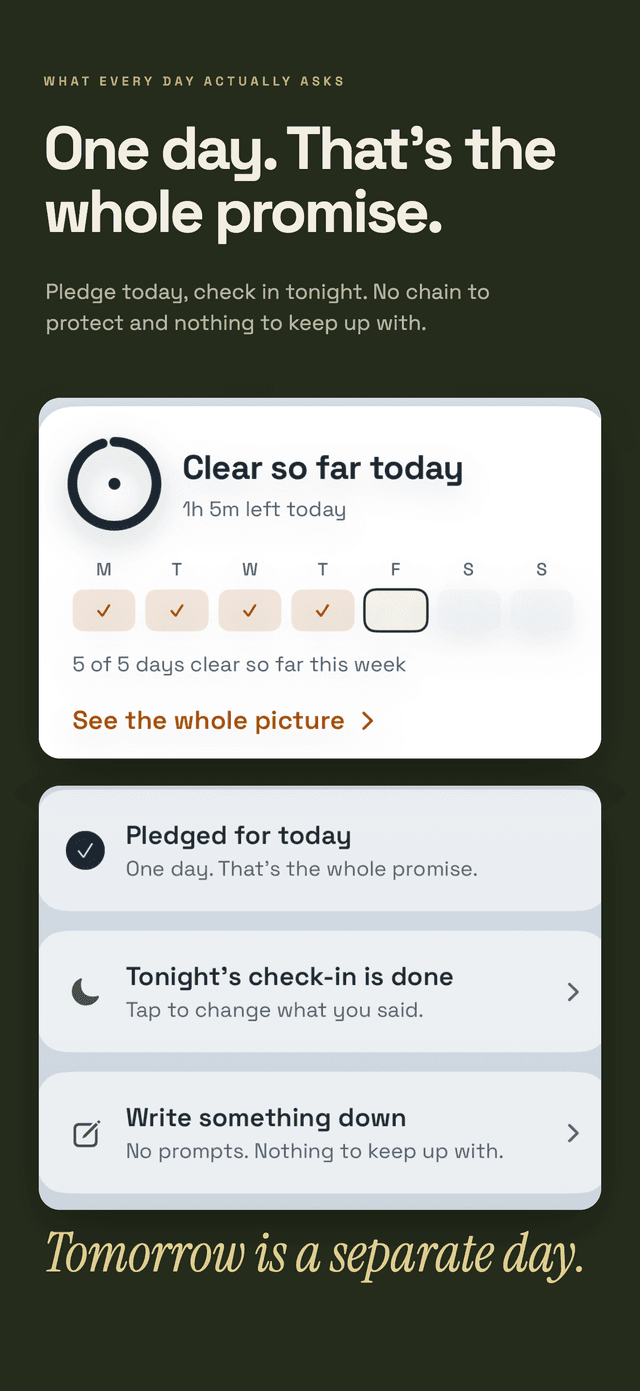
One option is to retain both clear and total days: “24 of 28 evenings went as planned.” That keeps the four difficult evenings visible without pretending the other 24 disappeared.
For the immediate response to an unwanted session, read what to do after a slip without erasing your progress.
Deleting information for privacy is a separate and legitimate decision. Deleting a craving log you no longer want explains that process.
Run a short weekly review
Use the same five questions once a week:
- Which sessions ran longer than planned?
- What happened in the hour before them?
- What purpose did I record for those sessions?
- What differed on evenings that went as intended?
- What is one condition I will change before the clearest repeat?
Ten minutes once a week is a practical editorial suggestion, not a clinically established schedule. Adjust it if another interval produces a clearer and less burdensome review.
Finish with one if-then plan:
If I start after 10pm, I will finish the current match when the alarm sounds and leave the headset downstairs.
Then close the log. If rereading entries every night adds self-criticism without producing new information, wait until the scheduled review.
Pause if tracking becomes punishment
Simplify or stop the record if you notice that you are:
- checking the total repeatedly to judge yourself,
- adding insults to otherwise factual entries,
- deleting days because they spoil the appearance of the record,
- recording more detail than your question requires,
- sharing the log with someone who uses it to pressure or humiliate you,
- feeling increasing distress without finding a useful next step.
You can keep the facts while removing hostile wording. You can also track fewer fields, review less often, or stop entirely. A log is optional.
If tracking repeatedly increases distress, discuss the wider situation with a qualified professional rather than trying to perfect the record.
Where Hard Bit fits
Daily Life Apps publishes Hard Bit, an optional craving tracker designed for iPhone. The App Store currently rates it 18+. It is a manual behaviour log, not a game-library manager, automatic playtime reader, or blocker.
Choosing gaming changes its prompts to hours rather than money. Each habit keeps separate logs, a counter, a difficult hour, and a reason for changing. You can choose to stop completely or cut down.
Logging a use changes the counter wording rather than returning it to zero, so day 84 can become “81 of 84 days clear.” The counter, hard-moment flow, personal sentence, logging, journal, milestones, help links, export, and deletion are free. Hard Bit Plus adds the on-device forecast and warning, patterns and calendar, widgets, and short reads.
The forecast makes no prediction below five entries and relies fully on your history at around twenty. Those are product rules, not clinical or statistical standards.
Current product documentation states that Hard Bit requires no account and has no social feed, advertising, third-party analytics, or server-side copy of your history. The Hard Bit overview describes the workflow, and Hard Bit support documents current features and subscription boundaries. A notebook can support the same method.
Know what a record cannot tell you
A gaming log cannot diagnose a disorder.
The World Health Organization defines gaming disorder in ICD-11 through impaired control over gaming, increasing priority given to gaming over other activities, and continuation or escalation despite negative consequences. The pattern must cause significant impairment in important areas of life and would normally have been evident for at least 12 months.
WHO also says studies suggest gaming disorder affects only a small proportion of people who game. An hours total alone is not a verdict in either direction.
In England, the National Centre for Gaming Disorders supports people aged 13 and over who have difficulty controlling video game use. It accepts self-referrals and referrals from family members and professionals. Its treatment includes CBT sessions focused on controlled gaming and increasing other activities.
The service does not provide crisis intervention. Outside England, start with a doctor or appropriate local mental health service. If anyone is in immediate danger, contact emergency or crisis services rather than relying on a tracker.
Do not delay help while collecting data. If gaming is seriously affecting sleep, study, work, essential spending, mental health, or relationships, a partial record can still help you describe what has been happening.
Our editorial policy explains how health guidance and product statements are reviewed. More articles are available in the Hard Bit guide library.
Frequently asked questions
Can tracking make me feel worse about gaming?
It can become unhelpful if every number triggers self-criticism or repeated checking. Keep the fields factual, include ordinary evenings, and review on a schedule. Pause or stop if tracking increases distress without helping you make a plan.
Should I track hours or sessions?
Track sessions and include their duration. A session has a start, cue, intended endpoint, purpose, and outcome. A weekly hours total alone cannot show those decision points.
Is it normal to feel guilty about how much I play?
Guilt can occur when a session conflicts with something you value. Describe the specific conflict, such as missing sleep or postponing work, rather than turning it into a conclusion about your character. Seek support if guilt or shame becomes persistent or overwhelming.
Can I show the log to a clinician or family member?
Yes, if sharing feels useful and safe. A factual log can provide concrete examples of timing, context, and consequences. Share only the dates and details you want to discuss, and remember that the record is information for a conversation, not evidence for a trial.