
A smoking trigger while driving is best handled before the vehicle moves. Compare the trips that prompt an urge with those that do not, remove smoking supplies from the car, and prepare one route-specific response. Once you are moving, driving takes priority over tracking or changing the plan.
The aim is not to make every journey effortless. It is to stop an automatic car routine from making the next decision for you.
Put driving safety ahead of the craving plan
Never type an entry, handle a phone, search the cabin, or unwrap gum or nicotine products while driving. Set up music and navigation before moving. Record what happened only after parking in a safe, legal place and switching off the engine.
A 2016 PNAS study examined 905 injury and property-damage crashes alongside normal-driving segments. Observable distraction was present in 68.3% of the crashes, and reaching for a non-phone object was associated with substantially higher crash odds. The study did not estimate a separate risk for smoking, so it should be read as evidence about distraction, not as a smoking-specific statistic.
If an urge, tiredness, or withdrawal symptom makes it hard to drive safely, leave the road and park safely before doing anything else. A cigarette is not a safe response to driver fatigue.
Compare the trips that do and do not trigger smoking
“Driving” may be too broad to explain the pattern. Compare journeys with similar distances but different outcomes.
After each relevant trip, record:
- the journey and time,
- whether you were alone,
- what happened shortly before the urge,
- urge strength on one consistent scale,
- whether you smoked and where in the trip it happened.
For example:
Drive home after late shift; alone; urge began leaving the car park; 8/10; smoked before joining the main road.
Same drive on Saturday afternoon; rested; 3/10; did not smoke.
That comparison suggests questions about time, tiredness, work stress, or the departure routine. It does not prove a cause. The broader guide to identifying craving triggers and difficult times explains how to test repeated combinations. If clock time keeps standing out, use the method for tracking the hours you are most likely to smoke.
Make the cabin a no-smoking environment
The National Cancer Institute (NCI) recommends removing cigarettes, lighters, and the ashtray from the car. Check the centre console, glovebox, door pockets, under the seats, boot, and any coat or bag that stays in the vehicle.
Clean the interior and air it out. A deodoriser may help if it suits you, but replacing the smell with a strong fragrance is not required. Ask passengers not to smoke in the car.
NCI also suggests keeping options such as sugar-free gum, mints, or nuts available. Choose anything you will use before departure or during a parked break. Do not create a new reason to reach around while moving.
Write a route card before picking up the keys
A route card turns a general intention into a plan for one journey. Write five lines:
- Trip: Which journey am I preparing for?
- First cue: When does the urge usually begin?
- Prepared response: What will already be set up?
- Safe stop: Where could I leave the road and park?
- Handoff: What will I do immediately after arrival?
One card might read:
Drive home after the late shift. The urge starts at the car-park exit. New playlist set before departure. Service station is the safe stop. At home, park, lock the car, and walk straight inside before logging the trip.
NCI and NHS Better Health both suggest changing a commute route or what you listen to. These are experiments, not guaranteed fixes. Change one feature, observe several comparable trips, and keep the version that helps.
For a closer look at the small step between a cue and a cigarette, read how to separate a smoking cue from the next action.
Match the plan to the actual driving cue
Different cues need different preparation:
- Starting the car: Put gum or a mint in your mouth before starting, and begin the prepared audio before moving.
- Traffic or boredom: Choose audio in advance. Do not browse for something new while driving.
- Long journeys: NCI recommends planned stretch breaks, rest stops, and snacks. Eat, change products, and update the plan only while parked.
- A smoking passenger: Explain before the trip that the car is smoke-free. NCI advises not allowing passengers to smoke in it.
- Tiredness: Stop somewhere safe and rest. Do not rely on smoking to make an unsafe drive manageable.
The safest mid-drive response is deliberately limited: keep attention on the road and postpone every other decision until you are parked.
Allow for nicotine withdrawal as well as routine
A car cue may overlap with nicotine withdrawal. NHS Better Health says cravings often last a few minutes and are commonly hardest during the first 28 days. NCI says withdrawal symptoms are usually worst during the first week, often peak during the first three days, and generally decrease over the first month, although some people experience symptoms for longer.
Those are population-level descriptions, not a countdown for one journey. An urge can recur several times along the same route.
Nicotine replacement and other stop-smoking medicines can reduce cravings and withdrawal. NCI describes nicotine replacement as effective and notes that a long-acting product such as a patch can be combined with a short-acting product such as gum or a lozenge. Ask a clinician, pharmacist, or stop-smoking adviser what is suitable for you. Follow the product instructions and prepare it before driving.
For options that do not involve driving, see how to handle a craving in the moment.
Know the smoke-free vehicle law
In England and Wales, it has been illegal since 1 October 2015 to smoke in a private vehicle enclosed wholly or partly by a roof when anyone under 18 is present. GOV.UK says both the driver and smoker could receive a £50 fine. Opening the windows or sunroof does not remove the restriction.
Rules differ by location, so check the current law where you drive. Regardless of the legal minimum, making the entire car smoke-free creates one consistent boundary.
Keep the record for after the drive
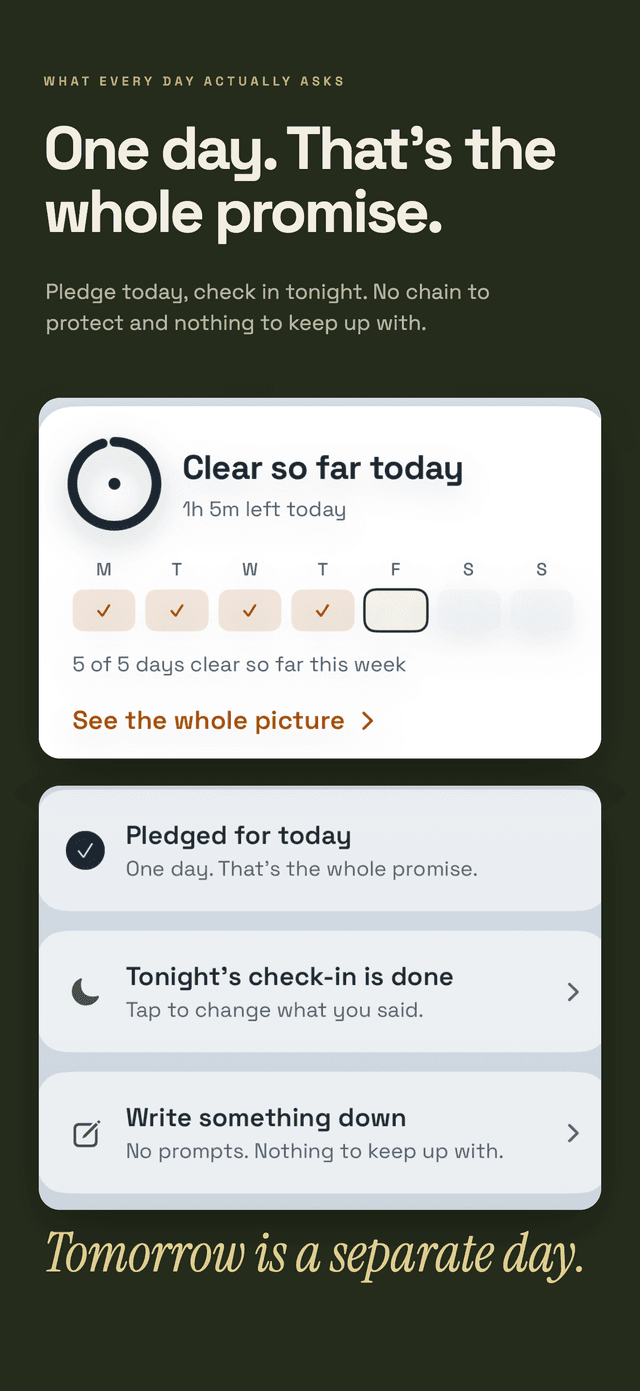
Paper is enough for a trip log. Hard Bit is an optional iPhone tracker that stores entries on the device without an account, advertising, third-party analytics, or a server copy.
Its free features include the counter, logging, journal, hard-moment flow, personal reason, help links, export, and deletion. Hard Bit Plus adds the learned difficult-hour forecast, advance warning, patterns, calendar, widgets, and short reads. The forecast makes no prediction below five entries and relies fully on your history at around twenty. Those are product rules, not clinical thresholds.
The forecast learns time patterns, not routes. A route name belongs in your note. Read any warning before picking up the keys, never while moving. The Hard Bit overview and support page explain the workflow and subscription boundaries.
If a trip ends with a cigarette, keep the entry. Tracking smoking without turning it into shame explains how to preserve useful facts without adding a judgment about your character.
Add qualified stop-smoking support
Changing the car routine does not assess nicotine dependence or replace treatment.
NHS Better Health says people using professional or expert help are three times more likely to quit for good. Local Stop Smoking Services in England are free, use trained advisers, and can help people choose nicotine replacement or other stop-smoking medicines. The NHS page also links to services in Wales, Scotland, and Northern Ireland.
In the United States, the NCI Smoking Quitline at 1-877-44U-QUIT offers individual counselling, information, and referrals.
Contact a clinician if withdrawal, low mood, anxiety, sleep problems, or difficulty concentrating is severe, persistent, or affecting safe driving. Seek urgent help for self-harm thoughts, chest pain, severe breathing difficulty, or another emergency. The Daily Life Apps editorial policy explains how health and product claims are reviewed.
Frequently asked questions
Why do I crave a cigarette in the car but not elsewhere?
The car can combine a repeated time, route, mood, and starting action. NCI lists being in a car as a pattern or activity trigger. Compare individual trips before deciding which part matters most.
Should I avoid driving while quitting smoking?
You do not need to test yourself on an unnecessarily difficult route. Use another driver, public transport, car sharing, or a changed route when practical. Do not drive if tiredness, poor concentration, medicine side effects, or another symptom makes it unsafe.
What if I light a cigarette while driving?
Keep control of the vehicle. Do not search for dropped items or make a sudden manoeuvre. Leave the road and park somewhere safe and legal before dealing with the cigarette or recording what happened. Afterward, reset the car rather than treating one trip as proof that the plan cannot work.
How long until the car stops feeling like a smoking place?
There is no fixed timeline. Withdrawal often becomes less intense over the first month, but learned cues can return later. Removing supplies, changing the departure routine, and repeating smoke-free trips provide more useful information than waiting for a guaranteed date.