
To track smoking without shame, record what happened without adding a verdict about what it means about you. Note the time, place, immediate cue, urge strength, whether you smoked and how many cigarettes, and what happened next.
Keep words such as “hopeless,” “weak,” and “ruined” out of the entry. Review several entries together at a time you choose, rather than treating each cigarette as a final judgment. Use the record to prepare for repeated situations and to communicate with qualified quit support.
What the evidence says about smoking stigma
Research does not show that shame is a dependable way to help someone quit.
A prospective study using 2008–2012 survey data from adults who smoked in Mexico and Uruguay found mixed associations. Perceived smoking-related stigma was associated with more quit attempts in Uruguay but with less successful quitting in Mexico. Because this was an observational study in two countries, it cannot prove that stigma caused either result or predict what will happen for an individual.
A separate qualitative study examined interviews with 39 US adults aged 55 to 70 who had long smoking histories. Participants described being looked down on, humiliated in public, blamed for health problems, or told to “just quit.” Some described hiding their smoking. The paper also discussed earlier evidence linking smoking self-stigma with shame, guilt, isolation, defensiveness, and non-disclosure to healthcare providers, while noting that other studies found different associations.
These studies have important limits. They do not test a particular logging method, and they do not show that shame always prevents quitting. They do support treating concealment and self-judgment as relevant concerns rather than assuming that harsher self-talk will help.
Build a neutral entry template
Choose fixed fields before the next cigarette or urge. Six are enough:
- Day and time
- Place or activity
- What happened immediately before
- Urge strength on one consistent scale
- Whether you smoked, and how many
- What happened next
For example:
Friday, 7:15am; kitchen; first coffee; urge 6/10; smoked one; left for the bus.
Or:
Saturday, 11pm; outside the pub; two drinks; urge 9/10; did not smoke; went back inside.
The urge score is only a personal comparison tool. It is not a clinical measure of nicotine dependence.
Use paper, a note, or a tracker that you can reach safely. Do not log while driving or during another activity that needs your full attention. If clock time is the main pattern you want to examine, use the more detailed guide to tracking the hours you are most likely to smoke.
Describe the event, not your identity
Compare two accounts of the same evening.
A verdict:
Caved again. No willpower. Ruined the whole week.
An observation:
Tuesday, 9:40pm; back step; argument on the phone; urge 8/10; smoked one.
Only the second version identifies something you could prepare for. It preserves the difficult event without turning it into a claim about your worth.
Use three editing rules:
- Name the action: “Smoked one,” not “I am hopeless.”
- Remove absolutes: “Always,” “never,” and “back to square one” rarely describe the complete record.
- Keep feelings as data: “Felt angry after the call” is useful. “I am pathetic” is an insult, not an observation.
This is an editorial logging method, not a tested treatment. Its purpose is to keep entries consistent and usable.
Keep the cigarettes you smoked in the record
The entry you most want to hide may contain a useful part of the sequence. If writing details feels difficult, record the minimum: time, place, and number of cigarettes. You can add context later.
Smokefree.gov describes a slip during a quit attempt as a temporary setback rather than proof that all previous progress has disappeared. It advises identifying the specific reason for the slip and deciding what to do in the same situation next time.
That review requires an honest record. Look at what happened before the cigarette, such as carrying a lighter, taking the usual route past a shop, or stepping outside during an argument. The guide to separating a smoking cue from the next action explores that sequence.
If you smoked more than intended or returned to smoking after a clear stretch, do not use neutral language to minimize it. Record the amount accurately and use the guide to responding after a slip to decide what needs to change.
Choose when and how to review
If reading every entry immediately leads to rumination or self-criticism, try reviewing several entries together at a planned interval. Once a week is one option, not a clinically established dose.
Ask:
- Which times, places, and activities repeat?
- What happened on comparable occasions when I did not smoke?
- Where was the earliest realistic point to change the sequence?
- Is smoking becoming more frequent or harder to manage?
- Would outside support make the next plan safer or more realistic?
Do not turn a few observations into a rule. One entry can reveal an obvious cue, but repeated entries make a pattern more credible. How many logs you need before a pattern means anything explains why early findings should remain provisional.
If tracking repeatedly increases distress, prompts compulsive checking, or makes you less willing to seek help, pause it. A log is optional. Speak with a clinician or quit adviser about another approach.
Use more than a streak
A continuous smoke-free streak answers one question, but it does not describe the entire record. You may also choose to track:
- smoke-free days in the month,
- cigarettes per week,
- urges that did not lead to smoking,
- repeated situations you prepared for,
- support contacts or appointments used,
- how quickly you returned to the plan.
Keep the original counts visible. These measures should not disguise rising smoking or other concerns. They also do not measure health improvement or diagnose dependence.
A broader record prevents one cigarette from erasing every previous smoke-free day while still showing exactly what happened.
Turn one pattern into one change
Smokefree.gov groups smoking triggers into emotional, pattern, social, and withdrawal categories. These labels can help organize entries, but the practical unit is a specific situation.
Instead of “stress makes me smoke,” you might find:
On workdays, I smoke after the 4pm call when I leave through the side entrance.
That creates several possible changes: take another exit, call someone before leaving, remove cigarettes from your bag, or arrange quit support for that time.
Choose one change for the clearest repeated situation. The broader guide to identifying craving triggers and difficult times can help when several cues overlap.
Where Hard Bit fits
Hard Bit is a private craving tracker for iPhone. It is not medical advice, diagnosis, or treatment.
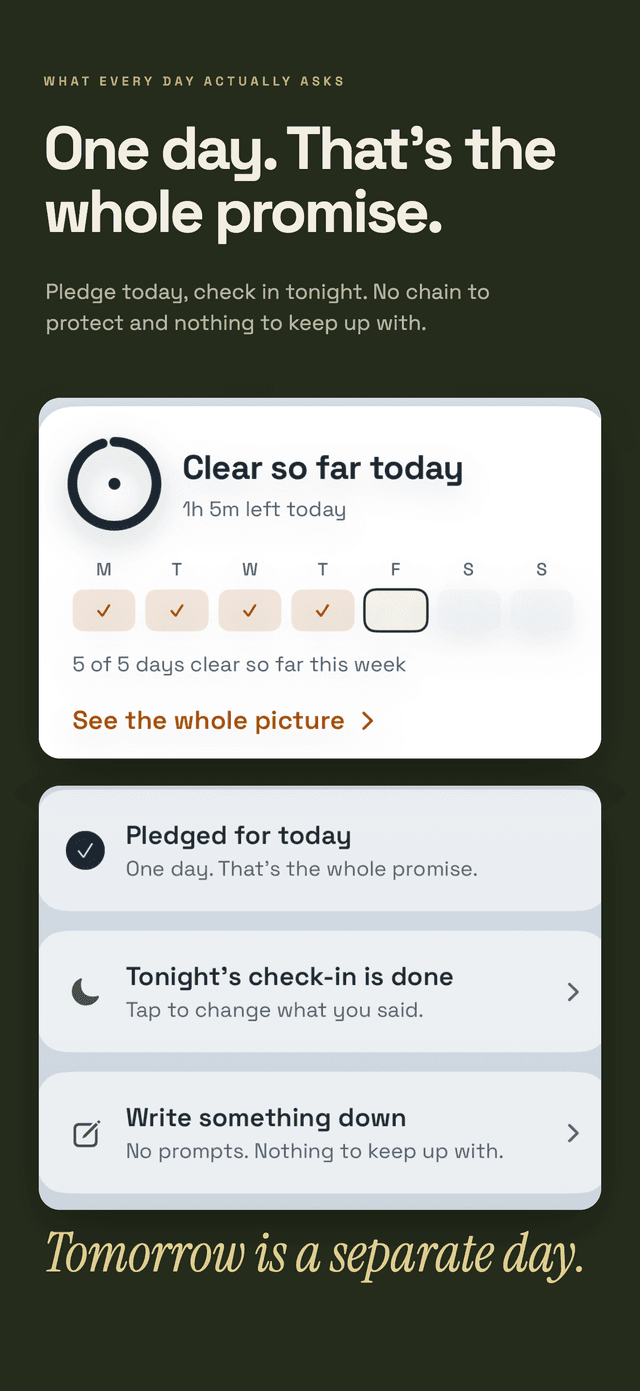
The app lets you choose a stop or cut-down goal. Each habit keeps its own counter, logs, difficult hour, and personal reason. Logging a use keeps the day in the history rather than deleting the earlier record.
The counter, hard-moment flow, personal sentence, logging, journal, milestones, help links, export, and deletion are free. Hard Bit Plus adds the forecast and advance warning, patterns and calendar, widgets, and short reads.
The forecast is calculated on the device from your entries. It makes no prediction below five entries and relies fully on your history at around 20. Those are product rules, not clinical thresholds or predictions about whether you will quit.
Hard Bit’s published privacy policy says there is no account, social feed, advertising, third-party analytics, or server-side copy of your history. The Hard Bit overview explains the workflow, while the support notes document forecast behavior and the free and subscription boundaries. For a wider privacy comparison, read how to assess private smoking trackers on iPhone.
Keep evidence-based quit support beside the log
Tracking can help you describe a pattern. It cannot choose treatment, assess symptoms, or provide counseling.
The CDC says counseling and medication together give people who smoke the best chance of quitting. In the United States, 1-800-QUIT-NOW (1-800-784-8669) provides free quitline coaching. The CDC lists over-the-counter nicotine patches, gum, and lozenges; prescription nicotine inhalers and nasal sprays; and the prescription medicines varenicline and bupropion.
In England, NHS local Stop Smoking Services are free and delivered by trained advisers. They can provide individual or group sessions and help people choose stop-smoking products. The NHS states that professional or expert help makes someone three times more likely to quit for good. Separate official services cover Wales, Scotland, and Northern Ireland.
Ask a clinician, pharmacist, or quit adviser which options suit your circumstances, particularly if you are pregnant, breastfeeding, under 18, have medical conditions, or take other medicines. If you are in immediate danger or crisis, contact local emergency services.
Our editorial policy explains how health information and product descriptions are reviewed.
Start with the smallest honest record
If previous logs became punitive, begin with one field: time. Add the place or activity when that feels manageable, then the immediate cue.
A short factual entry is more useful than a detailed entry you avoid. The goal is not to produce a perfect diary. It is to preserve enough information for the next decision.
More source-reviewed articles are available in the Hard Bit guide library.
Frequently asked questions
Can tracking cigarettes make me feel worse?
It can become unhelpful if you repeatedly check the record, use it to insult yourself, or treat every entry as a verdict. There is no single effect for everyone. Simplify or pause the log if distress rises, and speak with a clinician or quit adviser if you need support.
Should I delete an entry written in anger?
You can remove insulting wording without removing the event. Rewrite it as a plain observation and keep the useful details. If you do not want the entry retained, the deletion guide explains the Hard Bit controls.
Is it dishonest to track while cutting down?
No. Record your current goal and what actually happens. A cut-down record is still not treatment or proof of reduced health risk. A quit adviser can help you discuss your goal and evidence-based support.
Can a cigarette count tell me how dependent I am?
No. A count or urge score cannot diagnose nicotine dependence. A clinician or trained quit adviser can assess your circumstances and discuss suitable treatment.
What if I keep hiding cigarettes from my own log?
Treat that as a sign to examine the logging process, not as another reason to criticize yourself. Reduce the entry to time, place, and number smoked. If the record still feels punitive or smoking is becoming harder to manage, consider discussing it honestly with a clinician or quit adviser.