Late night gaming urges can be easier to manage before the game loads. Settle two questions first: is tonight a playing night, and if it is, what exactly will end the session? Write the answer before opening the game or joining a party.
If the urge arrives after the time you decided not to start, use a different plan. Move away from the setup and give the next few minutes another job rather than reopening the decision.
Decide whether to start before deciding when to stop
Late-night plans often begin with “I will only play for half an hour.” That skips an earlier choice: whether starting now fits the rest of the night.
Set a no-start time, a clock time after which you do not begin a new session on an ordinary night. There is no medically correct hour. Your work, study, care responsibilities, shift pattern, time zone, and sleep needs all matter.
Use two separate boundaries:
- No-start time: the latest time you will launch the game.
- Stop time: the backstop for a session that began earlier.
For example, you might decide not to start after 10pm and to end any permitted session by 11pm. If the urge arrives at 10:20pm, the task is not to design a shorter session. It is to follow the decision already made.
This guide focuses on that pre-launch choice and on games without reliable rounds. If the problem is repeatedly joining another multiplayer round, use the separate guide to stopping one more match from becoming the whole night.
Write the exit in four lines
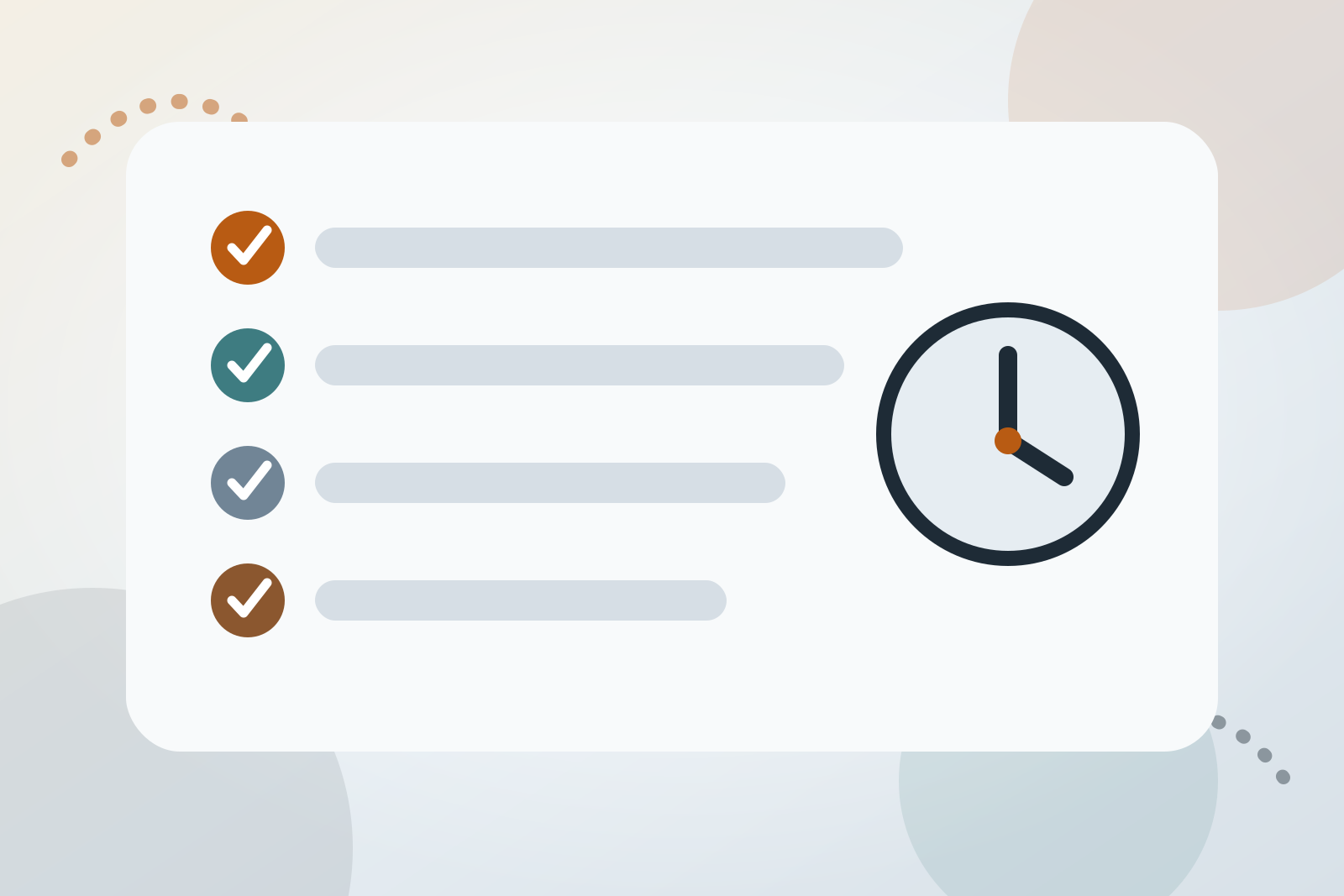
An exit invented while absorbed in a game can keep moving. Write these four lines beforehand:
- End signal: the observable event that ends the session.
- Clock backstop: the time that ends it even if the event has not arrived.
- Device move: where the controller, headset, phone, or laptop goes.
- First action: what you will begin immediately afterward.
For an open-ended building game, the plan could be:
End signal: save when the current in-game day ends. Clock backstop: 11:15pm either way. Device move: laptop closed and left on the kitchen table. First action: shower.
Use an event you can recognize, not an outcome you may keep pursuing. “After one successful run” or “when the build looks finished” can expand. A save point, completed in-game day, or fixed timer is easier to observe.
The clock remains the backstop because game events can take longer than expected. The event makes the exit feel natural; the clock prevents it from becoming indefinite.
Treat arousal as personal information, not a genre rule
A 2024 systematic review in Sleep Medicine examined 26 studies of gaming and sleep in adults. Observational studies associated excessive gaming with poorer sleep quality and delayed sleep timing, while habitual or casual play was not associated with poor sleep. Experimental findings differed according to factors including arousal, session duration, and frequency.
The review also reported that an arousing game before sleep delayed sleep onset, while non-arousing but cognitively challenging play was linked to improved sleep continuity in experimental evidence. These findings do not establish a universally sleep-safe genre, and they do not predict what will happen on a particular night.
Use your own observations cautiously. If a mode involving competition, voice chat, suspense, or an unfinished objective reliably leaves you alert or makes stopping harder, avoid that mode near your cutoff. The useful distinction is not “good game” versus “bad game.” It is whether this particular session fits the hour and your plan.
Place the session inside your sleep routine
NHS sleep guidance recommends going to bed and getting up at similar times when possible, including on non-working days. It also suggests avoiding phones, tablets, and computers for about an hour before bed and making the bedroom quiet, dark, and cool.
Work backward from the next morning:
- Note when you need to wake.
- Choose an intended bedtime that allows for your sleep needs.
- Allow time away from gaming before bed.
- Set the session backstop before that wind-down begins.
- Put the no-start time earlier than the backstop.
An hour away from screens is guidance to work toward, not a reason to abandon the plan if you cannot manage it perfectly. A shorter screen-free transition is still a clearer boundary than playing until the moment you try to sleep.
If sleep problems persist even when gaming changes, discuss them with a healthcare professional rather than assuming the game is the only cause.
Use a different plan after the no-start time
After the no-start time, do not keep recalculating whether a very short session might fit. Move from a gaming decision to a prepared action:
- leave the gaming chair or room,
- put the device or controller in its planned place,
- silence party and game notifications for the night,
- begin a short task with a clear end,
- contact someone if being alone makes the plan harder.
If you are already in bed and remain awake after around 20 minutes, NHS guidance suggests getting up, sitting somewhere comfortable, and doing something relaxing until you feel sleepy rather than forcing sleep.
WithYou describes substance cravings as waves that can build, peak, and pass, and suggests planning distractions. That source is about alcohol and drugs, not gaming, so it does not establish how long a gaming urge will last. The transferable idea is simply to prepare an activity instead of improvising while the urge is loud.
For a short sequence in that moment, use the five-minute plan for the start of a craving. If an empty evening is the main cue, replace the default boredom activity.
Make the room support the written exit
Change the setup so continuing requires a fresh action rather than happening automatically.
Options to test include:
- turn off automatic login or resume where the platform allows it,
- disable game and party notifications after the cutoff,
- place the backstop alarm beyond easy reach,
- tell teammates your departure time before starting,
- leave the next activity ready, such as a towel, book, or prepared drink,
- store the controller or charging cable away from the gaming chair.
These changes do not make gaming impossible. They create a visible transition at the point where the session would otherwise continue by default.
Record the start decision as well as the finish
For one or two typical weeks, record:
- when the urge arrived,
- whether it was before or after the no-start time,
- whether you opened the game,
- the planned end signal and backstop,
- when you stopped,
- what happened next.
Include nights when you did not play and sessions that ended as planned. Those entries may show useful combinations, such as choosing a different mode, telling friends in advance, or moving the device before the urge arrived.
Review repeated combinations rather than treating one night as proof. The guide to identifying craving triggers and difficult times explains how to do that without turning an early pattern into a prediction.
Paper or a notes app is enough. Hard Bit is an optional iPhone craving tracker. Choosing gaming changes its prompts to hours rather than money, and each habit keeps separate logs, a counter, a personal reason, and a difficult-hour pattern.
The counter, hard-moment flow, personal sentence, logging, journal, milestones, help links, export, and deletion are free. A subscription adds the on-device forecast and warning, patterns and calendar, widgets, and short reads. The forecast makes no prediction below five entries and relies fully on personal history at around twenty. Those are product rules, not clinical thresholds.
Hard Bit requires no account and has no social feed, advertising, or third-party analytics. The app overview, support page, and privacy page document its current boundaries. A record can describe a pattern. It cannot enforce bedtime, assess your health, or provide treatment.
Know when the pattern needs more support
A late session does not by itself establish gaming disorder. WHO describes gaming disorder through impaired control over gaming, increasing priority over other activities, and continued or escalating gaming despite negative consequences. The pattern must cause significant impairment and would normally have been evident for at least 12 months. WHO says studies suggest that only a small proportion of people who game are affected.
Seek qualified support if gaming persistently displaces sleep, meals, hygiene, work, study, essential spending, or relationships, or if repeated attempts to change feel unmanageable.
In England, the National Centre for Gaming Disorders supports people aged 13 and over who have difficulty controlling video game use. It accepts self-referrals and referrals from family members or professionals. It offers assessment and CBT-based treatment focused on greater control over gaming and increasing other activities.
The centre does not provide crisis intervention. If you or someone else is in immediate danger, contact emergency services or an appropriate local crisis service. Outside England, begin with your usual doctor or local mental health service.
Our editorial policy explains how health and product claims are reviewed.
Frequently asked questions
What if the game has no natural stopping point?
Choose an event you can see approaching, such as the end of an in-game day, a save point, returning to a base, or completing one defined task. Pair it with a clock backstop so waiting for the event cannot extend the session indefinitely.
Does this mean I can never play at night?
No. The plan distinguishes a permitted session from an urge that arrives too late. Some people can follow a written late-session exit; others find that any start after a certain hour repeatedly runs long. Use your record to decide what boundary fits you.
Why can the urge feel stronger when everyone else is asleep?
Quiet, privacy, tiredness, easy access, and fewer external stopping cues may occur together. That combination is a situation to prepare for, not a judgment about your character. Changing access, location, or the activity that follows can make the decision less automatic.
Does playing until 2am mean I have gaming disorder?
Not by itself. WHO's description requires a broader pattern involving impaired control, priority over other activities, continuation despite harm, and significant impairment, normally evident for at least 12 months. Speak with a qualified clinician if you are concerned rather than diagnosing yourself from one behavior.
More source-reviewed planning articles are available in the Hard Bit guide library.