A reason for quitting pornography that still helps later is usually short, specific and written in your own voice. It describes something you want to protect or get back, not something you hate about yourself. Write it while you are calm, but word it for the moment you will actually read it: late, tired, alone and half-persuaded already. Then test it, keep it where that moment happens, and update it whenever it stops landing.
Most lists of reasons to quit are fine in daylight. The harder job is writing one that still works at 11:40pm.
Why many reasons stop working when you need them
A lot of reasons are written on a day of strong resolve, often right after a bad night. They sound convincing then. A few weeks later, read during an urge, they can feel distant, preachy or untrue.
Common patterns that fade:
- Too abstract: "I want to be a better person" gives a tired mind nothing to picture.
- Borrowed: "Because my partner found out" can turn into resentment, or lose its force when nobody is watching.
- Punishing: "I'm disgusting" can add to the low mood that often comes before an urge.
- All-or-nothing: "I will never look again" can feel broken after one slip.
None of these mean your motivation was fake. They were written for the wrong reader: the calm version of you rather than the one who will need them.
Write for the hour it will actually be read
Before you write anything, picture the situation where your reason has to work. Be concrete: where you are, what time it is, what you just did, and how you feel.
If you are not sure when that is, look back over a week or two. Tracking the hours porn use feels most automatic can show whether it is late weeknights, a lazy weekend morning or the hour after a hard workday.
Then write for that person in that place. Someone lying in bed with a phone at midnight needs different words from someone at a desk at 3pm. The late-night version might mention sleep and the morning. The desk version might mention the work hours that disappear.
Start from a moment you remember clearly
Specific memories tend to carry more weight than general conclusions. Instead of starting with "porn is bad for me", start with an ordinary moment you remember:
- the morning after a long night, when everything felt slow and flat,
- the time you angled your screen away from someone on the train,
- an evening you meant to call a friend and never did,
- the hour you planned for a project that was gone again.
Ask what that moment cost you, then what you would have wanted instead. The second answer is usually where the reason lives. If time is a large part of it, tracking the time pornography used to cost can turn a vague feeling into something you can point to.
Name what you want to protect, not what you hate
A reason can name a real cost without attacking you. Compare these pairs:
- "I'm pathetic for doing this every night." → "I want to fall asleep before midnight and wake up clear."
- "Porn has ruined my relationship." → "I want to be fully present when we're together, with nothing to hide."
- "I have no self-control." → "I want porn to be something I decide about, not something that just happens at 1am."
Each rewrite keeps the honesty and drops the verdict. That matters because shame can make people want to hide, and hiding makes it harder to notice patterns or ask for help. Tracking pornography without turning it into shame covers the same principle for your logs.
The third example also works if your goal is to cut down rather than stop. Your reason should match the goal you have actually chosen.
Make sure the reason belongs to you
Other people can matter enormously, and a reason can include them. But check whether you would still want this if nobody else ever knew.
One way to test it: finish the sentence "Even if no one found out, I would still want to stop because…" If you can finish it honestly, that ending is probably your strongest reason. If you can't, it is worth thinking about before you rely on someone else's expectations to carry you.
Write it in first person, present or near-future tense, using words you would actually say. If "intimacy" or "integrity" isn't your normal vocabulary, use the plainer words you would use with a friend.
If your reason comes from your values or faith
For many people, the main reason is that their porn use conflicts with what they believe. That is a legitimate reason, and it can be a steady one.
The research gives two things to keep in mind. Researchers have proposed that acting against deeply held moral values can itself lead people to see their porn use as a problem, and the mental health field remains divided on whether internet pornography is addictive. This is an area of active research and debate, not settled fact. Separately, a clinical review of the ICD-11 criteria notes that distress coming entirely from moral judgments is not enough on its own for a diagnosis of compulsive sexual behaviour disorder.
None of this makes a values-based reason wrong. It suggests writing it as a direction ("I want my private life to match what I believe") rather than a condemnation ("I'm a terrible person"). It also suggests that if the distress feels overwhelming, it may help to talk it through with a therapist. Ideally that is someone who respects your values and also understands sexual health.
Keep it short enough to read mid-urge
During an urge, attention often narrows. A paragraph is unlikely to get read, so aim for one sentence you can take in within a few seconds.
If you have more to say, split it into two layers:
- The sentence: one line, read first.
- The list: a few concrete costs or gains to read if you have a little more time.
For example:
I want tomorrow morning to belong to me.
- Asleep before midnight
- No hiding my screen
- The two evening hours back for climbing and calls home
Keep both somewhere you will see them at the difficult hour, not in a notes folder you never open at night. The sentence fits well on a short craving emergency card alongside your first move. If you are working on more than one habit, keep this sentence about porn only; keeping a separate reason for each habit explains why shared reasons tend to blur.
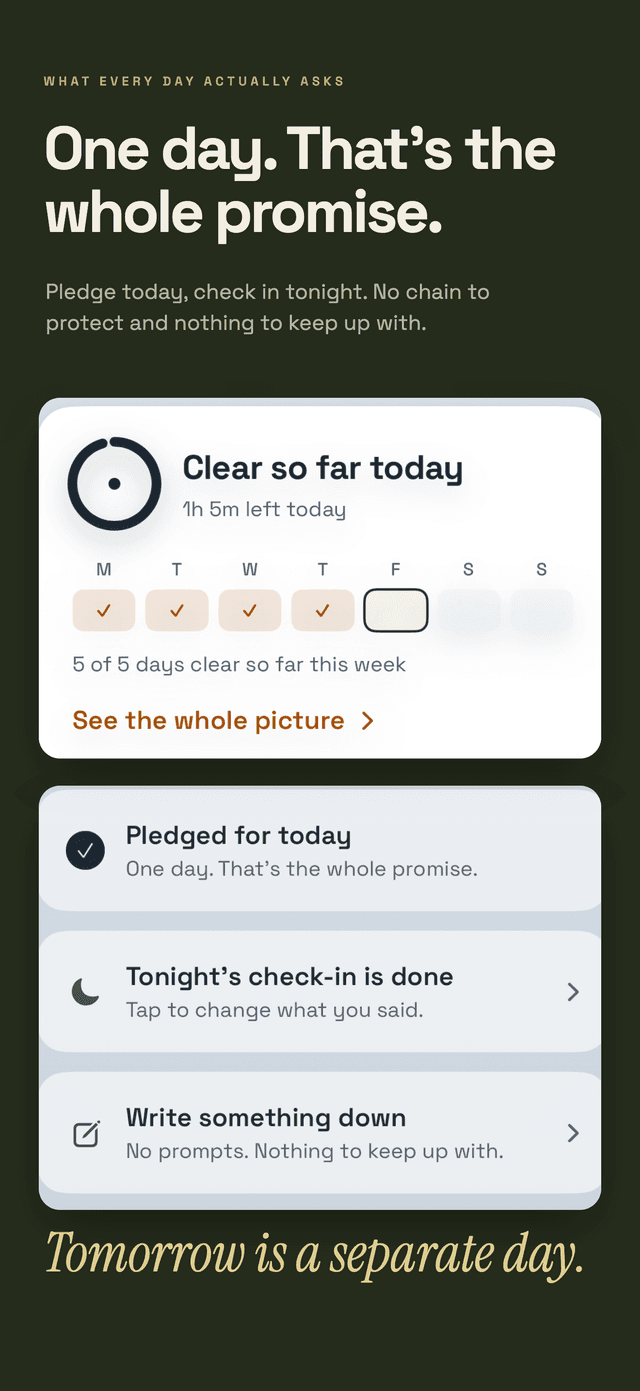
Hard Bit has a version of this structure built in. When you set up a habit, you write your own sentence, and the hard-moment button shows it alongside your list of what the habit has already cost you. Each habit keeps its own reason, and both the sentence and the button are free. A paper card or lock-screen note works on the same principle; the Hard Bit overview explains how the app version fits with private, on-device logging.
Test the sentence before you need it
Read your reason at the time and place it is meant for, before an urge arrives. Ask yourself:
- Does it still sound true right now?
- Does it make me want something, or just feel guilty?
- Could I argue it away in one line? ("One time won't affect tomorrow morning.")
If you can dismiss it easily, make it more concrete or answer the counter-argument directly: "Just tonight is how most of last month started."
Then connect it to an action. A reason makes the next step feel worth taking; the step itself should already be decided. Making a craving plan for pornography before you need it shows how to pair the sentence with a first move, such as putting the phone on charge in another room. For the moment itself, see how to handle pornography cravings in the moment.
Revise it after a slip instead of throwing it away
After a slip, it is common to decide the reason "didn't work" and either delete it or rewrite it as an attack. Try a calmer review instead:
- Did you read it at all? If not, the problem may be where it was kept, not what it said.
- Did you read it and argue with it? Note the argument you used; that is useful material.
- Did it feel irrelevant to that situation? You may need a second sentence for a different hour or trigger.
Change one thing, keep the rest, and date the new version. Over time, you may find that reasons shift. Early on, it might be about sleep; later, about being present or feeling settled in yourself. Updating it is maintenance, not failure.
When a reason is not enough on its own
A good reason helps, but it is one part of change. Setup, triggers, sleep, stress, loneliness and support all matter too, and willpower is not the only factor.
Consider speaking to a doctor, a licensed therapist or a sex therapist if porn use feels difficult to control despite repeated effort, or is seriously affecting your relationships, work, sleep or mood. If low mood or anxiety seems to sit underneath the urges, that is worth raising too. If it is straining a relationship, a couples or relationship counsellor can help both people talk about it. A self-tracking app or a written sentence cannot assess what kind of help you need.
If you are having thoughts of harming yourself, contact emergency services or a crisis line now, such as 988 in the US, Samaritans on 116 123 in the UK, or a local crisis line where you live. Our editorial policy explains how we handle health information and keep it separate from product content.
What the evidence does and does not say
- Established practice: Health services such as MedlinePlus and Mayo Clinic advise people quitting smoking to write down or remind themselves of their reasons. Applying the same idea to porn is a reasonable adaptation, not a tested intervention.
- Emerging evidence: Research on moral incongruence and porn use is active and debated.
- Lived experience: Many people trying to quit recommend writing reasons and keeping them visible. This is common advice, not proof that it works for everyone.
- Editorial advice: The guidance on wording, testing and revising in this article is practical suggestion, not clinical instruction.
Frequently asked questions
How many reasons should I write?
There is no correct number. A longer list can help you think, but during an urge one clear sentence is usually easier to use. Keep the full list as backup and choose one line to read first.
What if my only reason right now is that someone found out?
That can be where change starts. Over the next few weeks, look for a reason you would still hold if no one ever knew, such as sleep, time, honesty or how you feel about yourself. Add it alongside the original reason rather than pretending the first one doesn't exist.
Should my reason mention the harms of porn?
It can name real costs in your own life, such as lost sleep or hiding your screen. Be careful about relying on dramatic health claims you have read online; many are disputed. A reason based on your own experience is harder to argue away.
Can I use the same reason if I am cutting down rather than stopping?
Yes, if it fits. "I want porn to be a choice, not a reflex at 1am" works for either goal. Make sure your reason doesn't quietly assume a goal you haven't chosen.