
A reason for quitting cannabis helps later when it answers the thing cannabis actually does for you. Start with an honest list of what weed gives you and what it costs. Find the main job it does in your day, such as getting you to sleep, ending the workday, or making a social evening easier. Then write one short sentence about what you want instead. Read it at the hour you usually smoke, and rewrite it whenever it stops landing.
"It's bad for me" is true for a lot of people. It is also easy to argue with at 10 p.m. when cannabis is the only thing you know that switches your head off.
Why cannabis reasons tend to fade
Most reasons are written on a day when the downside is loud: a bad cough, an anxious morning, a low bank balance, a comment from someone you care about. A few weeks later the downside is quieter, and what you notice instead is what cannabis used to do for you.
That is the gap a good reason has to cover. If cannabis was your way to sleep, a sentence about lung health doesn't speak to the night you are lying awake. If it was your way to relax with friends, a sentence about money doesn't help when someone passes it to you.
Research on people who quit without formal treatment backs up the idea that reasons are personal. In one study of 104 adults, concerns about health and about self-image and social image were the main motivators. A later study of 385 adults found that motivations varied. For example, women were more likely than men to cite health and self-image. Neither study tells you which reason should move you. Their useful message is that reasons are personal, so yours should be too.
Write both sides of the list honestly
Cannabis Support, an Australian information service, suggests writing down the pros and cons of using cannabis as you see them, then rating each item from 1 to 10 for how much it matters to you. Write both columns honestly. A list written only to convince yourself tends to leave out the parts that come back later.
Take ten minutes and write two columns:
- What cannabis gives me: for example "I fall asleep faster," "it's how I stop thinking about work," or "gaming is more fun high."
- What it costs me: for example "I'm foggy until midday," "I've stopped seeing friends who don't smoke," or "I spend more than I admit."
Don't tidy it up. Small, awkward or embarrassing items often turn out to matter most. If money is on the list, working out what cannabis used to cost you can turn a vague worry into a specific figure.
One editorial tweak to the scoring: rate each item for how much it matters on an ordinary weekday, not on your worst day.
Find the job cannabis does in your day
Look back at the "gives me" column and circle the one or two items with the highest scores. That is the job cannabis is doing. Common jobs include:
- marking the end of work or study,
- getting to sleep,
- quieting anxious or racing thoughts,
- filling empty evenings or weekends,
- making music, films or games feel better,
- belonging in a group of friends who smoke.
This is the most useful part of the exercise, because it tells you what your reason has to answer. A reason that ignores the job ends up arguing against something you still value. A reason that names the job offers you something else.
This step also helps you spot a quieter risk. In the 2006 study above, quitting cannabis was often accompanied by more use of alcohol, tobacco or sleep aids. If cannabis was doing a job, something else may try to take that job over. Writing the job down makes that easier to notice.
Turn the job into one sentence you want to read
Now write one sentence that speaks to the job. These are our editorial wording suggestions, based on what is easier to read under pressure. They are not clinically tested rules.
- Name what you want instead. "I want to sleep without needing anything first" speaks to the sleep job directly.
- Use your own voice. If you would never say "optimise my wellbeing," don't write it.
- Make it easy to picture. "Clear head for Saturday football" is easier to see than "be more productive."
- Leave out insults. "Stop being a waster" adds shame at the moment you are already under strain.
- Keep it to one glance. Aim for roughly ten to fifteen words.
Here are a few original examples, each matched to a job:
- Job: end of the workday. "I want my evenings to start with a walk, not a cloud."
- Job: getting to sleep. "I want to find out what my sleep is like without it."
- Job: calming anxiety. "I want to know which worries are mine and which are the comedown."
- Job: social ease. "I want to stay at Sam's and still remember the whole night."
- Job: boredom on weekends. "I want my Sundays back for the bike, not the sofa."
Notice that none of these promise a perfect future. They name one thing you would like to get back.
Adjust the sentence if you are cutting down
You don't have to stop completely to use this method. If your goal is to cut down, the reason can protect particular days, hours or situations.
WithYou suggests keeping a simple cannabis diary for about a week, then setting one small, realistic first goal, such as one fewer joint a day. It also suggests putting off a joint and doing something else for a while, because the craving may pass. A cut-down reason fits alongside that: "Weeknights stay clear so I'm sharp for the morning shift," or "Only after 9 p.m. on Saturdays, so the rest of the week is mine."
Make it just as specific as a stopping reason. Vague limits like "less often" are hard to check against what actually happened.
Put the reason where your usual hour happens
Your sentence only helps if you see it at the moment you would normally roll up, not when it is tucked away somewhere. Put it near where the routine starts:
- in the tin, box or drawer where you used to keep cannabis,
- as a pinned note or lock-screen line on your phone,
- on a card by the console, speaker or sofa,
- in a saved message to yourself, timed for your usual hour.
If your hardest time is the evening, planning for evening cannabis cravings at the usual hour helps you prepare for that window. If your reason is about friends or a social setting, what to do when someone offers you cannabis can help you turn the sentence into words you can say out loud.
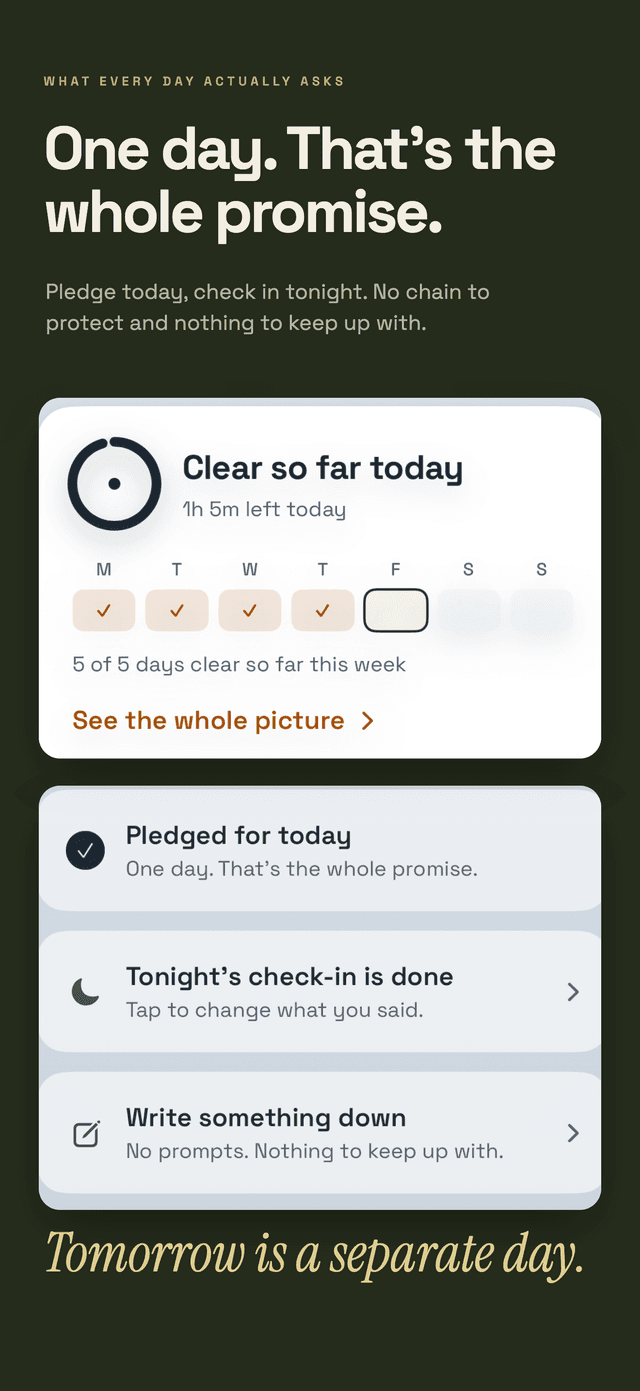
Hard Bit, an iPhone app, keeps a separate reason for stopping for each habit you track. It shows your sentence during the hard-moment flow, so it appears when you reach for the app during a craving. The personal sentence and hard-moment flow are free, and everything stays on your phone with no account. The Hard Bit overview explains how this fits with private logging. If you are changing more than one habit, keeping separate reasons for each habit stops one general sentence from covering them all. A card in the tin does the same job as the app. The point is that the sentence is waiting where the old routine begins.
Read it again after a hard night or a slip
The first week or two can be harder than expected. WithYou says withdrawal symptoms usually peak about four days after stopping or cutting down and that most ease within about ten days, though some people have symptoms for up to four weeks. Sleep problems, irritability and anxiety are among the symptoms it describes. Symptoms tend to be stronger if you used daily or stopped all at once. If you mixed cannabis with tobacco, you may also notice nicotine withdrawal. A reason built around sleep or calm may feel weaker during that stretch. That is not proof it was the wrong reason.
On a rough night, read the sentence once, then do one practical thing. Getting through a difficult cannabis night has ideas for that.
If you do use, don't throw the sentence away. Ask what it was missing. Perhaps it spoke to sleep, but the real pull that night was boredom. Rewrite it for the next similar evening, and keep the old versions so you can see how your thinking has changed. Measuring cannabis progress beyond a perfect streak shows how to keep the full picture instead of resetting to zero.
When a reason is not enough on its own
A well-written reason supports motivation. It cannot assess withdrawal, mental health or other risks.
Talk to a GP or a local drug service if you find it hard to cut down despite wanting to, if withdrawal is making daily life difficult, or if you are pregnant. In the UK, local drug services and the national FRANK service can advise on support, and WithYou offers free, confidential help. Elsewhere, a doctor or your local drug and alcohol service is a good first step. Get medical advice too if you notice yourself replacing cannabis with alcohol, sedatives or sleep medication.
Contact emergency services if you are in immediate danger, are having thoughts of harming yourself, or someone else is at risk. Our editorial policy explains how we choose and review health sources.
More planning guides are available in the Hard Bit guides.
Frequently asked questions
What are common reasons for quitting cannabis?
People often mention health, mental clarity, anxiety, sleep, money, relationships, self-image and wanting more control over their choices. Research suggests motivations differ from person to person. The most useful reason is the one that is specific to your life and still matters on an ordinary day.
Should I keep a long list or one sentence?
Keep both. The long list helps you think and remember everything that matters. The single sentence is what you can actually read in a few seconds when a craving starts.
What if cannabis genuinely helps me sleep or relax?
Then say so in your list. Writing a reason that ignores that benefit tends to fail at exactly that moment. Write a sentence about the sleep or calm you want to build without it, and consider talking to a GP if sleep or anxiety are a long-standing problem.
How often should I rewrite my reason?
Rewrite it whenever it starts to feel flat, after a slip, when you switch between stopping and cutting down, or when the original problem has improved. Revising it is part of the process, not starting over.
Can a written reason replace professional support?
No. It can help with motivation, but it cannot treat withdrawal, anxiety, depression or dependence. Contact a GP, local drug service or emergency services when your safety or health needs more than self-help.