
The practical answer to how to identify gambling triggers is to collect small facts close to each urge, then read them back as a chain. Each time you want to bet, note the time, where you were, what happened just before, how you felt, what money or access was within reach, and what you did next. Review the notes once a week and look for links that repeat. Then compare those days with the days you didn't gamble at all.
A trigger isn't a verdict on you, and it doesn't mean you will bet. It's advance notice of a situation you can prepare for.
What counts as a gambling trigger
Gambling Help Queensland's self-help guidance lists common triggers such as having extra money on payday, feeling bored or lonely, seeing gambling ads, watching sport, using alcohol or drugs, and spending time around other people who gamble.
It helps to sort possible triggers into four groups, because gambling has some cues that other habits don't:
- Situations: a match kicking off, a particular pub, a commute past a betting shop, a group chat about odds, an evening alone.
- Feelings and body states: stress, boredom, loneliness, anger, excitement, tiredness, or the flat feeling after a hard day.
- Money signals: payday, a refund, a bonus offer, a low balance, a recent loss, or seeing your account total.
- Access points: an app on the home screen, a saved card, a promotional email, a notification, cash in your pocket.
Money signals and access points are the most gambling-specific part of this list, and they're often overlooked. Wanting to win back a loss can be a trigger in its own right. If that pattern sounds familiar, pausing before chasing a loss covers it in more detail.
If you're working on more than one habit, the general guide to identifying craving triggers and difficult times applies the same method to any habit. This page focuses on the cues that are specific to betting.
Keep a log short enough to use
Gambling Help Queensland suggests a gambling diary that starts with the situation before you gambled and how you were feeling. You can keep it in a journal, a notepad or the notes app on your phone. A version you'll actually keep up is better than a thorough one you abandon.
Try seven short fields:
- Day and time
- Where you were and who was around
- What happened just before
- What you felt, in one or two words
- What money or access was nearby
- How strong the urge was, on a 0–10 scale you use the same way every time
- What you did next
Here is an example entry: "Thursday 10:40pm. Bed, alone. Payday text from the bank. Restless, a bit flat. Card saved in the app. 7/10. Opened the app, closed it, put the phone on charge in the kitchen."
Write it when it's safe to do so. If you're driving, in an argument, or need help urgently, the note can wait.
If writing about gambling brings up shame, keep the entries factual. Tracking gambling without turning it into shame has wording ideas that keep the record honest without making it harsh.
Write down the clear days too
A log that only records bets shows half the picture. The same Gambling Help Queensland diary guidance encourages you to keep writing on days you don't gamble, noting achievements such as resisting an urge.
On a clear day, a single line is enough:
- Was there an urge? Roughly when?
- What was different about today?
- What made gambling less convenient?
This is where you find protective conditions. You might notice that the Saturdays you didn't bet were the ones when you watched the match with a non-betting friend, or had already moved your wages into a separate account. Those details are worth more than a general resolution to try harder.
Read your entries as a chain, not a single cause
After about a week, read your entries in order. The central question isn't "what was my trigger?" It's "what were the steps, and where could the chain have broken?"
A typical gambling chain might look like this:
- Cue: a goal alert during a match.
- Thought: "I knew that would happen. I should have backed it."
- Money signal: checking your balance.
- Access: the app is one tap away, with a saved card.
- Bet.
The bet is the last link and usually the hardest to stop. The earlier links are often easier to change. In this example, you could turn off score alerts, move the app off your home screen, or remove the saved card before the weekend.
For each entry, ask:
- What came first?
- Which link happened every time?
- Which link would be easiest to remove or slow down?
If the same cue keeps appearing at the start, such as an advert, a promotion or live sport, these focused guides may help: preparing for gambling ads and promotions and handling urges during live sport.
Look for patterns in time, without treating them as destiny
Time is one of the most concrete patterns a log can show. Gambling Help Queensland notes that a diary can help you identify triggers and high-risk times, and show when you've successfully countered an urge. "Evenings are bad" is hard to plan for. "Thursday and Sunday, between 10pm and midnight, in bed" gives you something to work with.
Treat early patterns as hunches to test. A few entries can raise a question but can't settle it. Holidays, shift changes, big tournaments and illness can all change the shape for a while. For a fuller method, see tracking the hours you're most likely to gamble.
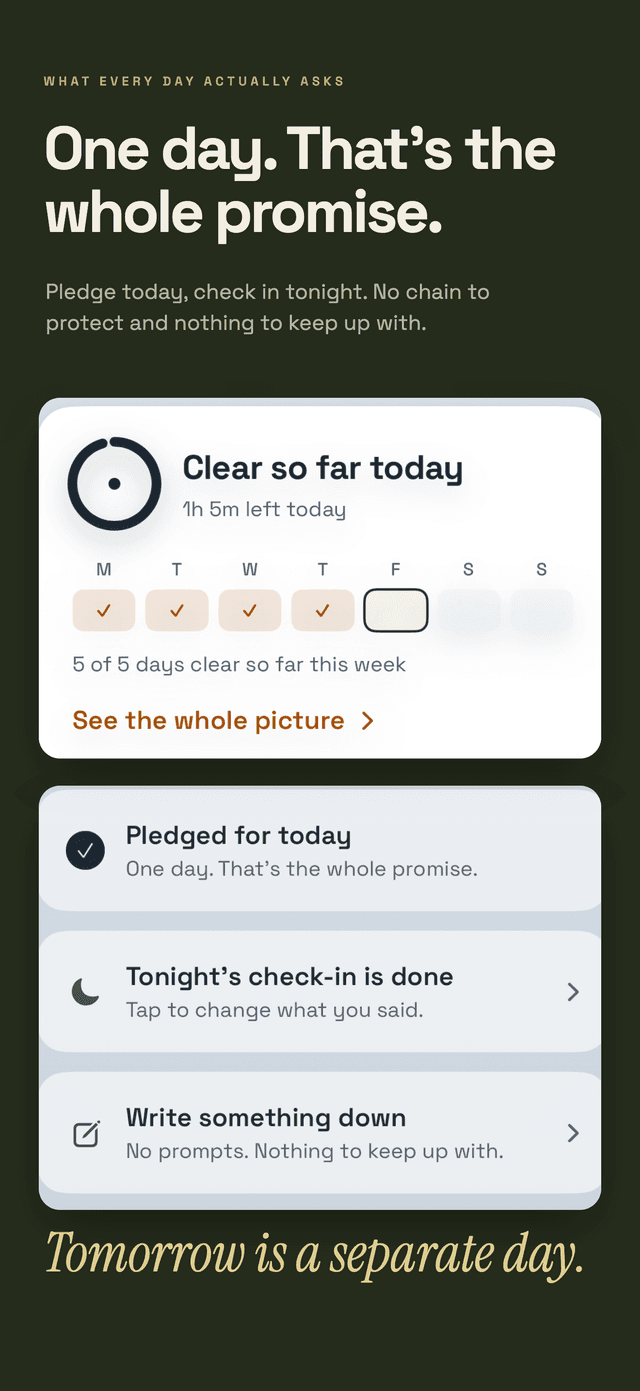
Hard Bit is one way to do this on iPhone. You can track betting as its own habit, log urges and bets for free, and write down your reason for stopping or cutting down. Hard Bit Plus adds a forecast of your difficult hour, worked out on your device from your own entries. It makes no prediction with fewer than five entries and relies fully on your own data at about twenty. There's no account, and your history doesn't leave your phone. The Hard Bit overview explains how it works. A paper diary that you review honestly does the same basic job.
Turn one repeated link into one plan
Pick the clearest repeated chain and write a plan for its earliest link before it comes round again:
- When: Sunday evening, after the late match
- Earliest link: checking the balance in bed
- Change: phone charges in the kitchen from 9:30pm
- Money barrier: bills paid on payday, with the rest in a separate account
- Alternative: shower, a snack, one episode of a series
- Person: message a friend who doesn't gamble at half-time
The NHS self-help guidance supports several of these barriers. It suggests asking your bank to block payments to gambling sites and apps, signing up to GamStop, installing Gamban, and paying important bills on payday before you gamble, for example by direct debit or standing order. Barriers like these slow down the step between the urge and the bet, so they don't depend on willpower at your hardest moment.
When the urge arrives anyway, handling gambling cravings in the moment gives a short sequence to follow.
After two weeks, check whether the plan helped. If it didn't, change the link you're targeting or bring in more support. Repeating the same plan more forcefully rarely works.
When your log points to needing more support
Gambling Help Queensland suggests checking your diary each week against signs of gambling harm, such as going into debt or chasing losses. A trigger log can show things that need more than self-help, such as:
- bets getting bigger or more frequent,
- borrowing, missed bills, or hiding transactions,
- gambling to escape distress more and more often,
- repeated failed attempts to stick to your own limits.
These entries are useful, not shameful. They're good reasons to talk to someone. In the UK, GamCare runs the National Gambling Helpline on 0808 8020 133. It's free and available 24 hours a day by phone, live chat or WhatsApp. The NHS also points to National Debtline for free help with debt. In Queensland, the Gambling Helpline on 1800 858 858 is free, confidential and open 24 hours. If you live elsewhere, look for your national or regional gambling helpline.
A gambling counsellor can help you make sense of the patterns and triggers in your diary and turn them into strategies. Your log gives that conversation a factual starting point.
If you're thinking about harming yourself, or you're in immediate danger, contact emergency services now.
Our editorial policy explains how we check health and safety information and keep it separate from product information.
Frequently asked questions
How long should I keep a gambling trigger log?
Gambling Help Queensland suggests keeping a gambling diary for at least 12 weeks and reviewing it each week. A first pattern may show up within a week or two, but a longer record makes it more reliable, especially if your weeks vary a lot. Treat each finding as provisional and update it as you add entries.
What if I can't find any trigger at all?
That's common at first. Urges can feel as if they come out of nowhere because the early links are small and automatic: picking up the phone, checking a score, glancing at a balance. Try recording the five minutes before the urge in more detail. Ordinary routines are often the missing link.
Should I just avoid all my gambling triggers?
Avoiding high-risk cues is often sensible, especially early on. You can turn off notifications, unsubscribe from promotions, block gambling payments, or use self-exclusion. Some triggers, like stress or payday, can't be avoided, so they need a plan and support rather than avoidance.
Can I track gambling triggers alongside another habit?
Yes, but keep a separate record for each habit. Drinking and betting, for example, can affect each other, and Gambling Help Queensland lists using alcohol or drugs among common gambling triggers. They may still peak at different times and cost different things. Separate logs make each pattern easier to see.
Is a trigger log enough to stop gambling?
For some people, it's one useful part of a wider plan. It can't assess risk, manage debt, or replace counselling or specialist treatment. If gambling is causing serious harm, use the log to support a conversation with a helpline, a counsellor or your GP.